Overview
Level 2 is where a Standard ESG certificate stops being a description of your organization and starts being a description backed by paper. This guide walks through exactly what documents are typically requested, what makes a document acceptable, how verification works, and how to build an evidence library that makes this — and every future renewal — easier.
What Level 2 Adds to Level 1
At Level 1, you declared. At Level 2, you substantiate: for each applicable indicator where documentary evidence is expected, you upload the actual document, and Standard ESG's internal team verifies it individually — checking it's genuine, current, and attributable to your organization. Your score is then recalculated with a verification adjustment layered on top of your Level 1 answers. The resulting certificate carries stronger wording — "Data substantiated through documentation reviewed and verified by Standard ESG" — and unlocks the public website badge, a digital collectible you can display, linked back to your verification page.
What Counts as Acceptable Evidence
Three rules apply across every document category:
- Dated: evidence must show when it was produced or when it's valid.
- Attributable: it must clearly relate to the specific legal entity under assessment — a group-level certificate covering a different subsidiary, for instance, generally won't substantiate a claim about your entity specifically unless the relationship is made clear.
- Current: no older than 24 months, unless the document type is inherently long-lived — articles of incorporation, or a certification with its own stated validity period (an ISO 14001 certificate valid for three years, for example, is accepted for its stated validity, not force-capped at 24 months).
Documents in any language are accepted, though the review team may request translation of key passages if needed to complete verification. All evidence is stored per-tenant, with access restricted to your organization and Standard ESG staff — it is never shared with other companies, including your own customers or suppliers, beyond what you choose to disclose yourself.
The Document Categories, In Depth
The exact list is managed per industry template, but the typical Level 2 categories are:
Legal & registration: business registration and ownership structure — usually the easiest category, since these documents already exist and rarely expire.
Environmental: ISO 14001 certificate (if held), energy bills or energy audits, a GHG inventory, waste transfer notes, and environmental permits. If you haven't formalized a GHG inventory yet, your energy bills alone can substantiate the underlying resource-use indicators even before you build a full inventory — see Measuring GHG Emissions: Scope 1, 2 and 3 when you're ready to formalize this.
Social: anonymized payroll samples, working-hours records, health-and-safety risk assessments, accident logs, training records, and a description of your grievance mechanism. Anonymization matters here — payroll evidence should demonstrate pay practices and structure without exposing individual employees' personal data unnecessarily.
Governance: code of conduct, anti-corruption policy, board or oversight charter (even a simple governance statement for smaller companies), supplier code of conduct, and procurement policy.
Reporting: a sustainability or GRI report, an integrated report, or third-party audit reports, where you have them. This category often does the most "double duty" — a single GRI-aligned report can substantiate indicators across all three pillars at once. See Sustainability Reporting with GRI: A Starter Guide.
The Verification Path a Document Takes
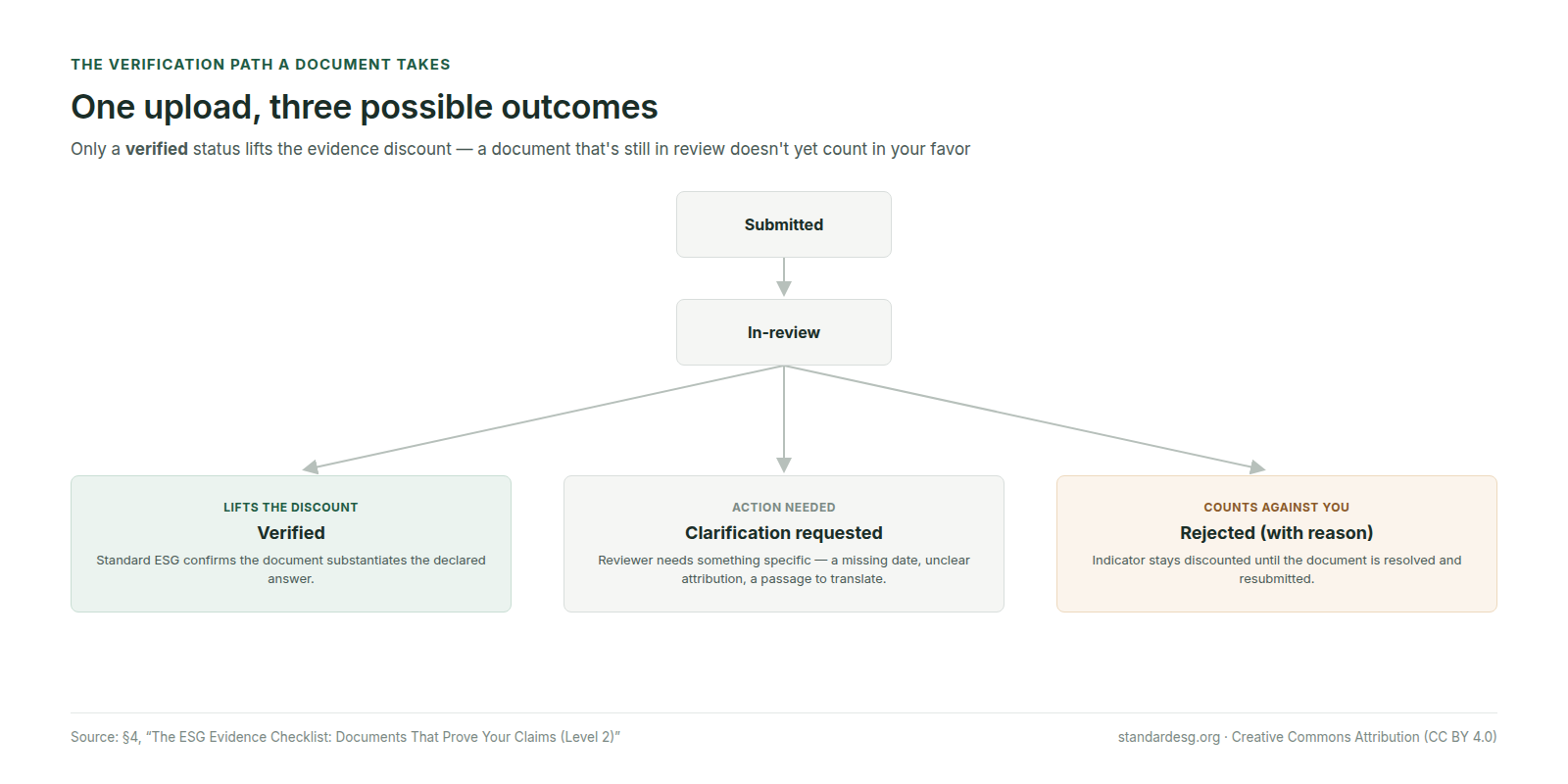
Every document you upload moves through a defined status sequence: submitted → in-review → verified | rejected (with reason) | clarification-requested.
Only a verified status lifts the evidence discount described below — a document that's merely submitted or still in-review doesn't yet count in your favor, and a rejected document counts against the relevant indicator until you resolve it. If a document is marked clarification-requested, the reviewer needs something specific from you — usually a missing date, an unclear attribution, or a passage that needs translation — before they can complete verification. Responding promptly to clarification requests is the single fastest way to move a Level 2 submission to completion.
The 50% Evidence Discount, Explained
This is the mechanism that gives Level 2 its teeth: if an indicator's required document is missing, expired, or rejected, that indicator is scored at only 50% of its declared value — or flagged for clarification rather than accepted at face value. In practice, this means a strong Level 1 answer you can't substantiate doesn't just fail to improve your score at Level 2 — it actively pulls it down relative to what you declared. This is deliberate: it makes overclaiming at Level 1 a cost you'll actually feel at Level 2, which is precisely why accurate, honest Level 1 answers (see How to Prepare for an ESG Self-Assessment) pay off later rather than just being good practice in the abstract.
Building an Evidence Library Year-Round
The organizations that find Level 2 easy are the ones that don't treat evidence-gathering as a one-time scramble before submission. A few practical habits:
- Keep a single folder structure mirroring the document categories (legal, environmental, social, governance, reporting) and drop new documents into it as they're produced — an updated energy bill, a renewed permit, a new training record — rather than hunting for everything at renewal time.
- Calendar your expirations. Since most evidence has a 24-month freshness window, set a reminder to refresh each category well before it goes stale, so you're never scrambling right before a renewal deadline.
- Anonymize as you go, not at submission time — build a habit of producing anonymized payroll extracts as a standard HR process output, rather than a special one-off task.
- Treat every new policy as a Level 2 asset. When you write or update a policy for internal reasons, immediately file the dated version in your evidence library.
An evidence library maintained this way turns each renewal from a project into a light review — you're checking what's already organized, not building it from scratch.
Common Reasons Documents Get Rejected
- No date, or an unclear date — a policy with no visible effective date.
- Wrong entity — a document that clearly belongs to a parent company or a different subsidiary than the one under assessment, without a clear explanatory link.
- Expired — outside the 24-month window with no evidence of a longer stated validity.
- Illegible or incomplete scans — pages missing, signatures cut off, or resolution too low to confirm authenticity.
- Generic templates presented as company-specific policy — a downloaded template with no evidence it was actually adopted or implemented by your organization.
Most rejections are fixable quickly once you know the reason — which is exactly why the clarification-requested status exists rather than an outright rejection wherever possible.
What You Get at Level 2
Beyond the stronger certificate wording, Level 2 unlocks the website badge — a digital collectible you can display on your own site, marketing materials, and communications, linked to your public verification page so anyone can check its current status. Level 2 is also, practically speaking, most of the preparation work for Level 3: once your documents are organized and verified, the on-site auditor's job at Level 3 is largely to confirm, in person, that what the documents describe matches physical reality.
Preparing for Level 3 While You're Here
If you expect to eventually pursue Level 3, a few extra habits at Level 2 pay off later:
- Keep originals, not just scans, of your key documents accessible — Level 3 auditors spot-check document authenticity against originals and issuing registers where possible.
- Make sure the same records you're using as Level 2 evidence (payroll, working-hours, accident logs) are the same records your team would actually produce if an auditor asked to see them on site — consistency between your Level 2 evidence and your day-to-day operational records is exactly what Level 3 checks.
See What to Expect from an On-Site ESG Assessment (Level 3) when you're ready.
Frequently Asked Questions
Standard ESG (standardesg.org) verifies every Level 2 document individually before it counts toward your score. Once your evidence library is solid, see What to Expect from an On-Site ESG Assessment (Level 3) for the next step.
Was this page useful?