Overview
The question "does ESG make you money?" gets asked constantly and answered badly, in both directions — either as unqualified promotion or dismissive skepticism. The actual evidence, across equities, private equity, and fixed income, tells a more precise story: ESG integration is predominantly a risk-management discipline with a demonstrable downside-protection case, not a guaranteed source of outperformance. This guide lays out that evidence honestly, asset class by asset class.
The Honest Starting Point
Two claims about ESG and financial performance are both wrong, and both are common: "ESG guarantees outperformance" and "ESG sacrifices returns for values." The actual research doesn't support either extreme. What it supports is a narrower, more useful claim: ESG factors are material to risk, and integrating them is predominantly a form of risk management — reducing exposure to severe downside events — with financial upside that is real but non-linear and asset-class-dependent, not a mechanical outperformance formula.
The Meta-Analysis Evidence
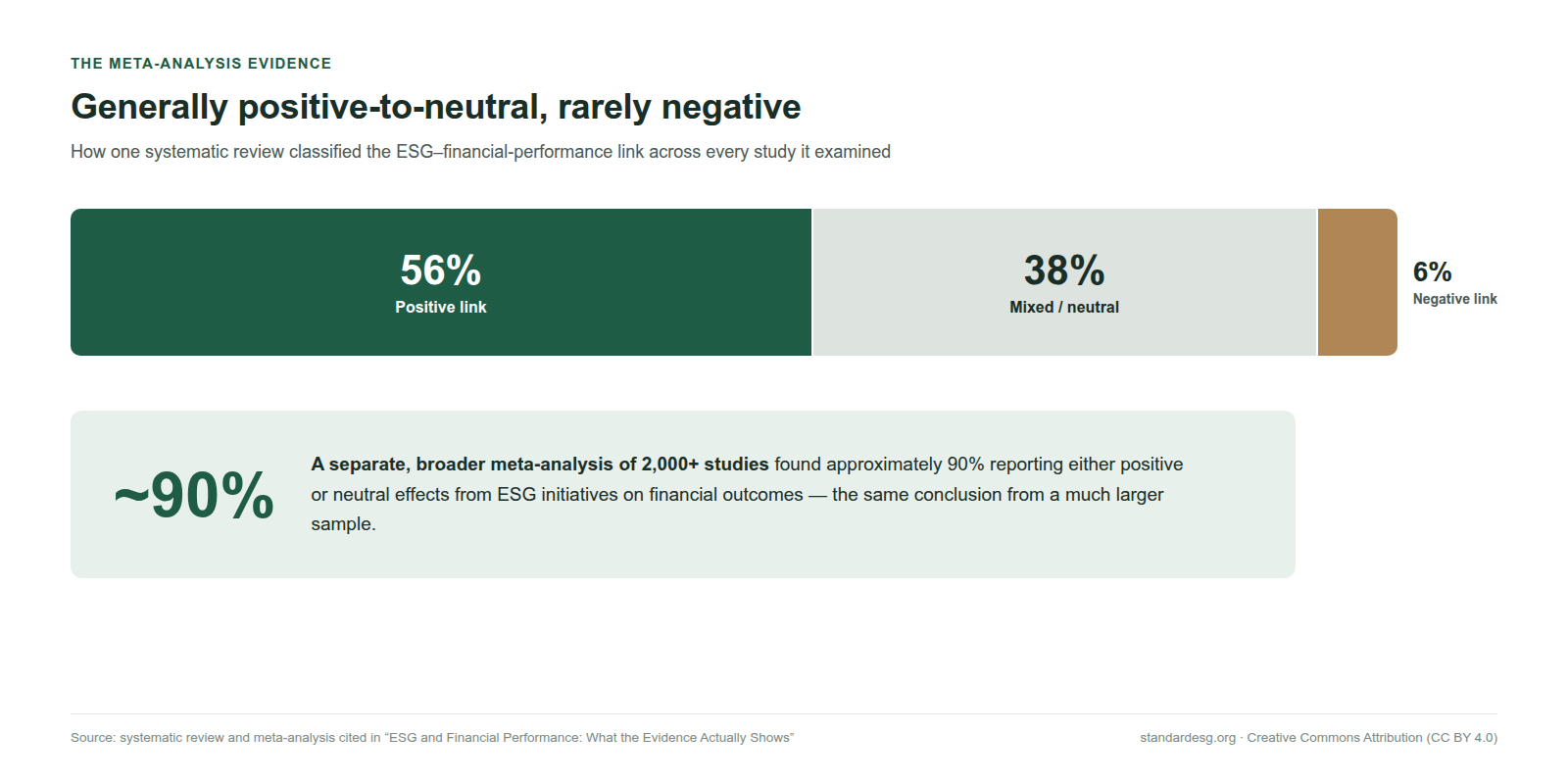
Broad academic synthesis gives the clearest overall picture, because it aggregates across many individual studies with different methods and time periods rather than relying on any single result. One meta-analysis of more than 2,000 studies found approximately 90% reporting either positive or neutral effects from ESG initiatives on financial outcomes. Another systematic review found 56% of studies showing a positive link between ESG and performance, 38% finding mixed or neutral links, and only 6% reporting a negative link. Read together, these numbers support one clear conclusion: concerns about an inherent trade-off between financial returns and ESG considerations are largely unfounded — but they don't support the opposite claim that ESG is a guaranteed source of excess return either. The honest middle reading is "generally neutral-to-positive, rarely negative."
Public Equities: A Non-Linear, Downside-Protection Story
In public equity markets specifically, the relationship between ESG performance and firm value is more nuanced than a straight line. Research has found a horizontal S-shaped nonlinear relationship between a company's ESG rating and its firm value — the financial benefits are most pronounced at intermediate levels of ESG performance, suggesting that reaching a "good enough" level of ESG maturity delivers outsized reward relative to incremental improvement beyond a certain point, rather than returns scaling indefinitely with ESG score.
The clearest and most consistent financial argument in public equities is downside protection: portfolio losses stemming from major ESG controversies — environmental incidents, safety failures, corruption scandals, labour disputes — average between 200 and 500 basis points. This is a materially different framing from "ESG makes stocks go up": the evidence more precisely supports "poor ESG conduct creates measurable tail risk that materializes as sharp, event-driven losses," which is a risk-management case, not a return-generation case.
Private Equity: ESG as a Value-Creation Lever
Private equity shows the strongest and most direct evidence of ESG as an operational value-creation tool, not merely a screening or risk overlay. Leading firms have demonstrated that integrating ESG principles into portfolio-company management can produce meaningful, double-digit percentage increases in value, with research showing companies with strong sustainability practices outperforming peers on EBITDA margins by up to 21%. Sustainability efforts in private companies have been found to increase exit multiples by up to 7%, and an examination of one European sustainability-focused private equity investor's portfolio found EV/EBITDA multiples nearly doubling from entry to exit over a typical investment horizon.
Private equity's structural advantage here is control: unlike a public-market investor holding a minority stake, a private equity owner can directly drive operational changes — energy efficiency, safety improvements, governance upgrades — that produce the underlying performance gains, rather than simply selecting for companies that already score well. This helps explain why the private equity evidence looks stronger than the more mixed public equity picture: it's measuring the effect of actively doing ESG improvement, not just correlating with pre-existing ESG scores.
Fixed Income: ESG as a Credit-Risk Signal
In fixed income, ESG factors are increasingly treated as indicators of credit risk and financial stability, integrated directly into how debt is priced and rated. Green bonds — debt earmarked for environmentally beneficial projects — have shown a tangible borrowing-cost advantage: one study found corporate green bonds carrying, on average, a yield spread 8 basis points lower than comparable conventional bonds, with another analysis finding a smaller but still present 0–2 basis point difference over its study period. The direction is consistent even where the magnitude varies: investors appear willing to accept somewhat lower yields for the perceived lower risk and positive impact associated with green bonds. Separately, research has found that green bond issuance announcements are associated with a measurable decrease in an issuer's credit default swap spreads — a market-based signal of reduced perceived credit risk. Major credit rating agencies have institutionalized this connection directly: Fitch Ratings, for example, assigns an explicit "ESG credit relevance" score that feeds into its final credit rating, treating ESG issues as capable of being credit-neutral, positive, or negative depending on the specific case, rather than uniformly one or the other.
Cross-Asset Summary
- Public equities: generally positive-or-neutral, with a non-linear relationship and the strongest downside-protection case — roughly 90% of 2,000+ studies found positive or neutral effects, and controversies caused average losses of 200–500 basis points.
- Private equity: a direct value-creation lever through operational control — up to 21% EBITDA margin outperformance and up to 7% higher exit multiples.
- Fixed income: priced as a credit-risk signal — roughly 8 basis points lower green-bond yield spreads, and lower CDS spreads following green bond issuance.
The Binding Constraint: Data Quality
None of the evidence above is more reliable than the data it's built on, and data quality is the field's clearest weak point. Poor ESG data quality or availability is cited as the single biggest barrier to sustainable investing by 53% of institutional investors surveyed. Correlations between different ESG rating providers' scores for the same company have been found as low as 0.38 — compared to roughly 0.92 for traditional credit ratings — attributed mainly to differing measurement methodologies rather than differing underlying data sources. This divergence means an investor relying on a single rating provider's ESG score is relying on one specific, contestable interpretation of a company's ESG performance, not an objective fact. See ESG Ratings vs. ESG Certification for a deeper look at why ratings diverge and what that means for how to use them.
How Verified Certification Data Improves the Signal
The financial-performance evidence above is only as trustworthy as the ESG data feeding it — and this is precisely the gap independent, evidence-based certification is built to close. Where an ESG rating aggregates opinions about largely self-reported disclosures, a certification protocol like Standard ESG's ties a score to a stated, checkable verification depth: a Level 1 score reflects self-declared data reviewed for plausibility; a Level 2 score reflects data substantiated by individually verified documents; a Level 3 score reflects data confirmed through on-site inspection, interviews, and tracing declared figures to source records. For an investor building or refining a systematic ESG-informed process, higher-verification-level data is structurally less susceptible to the self-reporting bias and rating divergence described in Section 7 — it's a different kind of input, not merely a more favorable one. See How Certification De-Risks ESG Due Diligence for how this applies specifically to investment due diligence.
What This Means for an Investor's Process
The evidence above supports a specific, disciplined use of ESG in an investment process, rather than either extreme: treat ESG primarily as a risk-management input — screening for downside tail risk (Section 3) and credit risk (Section 5) — while recognizing genuine value-creation potential where an investor has operational influence, as private equity evidence demonstrates most clearly (Section 4). Weight the reliability of any ESG data source by its verification depth, not just its availability — a self-declared score and a Level 3 on-site-verified score are not interchangeable inputs, even when displayed on the same 1–10-style scale. And treat persistent rating divergence as a signal to seek more granular, evidence-backed data rather than defaulting to whichever single rating happens to be most convenient.
Standard ESG publishes both a score and a verification level on every certificate specifically so investors can weight ESG data by its evidentiary strength. See How the Standard ESG 1–10 Score Works for the scoring methodology behind the number.
Was this page useful?