Overview
The Packaging and Packaging Waste Regulation — PPWR, formally Regulation (EU) 2025/40 — is the European Union's rewrite of the rules governing virtually every piece of packaging placed on its market: what it can be made of, how recyclable it must be, how much of it can be empty space, whether it can be single-use at all, and who pays for its end-of-life. It replaces a 30-year-old directive with a single, directly binding regulation, and it is one of the most consequential pieces of environmental product law the EU has adopted this decade. This primer explains what it covers, when its obligations take effect, and what companies placing packaging on the EU market — or exporting products into it — actually have to do.
What the PPWR Is and Why It Exists
Regulation (EU) 2025/40 establishes a single, harmonised legal framework for packaging and packaging waste across the EU, replacing Directive 94/62/EC (the Packaging and Packaging Waste Directive, or PPWD), which had governed the area since 1994. The shift from a directive to a regulation matters procedurally: a directive requires each Member State to transpose it into national law, which over three decades produced meaningfully divergent national rules; a regulation applies directly and uniformly across the Union from the moment it takes effect, closing much of that gap.
The PPWR's stated aims are twofold and explicitly linked: ensure the smooth functioning of the EU's internal market for packaged goods, while significantly reducing the environmental and health impacts of packaging across its full life cycle. It introduces recyclability and reuse targets, restrictions on hazardous substances, and requirements for eco-friendly design and labelling — obligations that did not exist, or existed only inconsistently across Member States, under the old directive.
The Regulation entered into force on 11 February 2025 and became formally EU law that day, even though most of its substantive obligations only start to bite later (discussed below). It was adopted as Regulation (EU) 2025/40 of the European Parliament and of the Council of 19 December 2024, published in the Official Journal on 22 January 2025.
Scope: What Counts as "Packaging"
The PPWR's scope is deliberately broad. It applies to all packaging placed on the EU market, whether sold empty or already containing a product, regardless of the material it is made from, and regardless of whether it was manufactured inside the Union or imported from a third country. It also governs all packaging waste generated within the EU, whatever its origin — household, commercial, industrial, or otherwise.
Packaging itself is defined functionally rather than by material or format: any item intended for the containment, protection, handling, delivery, or presentation of products, including its individual components, counts as packaging. Items that are an integral part of a product and are discarded together with it are excluded — the line the Regulation draws between "packaging" and "product" turns on this disposal-together test, not on appearance.
A few definitional details recur throughout the Regulation and its guidance:
- A unit of packaging is the whole assembly — including any integrated or separate components — that together performs a packaging function (containment, protection, handling, delivery, storage, transport, or presentation). A plastic bottle, its label, and its non-removable closure are one packaging unit; a peelable foil lid that a consumer must fully remove to reach the product inside is a separate component, while a label glued to the bottle and disposed of with it is an integrated component.
- Composite packaging is packaging where materials other than the main material make up more than 5% of total mass — even if plastic-only, if the layers are functionally different materials (e.g., a barrier film versus a structural layer) rather than variants of the same polymer.
- The definition of "producer" for extended-producer-responsibility purposes (discussed later in this guide) depends on marketing and distribution facts, not legal form — a farmer who packs and sells apples under their own name to a consumer in the same Member State is a producer; the same farmer selling to a retailer for resale generally is not.
The Timeline: 2025 to 2040
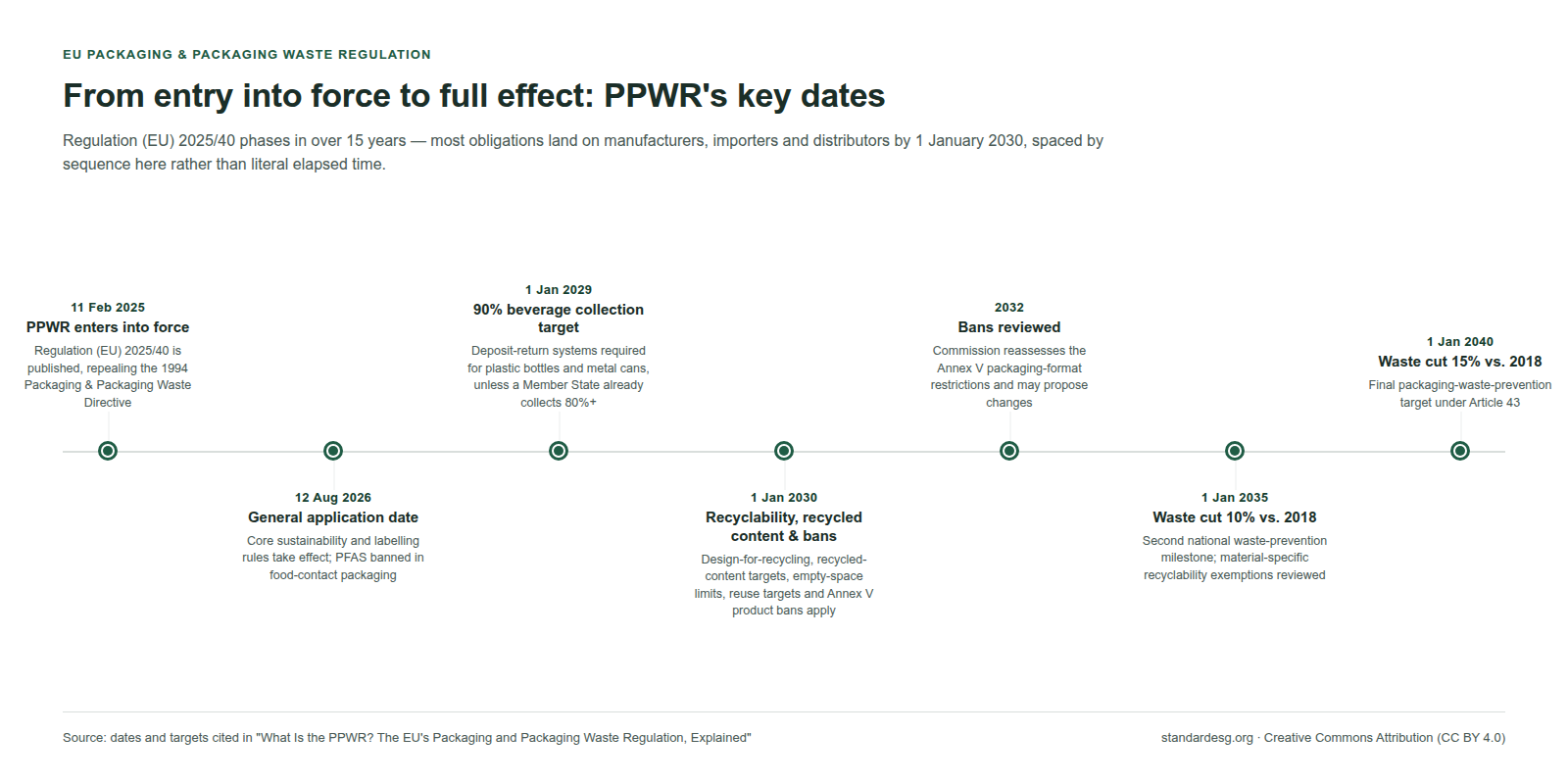
The PPWR phases in over roughly fifteen years, and different obligations attach to different dates — several of them tied to delegated or implementing acts the Commission has not yet adopted, which means some deadlines are still provisional. The chart above marks the headline dates; in narrative form:
- 11 February 2025 — the Regulation enters into force, repealing the 1994 Packaging and Packaging Waste Directive.
- 12 August 2026 — the Regulation's general application date. Where a specific provision does not name its own later date, this is the date it starts to bind. This is also when the ban on PFAS (per- and polyfluoroalkyl substances) in food-contact packaging takes effect, and when the general obligation to minimise substances of concern applies.
- 1 January 2029 — the target date for a 90% separate-collection rate for single-use plastic beverage bottles and metal beverage containers, generally achieved through mandatory deposit-return systems (discussed below).
- 1 January 2030 — the date by which most of the Regulation's headline sustainability obligations bite at once: packaging must be recyclable "at scale", recycled-content targets for plastic packaging apply, packaging-minimisation and empty-space rules apply, reuse targets for transport, e-commerce and beverage packaging apply, and the single-use format bans in Annex V take effect. Several of these dates float — they are pegged to "1 January 2030, or N years after the entry into force of [a named delegated or implementing act], whichever is later" — so the Commission's pace of adopting the underlying acts (design-for-recycling criteria, recycled-content calculation methodology, empty-space methodology) can push individual obligations later than 2030 in practice.
- 2032 — the Commission is required to review the Annex V packaging bans and may propose amendments.
- 1 January 2035 — the second national waste-prevention milestone (a 10% reduction in packaging waste generated per capita against a 2018 baseline), and the date the Commission reviews whether the material-specific recyclability exemptions (cork, lightweight wood, textile, ceramics, rubber, porcelain, wax) should continue.
- 1 January 2040 — the final packaging-waste-prevention target: a 15% reduction per capita against the 2018 baseline.
Packaging lawfully placed on the market before the relevant application date generally does not need to be withdrawn or brought into retroactive compliance — the Regulation applies to units placed on the market going forward, not to a manufacturer's existing design as an abstract matter. Reusable packaging placed on the market before 11 February 2025 gets the earliest of these cut-off dates.
Substances of Concern and the PFAS Restriction
The PPWR requires that the presence and concentration of substances of concern (SoC) in packaging — both in the material itself and in any resulting emissions or waste — be minimised. The SoC definition is imported directly from the EU's Ecodesign for Sustainable Products Regulation (ESPR): a substance qualifies if it meets any one of four criteria (not all four cumulatively) — it is a substance of very high concern under REACH, it falls into specified CLP hazard classes (carcinogenicity, mutagenicity, reproductive toxicity, endocrine disruption, persistence/bioaccumulation, and others), it is regulated as a persistent organic pollutant, or it negatively affects the reuse and recycling of the materials it is present in.
There is no single published list of SoC and no general concentration limit — the Commission and the European Chemicals Agency (ECHA) are running a dedicated study to identify them, expected to inform future delegated acts. Two concrete limits already exist in the text itself, however:
- Four heavy metals — lead, cadmium, mercury, and hexavalent chromium — are capped at a combined 100 ppm by weight (a limit carried over from the old directive, with a continuing derogation for concentrations arising from recycled glass content, provided none of the four is intentionally added).
- PFAS are restricted in food-contact packaging specifically, from 12 August 2026. This is a concentration limit, not an outright ban, and it does not distinguish between PFAS intentionally added and PFAS present as contamination — both are covered.
Recyclability and Recycled Content
Recyclability (Article 6). From 2030, all packaging placed on the EU market must be recyclable "at scale" — assessed against design-for-recycling criteria the Commission is still finalising by delegated act, and against a Union-wide recycling target of 55% for most materials (30% for wood). The "at scale" test is applied at EU level, not per Member State, so an individual country's underperformance on recycling does not by itself disqualify a packaging format. A narrow set of materials used in sales packaging — cork, lightweight wood, textile, ceramics, rubber, porcelain, and wax — is exempted from the recyclability assessment itself (though not from recyclability-linked fee adjustments, discussed later in this guide), pending a Commission review by 2035. Non-recyclable "innovative packaging" can also seek a narrowly defined exemption.
Recycled content (Article 7). Plastic packaging must contain a minimum share of recycled material, with targets that vary by polymer type and by whether the packaging is "contact-sensitive" (used for food or medicinal products). The requirement is calculated as an average per manufacturing plant, per year — not per individual unit — so a single plant producing several packaging formats must track compliance separately for each. Illustrative 2030 targets cited in the Regulation's guidance include 30% recycled content for single-use PET beverage bottles, 10% for other contact-sensitive plastic packaging, and 35% for non-contact formats such as pallet-wrapping film. Plastic components under 5% of a packaging unit's total weight are exempted; the exemption does not extend to non-plastic components of any size.
Where recycled content exceeds the legal minimum, manufacturers may make an environmental claim about it — but the claim must specify what it covers (the whole unit, or just the part containing the recycled material) and must not simply restate compliance with a legal floor as if it were a distinguishing achievement.
Minimisation and Empty Space
Separately from recyclability, the PPWR requires that packaging be minimised to what is functionally necessary — no double walls, false bottoms, or oversized outer boxes used to make a product look larger than it is, unless the added material serves a genuine functional purpose (structural protection, tamper evidence, and similar) that can be demonstrated and documented. Packaging protected by an existing trademark or design registration (registered before 11 February 2025) can be exempted, but the exemption must be actively evidenced, not simply asserted.
A related but distinct rule caps empty space at 50% for grouped, transport, and e-commerce packaging — the difference between a package's internal volume and the volume of what it actually contains, counting loose fill materials (air cushions, bubble wrap, packing peanuts) as empty space. There is no equivalent numeric cap for sales packaging sold directly to consumers; instead, the economic operator who fills it must simply minimise empty space and be able to show how. Both the minimisation and empty-space rules apply from 1 January 2030, pending Commission methodology for measuring compliance across irregular shapes and multi-product packs.
Reuse, Refill and Deposit-Return Systems
The PPWR sets binding reuse targets for three categories of packaging: transport and grouped packaging, e-commerce packaging, and beverage packaging — all generally effective from 2030. For beverages specifically, final distributors (retailers, bars, restaurants) must ensure a share of what they sell is offered in reusable packaging, with a wide set of proportionality carve-outs: distributors with under 100 m² of sales area, micro-enterprises placing under 1,000 kg of packaging on the market per year, businesses in low-population-density municipalities, and small distributors that pool their obligation together (up to five at a time) are all wholly or partly exempted.
Reuse systems themselves can be closed-loop (packaging returns to a single system operator, who tracks rotations via labelling and a QR code or equivalent digital carrier) or open-loop (packaging circulates across companies and sectors without a central operator — the German 0.33-litre reusable beer/soft-drink bottle system and the Euro Pallet are both established open-loop examples). Open-loop systems without an operator are exempted from the individual rotation-tracking and labelling requirements that apply to closed-loop systems.
Deposit-return systems (DRS) are the PPWR's mechanism for hitting a 90% separate-collection target for single-use plastic beverage bottles and metal beverage containers by 1 January 2029. A Member State that already collects more than 80% of these formats by 2026, and can show a credible plan to reach 90% by 2029 without a DRS, may be exempted from standing one up. Where a DRS is required, it must generally be non-profit, and Member States with significant cross-border retail activity must design their systems to accept returns originating in a neighbouring Member State's DRS.
Bans on Certain Packaging Formats
From 1 January 2030, Annex V of the Regulation bans a defined list of single-use plastic packaging formats outright, including:
- Single-use plastic packaging for unprocessed fresh fruit and vegetables weighing under 1.5 kg (with exemptions the Commission will detail in forthcoming guidelines for cases of "demonstrated need").
- Single-use plastic grouped packaging at the point of sale designed specifically to encourage consumers to buy more than one item — collation film and shrink wrap around multiple stock-keeping units are the paradigm case; business-to-business packaging is not covered.
- Single-use packaging for condiments, sauces, coffee creamer, sugar, and seasoning in the HORECA (hotel/restaurant/catering) sector, other than take-away food intended for immediate consumption or healthcare-sector use.
- Single-use miniature toiletries provided in accommodation packaging tied to an individual booking (hotel-room miniatures, in effect).
- Very lightweight plastic carrier bags, with a narrow exemption for bags needed on hygiene grounds or as loose-food packaging to prevent food waste — and even those exempted bags still count toward a separate 40% national reduction target for lightweight plastic carrier bags generally.
The list in Annex V is illustrative rather than exhaustive in its examples, and the Commission is due to publish detailed implementing guidelines by February 2027 to resolve edge cases (what counts as "unprocessed," what counts as "demonstrated need," and so on). The Commission must review the ban list again in 2032.
Labelling, Environmental Claims and Extended Producer Responsibility
Labelling. The PPWR introduces a harmonised sorting label so consumers across the Union see consistent recycling/disposal symbols regardless of where a product was purchased. Reusable transport packaging circulating in closed-loop systems must carry a reusable-packaging label and a QR code or equivalent digital carrier. Separately, any mark, symbol, or claim on packaging — about recyclability, recycled content, reusability, compostability, bio-based content, or hazardous-substance content — must not mislead consumers.
Environmental claims (Article 14). Claims about properties the PPWR itself regulates — recyclability, recycled content, reusability, minimisation — are only permitted where the underlying performance genuinely exceeds the PPWR's own legal minimum, and the claim must state clearly what it covers (the whole packaging unit, or only part of it). Claims about properties the PPWR does not regulate — recycled aluminium content, for instance — fall instead under the EU's general unfair commercial practices and consumer-empowerment rules.
Extended producer responsibility (EPR, Articles 44–47). Producers — generally whoever first makes packaging available on a given Member State's territory — must register with that state's national producer register and report on the packaging they place on the market. The PPWR harmonises the administrative mechanics of EPR across Member States (registration format, reporting frequency and granularity, and who counts as "the producer" for a given packaging type) to reduce the burden on companies selling into multiple states, while leaving Member States considerable latitude over how EPR fees are actually set. One harmonised element is coming, though: eco-modulation — adjusting the fees a producer pays based on its packaging's recyclability performance grade — will follow a common EU framework once the Commission adopts the relevant delegated act, though states may already modulate fees today on other bases such as recycled content or reusability. Producers making under 10 tonnes of packaging available per year face lighter reporting obligations, and microenterprises can, in specific same-Member-State supplier arrangements, be exempted from EPR obligations entirely.
Who Actually Has to Comply
Compliance responsibility under the PPWR runs primarily through manufacturers — the economic operator that designs or has packaging designed and places it on the market under its own name — but importers and distributors carry parallel obligations not to place or make available non-compliant packaging, and suppliers of packaging materials must give manufacturers the technical information needed to prove conformity, even though suppliers themselves bear no direct legal responsibility under the Regulation. The manufacturer must draw up an EU declaration of conformity and hold technical documentation demonstrating compliance for the entire packaging unit — not assessed piecemeal per component — and remains legally responsible for that declaration even where a third party (a lab, a certification body) actually performs the underlying assessment.
There is no general exemption from these obligations for small or micro-enterprises, though the Regulation repeatedly narrows specific obligations for them — lighter EPR reporting thresholds, reuse-target carve-outs for small final distributors, and so on (discussed earlier in this guide). Enforcement sits with national market-surveillance authorities, who apply penalties set at Member State level.
How the PPWR Fits Alongside Other EU Law
The PPWR does not operate in isolation. It repeals and replaces the 1994 Packaging and Packaging Waste Directive outright. It interacts with, but does not replace, the Single-Use Plastics Directive (SUPD) — SUPD's own recycled-content target and reporting obligation for beverage bottles remain in force until 2030, or three years after the PPWR's recycled-content implementing act enters into force, whichever is later, after which the PPWR's own (differently scoped) rules take over. It is deliberately narrower than the Ecodesign for Sustainable Products Regulation (ESPR) on packaging specifically: the ESPR sets general product eco-design principles across many product categories but explicitly leaves general packaging sustainability requirements to the PPWR, stepping in only to add product-specific detail the PPWR does not itself cover. And it sits alongside general EU consumer protection law — the Empowering Consumers for the Green Transition Directive governs environmental claims that fall outside the PPWR's own Article 14 scope.
Where This Fits Into ESG Certification
The PPWR is EU law, binding only on packaging placed on the EU market — but the practices it requires (design for recyclability, recycled-content tracking, waste minimisation, substance-of-concern management) map directly onto core environmental diligence that any credible ESG assessment expects a company to demonstrate, regardless of where it operates. Within the Standard ESG protocol, this evidence grounds subject E4 — waste, circularity, and pollution prevention — one of the five core environmental subjects every industry template assesses (see the ESG scoring pipeline for how subject-level evidence rolls up into a pillar and composite score). For companies in packaging-relevant industries specifically, the SASB Containers & Packaging standard that already grounds Standard ESG's industry-specific templates for that sector complements the PPWR's regulatory detail with disclosure-focused accounting metrics — a company already building PPWR compliance documentation (technical files, declarations of conformity, EPR registration) has already assembled most of the evidence a Level 2 document-verified assessment would ask for on this subject.
Standard ESG (standardesg.org) is designed to work alongside packaging-specific regulation like the PPWR, not duplicate it — compliance documentation built for one purpose typically substantiates the equivalent Standard ESG environmental indicators directly. See The Standard ESG Certification Protocol: A Public Overview for how the underlying methodology is structured.
Was this page useful?