1. Two Standards, One Supply Chain
SASB — now maintained by the International Sustainability Standards Board (ISSB) as part of the IFRS Foundation — places both standards in its Food & Beverage sector. Agricultural Products (SICS FB-AG) covers entities engaged in processing, trading and distributing vegetables and fruits, and producing and milling commodities such as grains, sugar, consumable oils, maize, soybeans and animal feed; entities in the industry typically purchase agricultural products from growers, directly or indirectly, then conduct value-adding activities such as processing, trading, distributing and milling. Meat, Poultry & Dairy (SICS FB-MP) covers entities that produce raw and processed animal products — meats, eggs and dairy — for human and animal consumption, with core activities spanning animal raising, slaughtering, processing and packaging; the industry's largest entities are vertically integrated to varying degrees and rely heavily on contract or independent farmers to supply live animals. Both industry descriptions name the same underlying risk: managing sustainability exposure within a supply chain the entity often doesn't fully own is central to securing reliable supply and controlling long-term costs. Where the two standards diverge is in how much of that exposure sits inside the entity's own operations versus its supplier network — covered further on.
2. The Two Standards at a Glance
Each standard organizes its material risks into a set of named disclosure topics, each with its own metrics (SASB's own terms: disclosure topics describe a specific sustainability-related risk or opportunity; metrics quantify or describe an entity's performance against a topic).
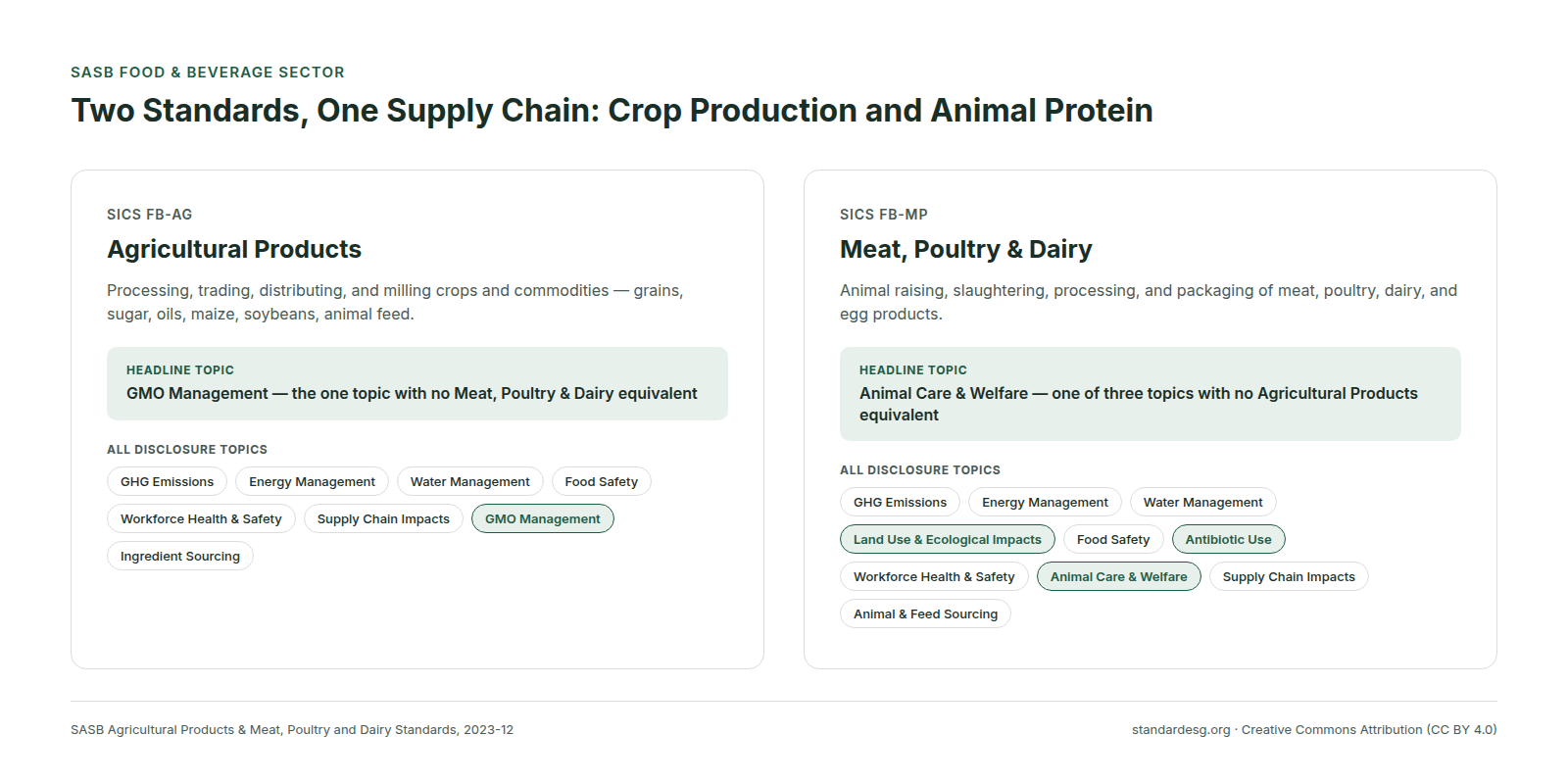
Agricultural Products — Greenhouse Gas Emissions, Energy Management, Water Management, Food Safety, Workforce Health & Safety, Environmental & Social Impacts of Ingredient Supply Chain, GMO Management, Ingredient Sourcing.
Meat, Poultry & Dairy — Greenhouse Gas Emissions, Energy Management, Water Management, Land Use & Ecological Impacts, Food Safety, Antibiotic Use in Animal Production, Workforce Health & Safety, Animal Care & Welfare, Environmental & Social Impacts of Animal Supply Chain, Animal & Feed Sourcing.
Eight topics against ten, and the overlap is genuinely close for six of them — Agricultural Products' Environmental & Social Impacts of Ingredient Supply Chain and Ingredient Sourcing map almost metric-for-metric onto Meat, Poultry & Dairy's Environmental & Social Impacts of Animal Supply Chain and Animal & Feed Sourcing, just relabelled for a livestock rather than a crop supply base. The real divergence is that Meat, Poultry & Dairy adds three topics with no Agricultural Products counterpart at all — Land Use & Ecological Impacts, Antibiotic Use in Animal Production, and Animal Care & Welfare — while Agricultural Products carries one topic, GMO Management, that Meat, Poultry & Dairy has no equivalent for.
3. Emissions and Energy: The Common Ground
Both standards open with near-identical Greenhouse Gas Emissions and Energy Management topics, reflecting how similarly both industries are built: processing and milling operations with meaningful freight and fleet components. Gross global Scope 1 emissions (FB-AG-110a.1 / FB-MP-110a.1) requires disclosure of all seven Kyoto Protocol GHGs in metric tonnes of CO2-equivalent, calculated per the GHG Protocol's financial-control consolidation approach — see Measuring GHG Emissions: Scope 1, 2 and 3 for how that boundary and methodology work in general. Both standards pair the emissions figure with a discussion of long- and short-term strategy or plan to manage Scope 1 emissions (FB-AG-110a.2 / FB-MP-110a.2), asking for reduction targets, base years, and performance against those targets. The one difference within this topic: Agricultural Products adds a third metric, fleet fuel consumed, percentage renewable (FB-AG-110a.3), broken out on its own — Meat, Poultry & Dairy has no equivalent fleet-specific fuel metric, folding fleet energy use into its broader Energy Management topic instead.
Energy Management is essentially identical across both standards: total energy consumed, percentage grid electricity, and percentage renewable (FB-AG-130a.1 / FB-MP-130a.1), each excluding fleet fuel and covering purchased electricity, heating, cooling, and steam. Both topic summaries name the same underlying driver — processing and milling are energy-intensive, and the trade-off between grid-sourced and on-site or alternative-fuel energy shapes both cost exposure and regulatory risk.
4. Water Management, and the Land-Use Topic Only Animal Protein Carries
Water Management is another close match: both standards require total water withdrawn and consumed, with the percentage of each in regions of High or Extremely High Baseline Water Stress (FB-AG-140a.1 / FB-MP-140a.1), a description of water management risks and mitigation strategies (FB-AG-140a.2 / FB-MP-140a.2), and the number of water-quality non-compliance incidents (FB-AG-140a.3 / FB-MP-140a.3), using the same World Resources Institute Aqueduct water-stress classification in both standards. Both topic summaries frame this the same way: processing facilities depend on reliable water access, and a separate supply-chain-facing topic — Ingredient Sourcing on the crop side, Animal & Feed Sourcing on the animal side — covers the water-stress exposure that sits further upstream, in growing regions and feed production rather than at the entity's own facilities.
Meat, Poultry & Dairy alone carries Land Use & Ecological Impacts, a topic with no Agricultural Products analogue at all. Its three metrics are facility- and land-specific in a way nothing in the crop standard is: the amount of animal litter and manure generated, and the percentage managed according to a nutrient management plan (FB-MP-160a.1); the percentage of pasture and grazing land managed to conservation plan criteria (FB-MP-160a.2); and animal protein production from confined animal feeding operations (FB-MP-160a.3) — a metric that exists specifically because concentrated animal feeding is recognized as carrying materially different ecological risk than pasture-based systems. The topic summary names the reason directly: raising livestock requires significant land, and both confined and non-confined operations create concentrated waste and land-degradation exposure that crop milling and processing simply doesn't generate at the same scale. This is the single largest structural gap between the two standards, and a template author covering an animal-protein SEIC group should treat land use as a genuinely distinct evidence category from crop-side Water Management, not an extension of it.
5. Food Safety, and the GMO Topic Only Crops Carry
Food Safety is close to a direct match. Both standards require Global Food Safety Initiative (GFSI) audit non-conformance and corrective-action rates, split between major and minor non-conformances (FB-AG-250a.1 / FB-MP-250a.1); the percentage of suppliers certified to a GFSI-recognised food safety programme (FB-AG-250a.2 / FB-MP-250a.2, worded slightly differently — Agricultural Products measures this by the cost of certified inputs sourced, Meat, Poultry & Dairy by the share of supplier facilities certified); and the number and weight of recalls issued (FB-AG-250a.3 / FB-MP-250a.3). Meat, Poultry & Dairy adds one metric Agricultural Products doesn't carry: a discussion of markets that ban imports of the entity's products (FB-MP-250a.4), tied specifically to sanitary and phytosanitary (SPS) trade restrictions — a reasonable addition given how animal-disease outbreaks (avian influenza, bovine spongiform encephalopathy) trigger import bans in a way crop contamination rarely does at the same geopolitical scale.
Agricultural Products alone carries GMO Management — a discussion of strategies to manage the use of genetically modified organisms (FB-AG-430b.1), covering jurisdictions that restrict GMO imports, labelling requirements, and shifting consumer preference. Meat, Poultry & Dairy has no GMO topic at all, which is a real gap rather than an oversight to read past: livestock feed itself is frequently GMO-sourced (soy, maize), so GMO exposure doesn't disappear on the animal-protein side — SASB's standard simply doesn't ask for it as a separate disclosure there, folding any such risk into the general Animal & Feed Sourcing topic instead rather than giving it its own consumer-facing topic the way crops get.
6. Workforce Health and Safety
Both standards require the same core metric — total recordable incident rate (TRIR) and fatality rate, split between direct and contract employees (FB-AG-320a.1 / FB-MP-320a.1) — reflecting shared labour-intensive, machinery-heavy processing environments. Agricultural Products' version also requires near miss frequency rate (NMFR) as a third sub-metric within FB-AG-320a.1, which Meat, Poultry & Dairy's otherwise-identical metric doesn't carry. Meat, Poultry & Dairy instead adds a second, distinct metric with no Agricultural Products equivalent: a description of efforts to assess, monitor, and mitigate acute and chronic respiratory health conditions (FB-MP-320a.2), naming chemical burns, bronchitis, and organic toxic dust syndrome — occupational hazards tied specifically to slaughter and processing-line environments that a grain-milling or fruit-processing facility doesn't carry in the same way.
7. Where Animal Protein Diverges: Antibiotic Use and Animal Care & Welfare
These two topics are Meat, Poultry & Dairy's most consequential additions, and they don't map cleanly onto any subject a crop standard would need. Antibiotic Use in Animal Production requires the percentage of animal production, by weight, that received medically important antibiotics and, separately, not-medically-important antibiotics, by animal type (FB-MP-260a.1) — "medically important" defined against the World Health Organization's own list of antimicrobials also used in human medicine. The topic summary frames this explicitly as a public-health and reputational risk: prevalent antibiotic use in livestock can promote antibiotic-resistant bacteria, a risk with no equivalent anywhere in crop production. Animal Care & Welfare requires the percentage of pork produced without gestation crates (FB-MP-410a.1), the percentage of cage-free shell egg sales (FB-MP-410a.2), and the percentage of production certified to a third-party animal welfare standard (FB-MP-410a.3) — covering treatment and handling, housing and transportation, slaughter procedures, and antibiotic/hormone use, per the standard's own definition of what an animal welfare standard addresses.
Neither topic translates naturally onto a Standard ESG core subject the way Workforce Health & Safety maps to S2 or Food Safety maps to S5 — the Protocol's Social subjects are built around ISO 26000's labour, human-rights, community, and consumer categories, none of which is animal-welfare-specific. Rather than force these into a social subject they don't fit, this guide maps both to G5 — Risk management & compliance: SASB's own topic summaries frame antibiotic resistance and animal-welfare practices primarily as regulatory and reputational exposure — the risk of mandated facility closures, market-access restrictions, and consumer-driven brand damage — which is a risk-management framing, not an operational-performance one. This is a genuine limitation worth flagging plainly rather than glossing over: an animal-protein producer's welfare and antibiotic-stewardship practices are real, substantive ESG content, and a template author covering this SEIC group should not read the G5 mapping as saying this content matters less than a labour or consumer topic — only that Standard ESG's current subject taxonomy has no purpose-built category for it.
8. Supply Chain: Sourcing Risk and Supplier Standards
Both standards close with a closely parallel pair of supply-chain topics. Environmental & Social Impacts of [Ingredient / Animal] Supply Chain requires, on the crop side, the percentage of agricultural products certified to a third-party environmental or social standard, and percentages by standard (FB-AG-430a.1) — naming Bonsucro, Fairtrade, RSPO, RTRS, Rainforest Alliance, SA8000, and USDA Organic as example certifications — plus suppliers' social and environmental responsibility audit non-conformance and corrective-action rates (FB-AG-430a.2) and a discussion of strategy to manage environmental and social risks from contract growing and commodity sourcing (FB-AG-430a.3). The animal-side version requires the percentage of livestock from suppliers implementing conservation plan criteria (FB-MP-430a.1) and the percentage of supplier and contract production facilities verified to meet animal welfare standards (FB-MP-430a.2) — narrower in scope than the crop version's three-metric structure, and focused specifically on conservation and welfare compliance rather than a broader third-party-certification landscape.
Ingredient Sourcing (crop side) and Animal & Feed Sourcing (animal side) both require a discussion of climate-change risks and opportunities to supply — crop-specific for Agricultural Products (FB-AG-440a.1, tied to identified "principal crops," those representing 10% or more of consolidated revenue), feed- and livestock-specific for Meat, Poultry & Dairy (FB-MP-440a.3) — alongside a percentage of [agricultural products / animal feed] sourced from regions with High or Extremely High Baseline Water Stress (FB-AG-440a.2 / FB-MP-440a.1). Meat, Poultry & Dairy adds one further metric with no crop-side equivalent: the percentage of contracts with producers located in water-stressed regions (FB-MP-440a.2), reflecting how much more of the animal-protein industry's supply chain runs through binding, named-supplier contracts rather than commodity-market purchasing.
9. Mapping to Standard ESG Subjects
Greenhouse Gas Emissions maps to E3 — Emissions & climate, as anticipated. Energy Management and Water Management map to E2 — Resource use, also as anticipated. Land Use & Ecological Impacts maps to E5 — Biodiversity & land use, confirming the brief's anticipated subject — but with a structural caveat worth naming plainly: this content exists only in the Meat, Poultry & Dairy standard. Agricultural Products, despite its own scope bullet anticipating land-use content, carries no comparable topic — its closest analogue, Ingredient Sourcing, discusses climate risk to crop supply rather than the entity's own land-use footprint. Food Safety and GMO Management both map to S5 — Consumer/end-user responsibility, as anticipated for Food Safety; GMO Management's addition to S5 is a deviation from the original scope, which didn't separately anticipate it, but it fits the same consumer-facing-disclosure logic as Food Safety cleanly enough to sit under the same subject rather than needing its own. Workforce Health & Safety maps to S2 — Occupational health & safety, as anticipated. Antibiotic Use in Animal Production and Animal Care & Welfare map to G5 — Risk management & compliance — a deviation from the original scope, which anticipated only S2/S5 for the social side, and reflecting this guide's judgment that neither topic fits a Standard ESG social subject cleanly. Both supply-chain topic pairs — Environmental & Social Impacts of Ingredient/Animal Supply Chain, and Ingredient/Animal & Feed Sourcing — map to G4 — Sustainable procurement & supply-chain management, also a deviation from the original scope: the brief anticipated only E2/E3/E5/S2/S5, with no G-pillar content, but both standards' supply-chain topics are fundamentally about supplier certification, audit, and sourcing-risk management rather than the entity's own environmental or social performance, which is squarely G4 territory.
The final subject set — E2, E3, E5, S2, S5, G4, and G5 — is wider than the brief's anticipated E2/E3/E5/S2/S5, adding G4 and G5 once the standards' actual content, rather than the anticipated scope, is read closely.
10. Which SEIC Sectors This Deepens Coverage For
These two standards carry the most weight for exactly the SEIC groups their SICS codes name: crop processing, trading, milling, and distribution companies (FB-AG) and meat, poultry, dairy, and egg production companies (FB-MP). Sustainable Sugarcane Production: The Bonsucro Standard Explained already covers one FB-AG sub-crop in depth via a single commodity-specific roundtable scheme — this guide's Ingredient Sourcing coverage is the broader, standard-wide layer that sits above any one crop's certification scheme, not a replacement for it; an entity growing or sourcing sugarcane specifically should read both.
11. Getting Started
- Confirm which standard applies — Agricultural Products for crop processing/milling/trading, Meat, Poultry & Dairy for animal raising/slaughtering/processing.
- Start with the near-identical GHG, energy, and water evidence trail shared by both standards — this is the most directly comparable ground and typically the most investor-scrutinized.
- If you're an animal-protein producer, don't treat Land Use & Ecological Impacts, Antibiotic Use, and Animal Care & Welfare as optional extras layered onto the crop-standard template — these are three of Meat, Poultry & Dairy's ten topics, with no shortcut through Agricultural Products' lighter scope.
- Build supplier-certification and sourcing-risk evidence early — GFSI audits, third-party environmental/social certifications, and water-stress-by-region figures are often already tracked for commercial reasons before a Standard ESG assessment asks for them.
- If your production involves GMO ingredients, don't assume Food Safety disclosure covers it — GMO Management is its own topic with its own jurisdiction-by-jurisdiction discussion requirement.
- See What to Expect from an On-Site ESG Assessment (Level 3) for how facility-level evidence like animal welfare compliance and land-use/conservation-plan documentation gets verified physically on site.
- Standard ESG (standardesg.org) draws on SASB's Agricultural Products and Meat, Poultry & Dairy standards to deepen subjects E2, E3, and E5 for crop and animal-protein producers, alongside S2, S5, G4, and G5 for the sector's workforce-safety, consumer-facing, supply-chain, and risk-management exposure. See The Standard ESG Certification Protocol: A Public Overview for how industry-dependent subjects fit into the full pillar and subject architecture.
Two SASB Food & Beverage Standards
Was this page useful?