A Standard Built Around a Supply Chain, Not a Factory
Apparel, accessories, and footwear brands sit under a single SASB industry standard, covering everything from restricted-substance testing on a finished garment to whether a cotton supplier is sourcing from a water-stressed region. Unlike the extraction and utility standards this library has already worked through, almost none of this standard's material risk sits inside the reporting company's own four walls — it sits in a multi-tier supplier network the brand rarely owns and often can't fully see. This guide works through the Apparel, Accessories & Footwear standard (SICS CG-AA) topic by topic, and is honest about where its four topics blur together in ways a casual reading of the topic list wouldn't suggest.
SASB — now maintained by the International Sustainability Standards Board (ISSB) as part of the IFRS Foundation — describes the Apparel, Accessories & Footwear industry as entities involved in the design, manufacturing, wholesaling, and retailing of adult and children's clothing, handbags, jewellery, watches, and footwear. The standard's own industry description names the structural fact that shapes everything else in it: products are manufactured primarily by vendors in emerging markets, which lets a reporting entity focus on design, wholesaling, marketing, supply chain management, and retail rather than on manufacturing itself. That single sentence explains why three of this standard's four disclosure topics are explicitly scoped to supplier facilities rather than the reporting entity's own operations — a structural difference from standards like Coal Operations or Waste Management, where nearly every metric measures something the reporting company operates directly.
The standard defines its supplier universe in two tiers, consistently across every topic that uses it: Tier 1 suppliers transact directly with the entity (finished-goods manufacturers such as cut-and-sew facilities), while suppliers beyond Tier 1 are the essential suppliers to those Tier 1 suppliers — mills, dye houses, washing facilities, tanneries, embroiderers, screen printers, farms, and slaughterhouses. A single activity metric (CG-AA-000.A) asks entities to disclose the number of suppliers in each tier, letting a reader size how much of a company's disclosed audit or compliance percentage actually covers its full supply chain versus just its most visible layer.
The Standard at a Glance
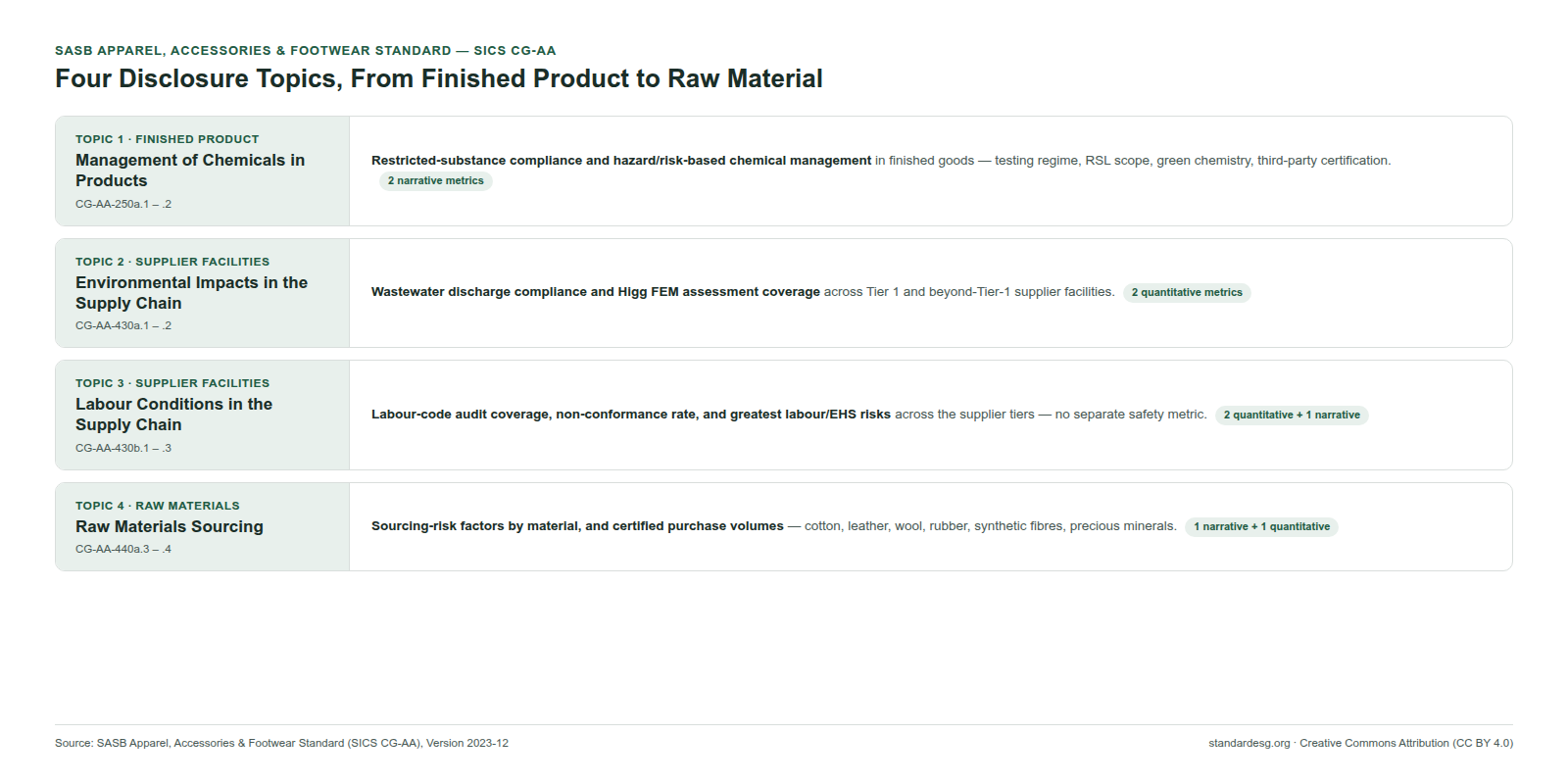
Four disclosure topics carry the standard's substantive content, plus the one activity metric described above:
- Management of Chemicals in Products (CG-AA-250a.1-.2): two Discussion and Analysis metrics, no quantitative ones at all.
- Environmental Impacts in the Supply Chain (CG-AA-430a.1-.2): two percentage metrics on supplier-facility compliance and assessment coverage.
- Labour Conditions in the Supply Chain (CG-AA-430b.1-.3): two quantitative metrics (audit coverage, non-conformance rate) plus one Discussion and Analysis metric.
- Raw Materials Sourcing (CG-AA-440a.3-.4): one Discussion and Analysis metric covering sourcing risk factor-by-factor, plus one quantitative metric on certified purchase volumes.
Narrative vs. Quantitative Balance
Two of the four topics — Management of Chemicals in Products and part of Raw Materials Sourcing — are entirely or mostly narrative (SASB's own term: Discussion and Analysis), asking an entity to describe its processes and reasoning rather than report a number. That's a real contrast with the two supply-chain topics, which lean on hard percentages: facility compliance rates, audit coverage, and non-conformance rates. A reader building an evidence file against this standard should expect roughly half of it to be a qualitative process description and half a quantitative supplier-performance scorecard, not a uniformly numeric standard.
Management of Chemicals in Products
This topic sits apart from the other three because it's the only one scoped to the finished product itself rather than the supply chain that made it. The standard's own framing is direct: finished apparel and footwear products have been found to contain traces of banned or regulated chemicals, some of which are carcinogenic or disrupt hormone activity, and failure to manage this can trigger recalls, litigation, and reputational damage — consumer-facing risk, not supplier-facility risk.
CG-AA-250a.1 asks an entity to discuss how it maintains compliance with restricted substances regulations — laws and rules that restrict or ban specific materials, chemicals, and substances in finished apparel, footwear, and home textile products. The disclosure is detailed about how: whether the entity tests the finished product or each individual product input, whether testing is done in-house or by a third party, testing frequency, and whether the scope of the entity's Restricted Substances List (RSL) — the list of chemicals it restricts, at what concentration, tested by what method — reflects the strictest regulation across every market it sells into, or something narrower. CG-AA-250a.2 goes a layer deeper, asking whether the entity's overall approach is hazard-based (managing chemicals by their toxicological properties), risk-based (managing exposure route, frequency, duration, and magnitude together), or a mixture, and how it integrates green chemistry principles and third-party certifications such as OEKO-TEX Standard 100 or Bluesign into product design.
Both metrics are entirely narrative — there's no percentage-compliant, no chemical count, no pass/fail rate anywhere in this topic. That's a genuine limitation for anyone hoping to score this topic the way the standard's other, more quantitative topics can be scored: the evidence here is a process description, best evaluated for specificity and rigor rather than compared numerically across companies.
Environmental Impacts in the Supply Chain
Where Chemicals in Products looks at the finished good, this topic looks upstream at the facilities that made it — specifically at water. The standard names water pollution from dyeing and tanning, and air pollution from energy use and manufacturing, as the industry's two central environmental externalities, intensified historically by manufacturing concentrated in emerging markets with limited environmental oversight.
CG-AA-430a.1 asks for the percentage of Tier 1 and beyond-Tier-1 supplier facilities that comply with wastewater discharge permits or contractual agreements — covering any facility activity that uses water and discharges industrial wastewater: dyeing, tanning, lamination, laundry/washing, wet finishing, boiler blow-down, steam generation, cooling, cleaning, printing, screen printing, and degreasing. The metric's own notes point entities toward the Sustainable Apparel Coalition's Higg Facility Environment Module (Higg FEM) as the alignment reference for what "compliance" means. CG-AA-430a.2 measures something adjacent but distinct: the percentage of supplier facilities that have actually completed a Higg FEM assessment (or an equivalent), which covers a wider environmental scope than wastewater alone — environmental management systems, energy and GHG, water, wastewater, waste, air emissions, and chemicals management, all as assessment categories. A facility can comply with its discharge permit without having completed a full environmental assessment, and vice versa, so the two percentages measure genuinely different things: outcome compliance versus assessment coverage.
Despite the Higg FEM assessment's broader scope, this topic's own metrics don't isolate GHG or energy performance the way a utilities or manufacturing standard would — no emissions-intensity figure, no energy-consumption metric anywhere in this topic. What gets measured directly is wastewater discharge compliance and assessment completion; the rest of Higg FEM's categories are folded into "has the facility been assessed" rather than reported as their own disclosed figures.
Labour Conditions in the Supply Chain
The standard frames this as the industry's other central supply-chain issue: worker health and safety, fair pay, child labour, and forced labour, made harder to manage by a multitiered system of suppliers, subcontractors, labour recruitment firms, and part-time workers, concentrated in countries with the lowest direct manufacturing costs and often the least regulatory enforcement.
CG-AA-430b.1 asks for the percentage of Tier 1 and beyond-Tier-1 supplier facilities audited to a labour code of conduct during the reporting period, plus the percentage of those audits conducted by an independent third-party auditor rather than an internal representative or another brand's shared audit. A labour code of conduct, per the standard's own definition, covers at minimum worker hours, excessive overtime, non-discrimination, minimum age, compensation, freedom of association, anti-harassment and anti-abuse policies, and termination practices — plus a parallel set of environmental, health, and safety criteria covering building and occupational safety hazards, environmental permit compliance, and hazardous materials management. CG-AA-430b.2 adds the priority non-conformance rate (violations of a jurisdictional law or regulation, or a code-of-conduct element corroborated by more than one source) and the associated corrective-action rate — how much of what audits find actually gets fixed, not just identified.
CG-AA-430b.3 is the topic's one Discussion and Analysis metric, and it's structured distinctively: it asks the entity to name, separately, its three greatest labour conditions risks (excessive hours, minimum-age violations, unfair compensation, lack of freedom of association, unfair treatment) and its three greatest environmental, health, and safety risks (unsafe building or occupational hazards, non-compliance with environmental permits, unsafe air or water pollution levels, improper hazardous-waste disposal) in its supply chain. That's the standard drawing a real distinction between labour-rights risk and physical safety/environmental risk within one topic — worth noticing precisely because the topic's two quantitative metrics (audit coverage, non-conformance rate) don't separate the two at all; they're scored as one combined "labour code of conduct" figure covering both categories together.
Raw Materials Sourcing
The fourth topic looks further upstream still, to the materials themselves — cotton, leather, wool, rubber, synthetic fibres, and precious minerals and metals — and to what threatens an entity's ability to keep sourcing them reliably: climate change impacts, GHG regulation, land-use practices, deforestation and biodiversity loss on the environmental side; animal welfare, labour and human rights practices, materials sourced from conflict regions, and labour or human-rights regulation on the social side.
CG-AA-440a.3 is a four-part Discussion and Analysis metric: for each priority raw material an entity identifies (using the Textile Exchange's Materials Terminology Guide for what counts as "priority"), it discloses which environmental or social factors most threaten its ability to source that material, the business risks or opportunities those factors create (access and availability, traceability, price volatility, regulatory exposure, customer demand, brand reputation), and its management strategy — supply-chain monitoring and traceability investment, supplier training, partnerships with industry groups or NGOs, or R&D into substitute materials. A dedicated note requires any entity identifying cotton as a priority material to specifically discuss its exposure to cotton-growing regions under high or extremely high baseline water stress, using the World Resources Institute's Aqueduct tool. CG-AA-440a.4 is the topic's one quantitative metric: the amount purchased of each priority raw material, in metric tonnes, and the amount of each that's certified to a recognized third-party environmental or social standard — the standard names the Global Recycled Standard, Responsible Wool Standard, Global Organic Textile Standard, Fair Trade Certified, Leather Working Group certification, and Forest Stewardship Council certification, among others, as examples.
This topic is where the standard's social-factor language comes closest to a genuine human-rights disclosure — "materials sourcing from regions of conflict" and "regulations on labour practices or human rights" both appear explicitly as sourcing risk factors — but it's folded into one generic factor list rather than given its own dedicated metric the way a framework built specifically around human-rights due diligence would structure it. For that fuller treatment, see Human Rights Due Diligence: The UN Guiding Principles Explained.
Where the Topics Blur: Safety and Human Rights Without Their Own Metrics
Two real limitations are worth naming plainly rather than glossed over, because a casual reading of this standard's topic list could suggest broader coverage than it actually delivers.
Occupational health and safety has no quantitative metric anywhere in this standard. Every other SASB standard this library has reviewed with a labour-intensive supply chain or operations footprint carries some quantitative injury measure — a TRIR, a fatality rate, a Near Miss Frequency Rate. This standard doesn't. Environmental, health, and safety risk appears only inside CG-AA-430b.3's qualitative "name your three greatest risks" discussion, bundled alongside labour-conditions risk in the same metric, with no separate audit-coverage or non-conformance figure isolating safety performance from general labour-code compliance. An entity can score well on labour-code audit coverage (CG-AA-430b.1) while disclosing nothing quantitative about worker injury rates at all.
Human rights and due diligence has no topic of its own. The standard's supply-chain social content is split across two places — Labour Conditions in the Supply Chain's code-of-conduct audits (forced labour and child labour are addressed only implicitly, as elements a code of conduct "shall include, at a minimum") and Raw Materials Sourcing's generic "environmental or social factors" list (which names conflict-region sourcing and human-rights regulation as one bullet among several) — rather than getting a dedicated topic with its own metrics, the way the two upstream oil-and-gas standards elsewhere in this library carry a named Security, Human Rights & Indigenous Peoples topic. A template or evidence file built from this standard alone will have real labour-practices coverage but comparatively thin, narrative-only human-rights coverage — worth supplementing with a dedicated UNGPs-based due-diligence framework.
Mapping to Standard ESG Subjects
Management of Chemicals in Products maps to S5 — Consumer/end-user responsibility: it's a finished-product chemical-safety topic driven by consumer and regulatory exposure, not a circularity or resource-use topic, despite chemicals management sometimes being associated with waste handling elsewhere. Environmental Impacts in the Supply Chain maps to E4 — Waste, circularity & pollution prevention, specifically its pollution-prevention half — wastewater discharge and hazardous-substance management — since this standard, notably, has no circularity, recycling, or take-back-program content anywhere in it, a real gap relative to what "E4" usually covers in this library's other SASB deep dives.
Labour Conditions in the Supply Chain maps primarily to S1 — Labour practices & decent work, with S2 — Occupational health & safety present only thinly: safety content exists but shares an undifferentiated audit/non-conformance metric with labour conditions rather than being measured on its own. Raw Materials Sourcing maps to G4 — Sustainable procurement & supply-chain management as its dominant frame, with two genuine but metric-thin secondary subjects drawn from its factor list: E5 — Biodiversity & land use (deforestation, land-use practices, water stress) and S3 — Human rights & due diligence (conflict-region sourcing, labour and human-rights regulation) — both real, both explicitly named in the standard's own text, and both folded into one Discussion and Analysis metric rather than broken out separately.
That's a final subject set of E4, E5, G4, S1, S2, S3, and S5 — wider than this task's original working scope of S1/S3, E4, and G4, with S5 and E5 added as genuine findings from reading the standard directly, and E4 and S3 both carrying a narrower or thinner meaning here than in this library's other SASB articles.
Which SEIC Sectors This Deepens Coverage For
This standard maps directly onto Standard ESG's Apparel, Accessories & Footwear SEIC group — clothing, handbag, jewellery, watch, and footwear design, manufacturing, wholesaling, and retail. A company that also manufactures the raw textiles or leather itself, rather than sourcing them from suppliers, sits further upstream than this standard's own scope and should be evaluated against textile- or leather-manufacturing sources instead; this standard is written from the perspective of the brand that designs, markets, and sells the finished product, not the mill or tannery that supplies it.
Getting Started
A brand or manufacturer building out its E4, E5, G4, S1, S2, S3, and S5 evidence base can work through this standard's topics roughly as follows:
- Separate finished-product chemical-safety evidence (RSL scope, testing regime, third-party certifications) from supply-chain environmental evidence entirely — they're two different topics measuring two different things.
- Distinguish wastewater discharge compliance from Higg FEM (or equivalent) assessment completion when reporting supply-chain environmental performance — one is an outcome, the other is process coverage.
- Build separate evidence trails for labour-code audit coverage and non-conformance rate, and don't assume either one captures workforce safety performance — this standard doesn't measure safety quantitatively at all.
- For every priority raw material, document the specific environmental and social sourcing-risk factors, the business risk or opportunity each creates, and the management strategy addressing it — the standard's own suggested table format (material, factors, risks, strategy) is a reasonable evidence template to reuse.
- Treat this standard's human-rights content as a starting point, not a complete picture, and supplement it with a dedicated due-diligence framework for supply-chain human-rights evidence.
See What to Expect from an On-Site ESG Assessment (Level 3) for how supplier-facility evidence like this gets verified beyond a company's own self-reported percentages.
Standard ESG draws on SASB's Apparel, Accessories & Footwear standard to deepen subjects E4, E5, G4, S1, S2, S3, and S5 for apparel, accessories, and footwear brands and manufacturers. See The Standard ESG Certification Protocol: A Public Overview for how industry-dependent subjects fit into the full pillar and subject architecture.
Was this page useful?