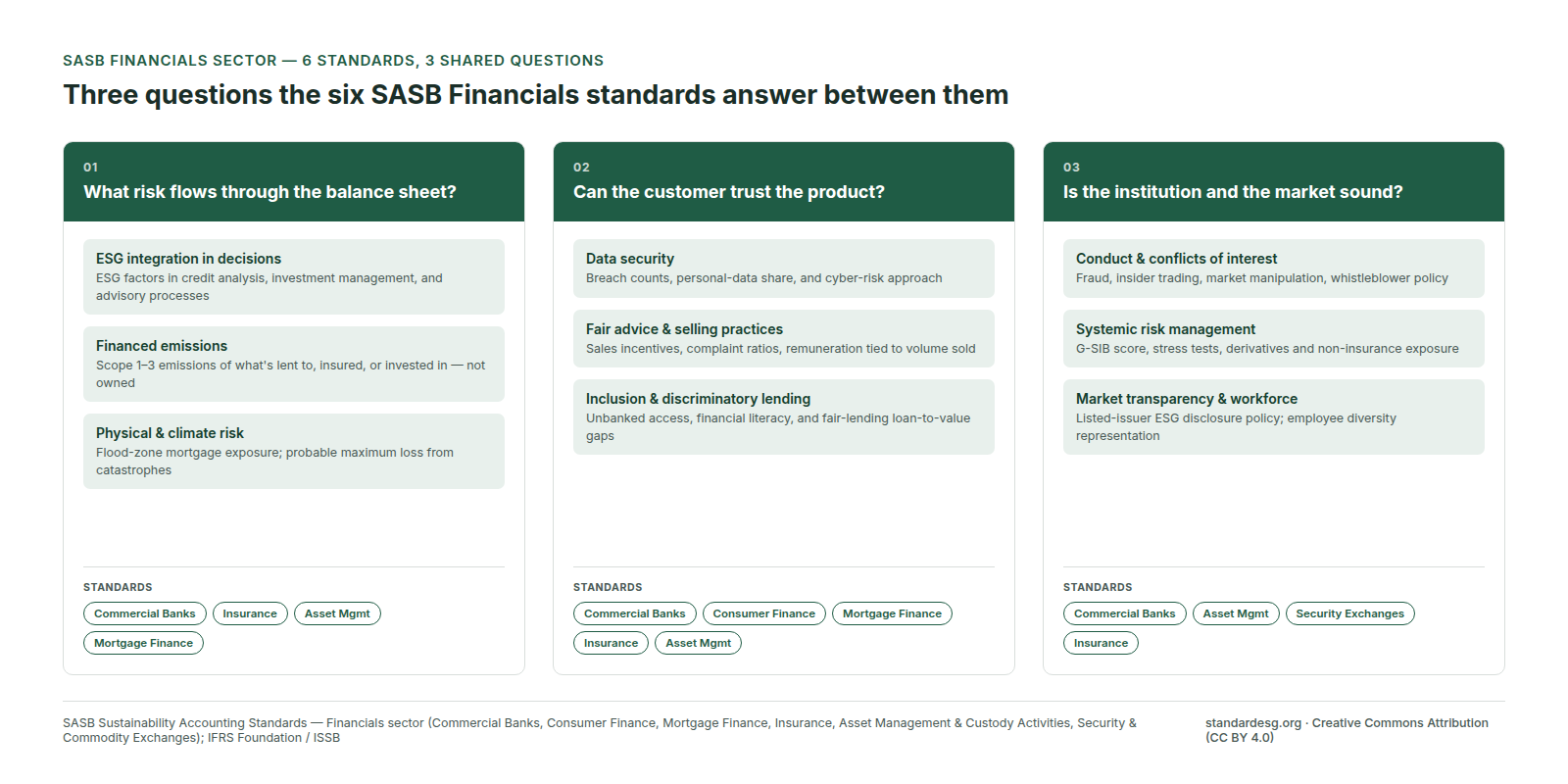
The Six Standards at a Glance
SASB — now maintained under ISSB/IFRS Foundation stewardship, with its industry metrics incorporated into IFRS S2 — splits financial services into six SICS industries, each with its own standard: Commercial Banks (FN-CB), Consumer Finance (FN-CF), Mortgage Finance (FN-MF), Insurance (FN-IN), Asset Management & Custody Activities (FN-AC), and Security & Commodity Exchanges (FN-EX). The split matters because the material ESG risks genuinely differ by business model: a commercial bank's biggest exposure runs through the loans on its balance sheet, an insurer's runs through the catastrophes it underwrites, and an exchange's runs through the fairness of the market it operates — not through any single "financial services ESG" checklist that could apply identically to all three. Each standard nonetheless follows the same five-part SASB structure: an industry description, disclosure topics, quantitative and discussion-and-analysis metrics, technical protocols, and activity metrics used to normalize the data. Read together, the six standards reveal both a shared core — data security, fair advice to customers, ESG integration into financial decision-making, financed emissions, business ethics — and topics unique to a single business model, like a mortgage lender's flood-zone exposure or an exchange's role in encouraging its own listed companies to disclose ESG information.
Fair Advice, Transparent Products, and Selling Practices
Consumer Finance, Insurance, and Asset Management each require disclosure on whether customers are being sold products that genuinely suit them, structured around the same underlying concern in three different guises. Consumer Finance's Selling Practices topic asks for the percentage of covered employees' remuneration that varies with the volume of products sold — a direct proxy for whether staff are incentivized to push products a customer doesn't need — alongside average add-on fees, average APR, and complaint volumes with their resolution outcomes. Insurance's Transparent Information & Fair Advice topic asks for a complaints-to-claims ratio and a customer retention rate, on the logic that a policyholder who feels misled complains or leaves. Asset Management's version asks for the number and percentage of licensed employees and identified decision-makers with a record of investment-related investigations, complaints, or litigation — a workforce-level integrity metric rather than a product-level one, but answering the same underlying question of whether the people giving advice can be trusted to give it fairly. Mortgage Finance contributes a related but distinct angle under its own Lending Practices topic: the remuneration structure of mortgage loan originators, and disclosure of prepayment penalties — the same "does the incentive structure encourage mis-selling" concern Consumer Finance raises, applied to the largest single loan most consumers ever take out.
ESG Integration in Lending, Underwriting, and Investment Decisions
Three standards each require, in near-parallel language, a description of how the entity incorporates environmental, social, and governance factors into its core financial decision-making process — but the process itself differs by business model. Commercial Banks must describe how ESG factors enter credit analysis: who is responsible day to day, how ESG-related credit losses are estimated over a loan's contractual term, what scenario analysis is run on the credit portfolio, and which concentrations of ESG-related exposure (carbon-intensive assets, water-stressed regions) the bank tracks. Insurance must describe the same kind of incorporation, but in investment management — how the insurer's own investment portfolio (built from premium income, not loans) weighs ESG factors — plus a separate, insurance-specific topic: net premiums written on products designed to incentivize responsible behavior, such as energy-efficiency or low-carbon technology cover. Asset Management goes furthest in specificity, requiring not just a qualitative description but a quantitative breakdown of assets under management by asset class that employ (1) ESG integration, (2) sustainability-themed investing, or (3) screening — plus a separate disclosure on proxy voting and investee engagement policies, since an asset manager's influence over a portfolio company's own ESG performance runs through the votes it casts and the engagement it conducts, not just the securities it chooses to hold.
Financed Emissions: Measuring a Portfolio's Carbon Footprint
Commercial Banks, Insurance, and Asset Management all carry a Financed Emissions topic, and as of the standards' most recent (2025-12) revision, all three define it by direct reference to IFRS S2's own financed-emissions requirements — a clean example of the SASB-into-ISSB integration described in What Is SASB? Industry-Specific Materiality and the Standards Behind Standard ESG's Templates. Each standard asks for absolute gross financed emissions, disaggregated by Scope 1, 2, and 3, the gross exposure by industry and asset class the calculation covers, the percentage of total exposure actually included (financed-emissions data availability is often partial), and a description of the calculation methodology and allocation approach used to attribute a fair share of a borrower's or investee's emissions to the financial institution's own book. The concept is the same one covered in more general terms in Measuring Greenhouse Gas Emissions and the GHG Protocol: a bank's, insurer's, or asset manager's real climate exposure is overwhelmingly a Scope 3 category-15 (investments) question, not a Scope 1 or 2 one, since virtually none of these institutions' own direct operations are carbon-intensive.
Conduct, Ethics, and Conflicts of Interest
Commercial Banks, Asset Management, and Security & Commodity Exchanges each require disclosure of the total monetary losses from legal proceedings tied to fraud, insider trading, antitrust behavior, anti-competitive conduct, market manipulation, or malpractice — worded almost identically across all three standards — alongside a description of whistleblower policies and procedures (Commercial Banks and Asset Management) or, in the Exchanges standard's own framing, a description of the processes an exchange uses to identify and assess conflicts of interest. The overlap reflects a shared structural risk: any institution that handles other people's money, sits on both sides of a transaction, or operates market infrastructure has a built-in temptation to put its own interests ahead of its customers' or the market's, and SASB treats robust, independently verifiable conduct disclosure as the check on that temptation. Consumer Finance and Mortgage Finance don't carry a standalone Business Ethics topic, but fold conduct risk into their own Selling Practices and Lending Practices topics instead.
Systemic Risk Management
Commercial Banks and Insurance are the two standards written for institutions large enough, or interconnected enough, to threaten the stability of the wider financial system if they fail — and both carry a Systemic Risk Management topic as a result. Commercial Banks requires disclosure of the entity's Global Systemically Important Bank (G-SIB) score, calculated under the Basel Committee's own assessment methodology across six categories (size, cross-jurisdictional activity, interconnectedness, substitutability, complexity, and an overall score), plus a description of how mandatory and voluntary stress-test results feed into capital planning and long-term strategy — including, specifically, how those stress-test results inform the entity's own ESG strategy. Insurance's version asks for exposure to derivative instruments by category, the fair value of securities-lending collateral, and a description of the entity's approach to managing capital- and liquidity-related risk from non-insurance activities — since some large insurers engage in non-traditional activities, like credit-default-swap protection, that regulators treat as a source of systemic risk in their own right. Asset Management and Security & Commodity Exchanges don't carry an equivalent topic, but Exchanges' own Managing Business Continuity & Technology Risks topic covers an adjacent concern — market-level disruption rather than institution-level capital adequacy.
What's Distinct to Each Standard
Beyond the shared themes above, each standard contributes at least one topic none of the others do, and these are often the most operationally specific content in the whole set:
- Commercial Banks — Financial Inclusion & Capacity Building: the number and value of loans qualifying for small-business and community-development programs, no-cost checking accounts provided to unbanked or underbanked customers, and participants in financial-literacy initiatives — treating expanded access to banking services as a disclosure-worthy opportunity, not just a risk to manage.
- Mortgage Finance — Discriminatory Lending and Environmental Risk to Mortgaged Properties: a weighted-average loan-to-value ratio broken out by minority versus all other borrowers (a direct fair-lending metric), alongside the number and value of mortgages in 100-year flood zones and a description of how climate and environmental risk factor into origination and underwriting — the standard where physical climate risk is most concretely operationalized into an underwriting metric anywhere in the FN sector.
- Insurance — Physical Risk Exposure: Probable Maximum Loss (PML) of insured products from weather-related natural catastrophes, and monetary losses actually paid out from modelled versus non-modelled catastrophe events by geography — the standard's own answer to the same physical-risk question Mortgage Finance asks, from the underwriting side rather than the lending side.
- Asset Management — Employee Diversity & Inclusion: gender and diversity-group representation across executive management, non-executive management, professional staff, and all other employees — the only standalone workforce-diversity topic anywhere in the six FN standards.
- Security & Commodity Exchanges — Promoting Transparent & Efficient Capital Markets: trading halts and volatility pauses, the percentage of trades generated by automated/algorithmic systems, and — distinctively — a description of the exchange's own policy to encourage or require its listed entities to publicly disclose ESG information. An exchange doesn't just report its own ESG performance; under this topic, it's assessed on whether it uses its market-infrastructure position to push disclosure standards onto every company it lists.
Mapping to Standard ESG Subjects G1 and G2
The six standards' shared themes deepen two Standard ESG subjects at once, plus a narrower angle on a third. G1 — Organizational governance & board oversight is deepened by the ESG-integration-in-decision-making topics and by Asset Management's proxy-voting and engagement disclosure — concrete, checkable content for what "board oversight of ESG" actually looks like inside a financial institution's own core business process, not just its own boardroom. G2 — Ethics, anti-corruption & fair operating practices is deepened directly by the conduct, conflicts-of-interest, and fair-advice topics running through the sections above — legal-proceedings disclosure, whistleblower policies, and selling-practices transparency give a template author concrete indicator language for exactly the kind of misconduct risk G2 is built to catch. The financed-emissions topic also gives E2/E3 — resource use and emissions & climate a sector-specific extension: for a financial institution, most of its real emissions exposure lives in its financed portfolio rather than its own operations, so a generic Scope 1/2 questionnaire item under-measures a bank's, insurer's, or asset manager's actual climate footprint without this financed-emissions layer.
Which SEIC Financial-Services Groups This Deepens Coverage For
These six standards carry the most weight for SEIC groups whose core business is exactly what SASB's Financials sector covers: commercial and retail banking, consumer and mortgage lending, insurance underwriting, asset and wealth management, and market infrastructure (exchanges, clearinghouses, brokerages). For these groups, the shared themes above — data security, fair advice, ESG integration into lending or investment decisions, financed emissions, and conduct/ethics — are not optional context; they're close to the core of what a financial-services questionnaire, Level 2 document list, and Level 3 checklist should be asking about, in a way a generic 15-subject seed template can't fully anticipate on its own. A company outside financial services will find little direct use for these six standards beyond the general pattern they establish — that ESG risk in a service-based, capital-intermediating business runs through what an institution finances, insures, or advises on, not through smokestacks or supply chains.
Getting Started
A financial-services company building out its G1/G2 evidence base can use these six standards as a practical starting point, roughly in order of how directly each maps onto existing operations:
- Identify which of the six standards (or which combination, for a diversified financial group) matches your actual business lines, and pull that standard's full disclosure-topic table as a first-pass gap check against what you already disclose.
- Establish or document your data security posture against an external framework — ISO/IEC 2700, NIST's Cybersecurity Framework, or an equivalent — before treating individual breach-disclosure metrics in isolation; all three data-security standards assume this foundation already exists.
- If your business involves lending, underwriting, or managing investment portfolios, document how ESG factors formally enter that process today, even if informally — this is usually the single highest-leverage gap, since it's required in some form across three of the six standards.
- Scope a financed-emissions calculation early, even a partial one covering your highest-exposure asset classes first — full-portfolio Scope 3 category-15 data is rarely available on day one, and the standards explicitly expect and ask for disclosure of the percentage of exposure actually covered.
- Review your incentive and remuneration structures for anything that varies directly with the volume of products sold, and document the safeguards in place against mis-selling — the single theme threaded through Consumer Finance, Mortgage Finance, Insurance, and Asset Management alike.
See The Standard ESG Certification Protocol: A Public Overview for how industry templates fit into the full pillar and subject architecture, and What Is SASB? Industry-Specific Materiality and the Standards Behind Standard ESG's Templates for how these standards fit into SASB's broader 77-industry system.
Standard ESG (standardesg.org) draws on SASB's six Financials-sector standards to deepen subjects G1 and G2 for banking, consumer and mortgage finance, insurance, asset management, and market-infrastructure companies, alongside the ⟨IR⟩ Framework and GRI for the rest of the Governance pillar. See The Standard ESG Certification Protocol: A Public Overview for how industry-dependent subjects fit into the full pillar and subject architecture.
Was this page useful?