Three Standards, One Extractive-to-Industrial Chain
A mining or metals company rarely fits neatly under one SASB standard. A coal miner uses Coal Operations. A company that mines iron ore or coking coal and also smelts it into steel may need both Metals & Mining (or Coal Operations) for the extraction side and Iron & Steel Producers for the processing side. A pure-play steelmaker that buys its raw materials rather than mining them applies Iron & Steel Producers alone. Reading the three standards side by side surfaces something initially expected to be a difference of degree — Coal Operations and Metals & Mining turn out to share nearly identical topic architecture, while Iron & Steel Producers drops entire categories of disclosure that the other two treat as central. That's the throughline for the rest of this guide: two extraction standards that mostly agree, and one processing standard that is a genuinely different kind of document.
The Three SASB Standards at a Glance
Each standard organizes its material risks into a small set of named disclosure topics, each with its own accompanying metrics:
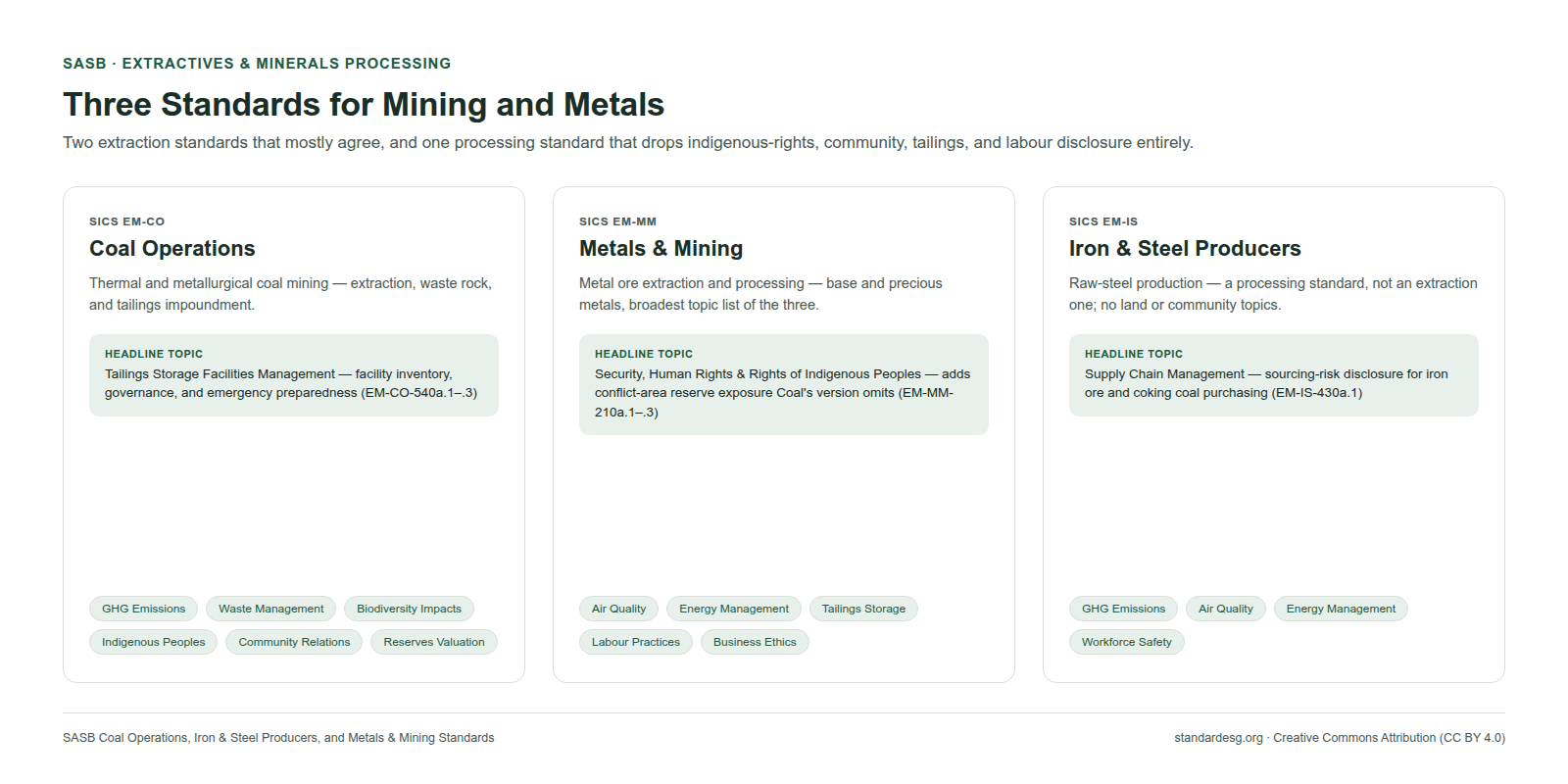
- Coal Operations (SICS EM-CO) covers thermal and metallurgical coal mining. Its ten disclosure topics are Greenhouse Gas Emissions, Water Management, Waste Management, Biodiversity Impacts, Rights of Indigenous Peoples, Community Relations, Labour Relations, Workforce Health & Safety, Reserves Valuation & Capital Expenditures, and Tailings Storage Facilities Management.
- Metals & Mining (SICS EM-MM) covers metal ore extraction and processing — everything from base metals to precious metals. Its topic list is close to Coal's: Greenhouse Gas Emissions, Air Quality, Energy Management, Water Management, Waste & Hazardous Materials Management, Biodiversity Impacts, Security/Human Rights & Rights of Indigenous Peoples, Community Relations, Labour Practices, Workforce Health & Safety, Business Ethics & Transparency, and Tailings Storage Facilities Management — twelve topics against Coal's ten, with Air Quality, Energy Management, and Business Ethics & Transparency as the additions.
- Iron & Steel Producers (SICS EM-IS) covers raw-steel production — basic oxygen furnace and electric-arc furnace processes. Its seven topics are Greenhouse Gas Emissions, Air Quality, Energy Management, Water Management, Waste Management, Workforce Health & Safety, and Supply Chain Management. Every topic tied to land, communities, indigenous peoples, or labour relations that the two extraction standards carry is simply absent here.
Emissions, Air Quality, and Energy: A Genuine Three-Way Split
All three standards require gross global Scope 1 emissions and the percentage covered under emissions-limiting regulation, plus a discussion of emissions-management strategy (EM-CO-110a.1/.2, EM-IS-110a.1/.2, EM-MM-110a.1/.2) — the one metric pair that lines up identically across all three. Beyond that, the standards split.
Air Quality — pollutant-specific tonnage for CO, NOx, SOx, particulate matter, and a handful of metal-specific toxics — appears in Iron & Steel Producers (EM-IS-120a.1, which adds manganese oxide to its pollutant list, reflecting steelmaking's own process chemistry) and Metals & Mining (EM-MM-120a.1, which lists mercury instead of manganese). Coal Operations has no Air Quality topic at all. Energy Management — total energy consumed, percentage grid electricity, percentage renewable — likewise appears only in Iron & Steel Producers (EM-IS-130a.1, plus a second metric on fuel mix at EM-IS-130a.2 covering percentage coal, natural gas, and renewable fuel) and Metals & Mining (EM-MM-130a.1, a single combined metric with no separate fuel-mix disclosure). Coal Operations has no Energy Management topic either. The pattern is that combustion-heavy processing and smelting operations (steel, metals refining) draw SASB's attention to stack emissions and energy mix in a way a coal mine itself — whose principal emissions footprint is fugitive methane and diesel fleet use already captured under GHG Emissions — does not.
Water and Waste Management
Water Management is close to uniform: all three require total water withdrawn, total water consumed, and the percentage of each in regions of High or Extremely High Baseline Water Stress (EM-CO-140a.1, EM-IS-140a.1, EM-MM-140a.1). Coal and Metals & Mining add a second metric — the number of water-quality permit non-compliance incidents (EM-CO-140a.2, EM-MM-140a.2) — that Iron & Steel Producers omits.
Waste Management is where the extraction/processing split becomes sharp. Coal Operations breaks waste into seven distinct disclosures: non-mineral waste generated, tailings produced, waste rock generated, hazardous waste generated, hazardous waste recycled, significant hazardous-waste incidents, and a description of waste-management policy for active and inactive operations (EM-CO-150a.2 through .8). Metals & Mining, under the broader label "Waste & Hazardous Materials Management," requires the same seven-part breakdown (EM-MM-150a.4 through .10). Iron & Steel Producers collapses all of that into a single combined metric — amount of waste generated, percentage hazardous, percentage recycled (EM-IS-150a.1) — with no tailings or waste-rock line item at all, because a steel mill doesn't generate mine tailings or waste rock in the first place.
Tailings Storage Facilities: An Extraction-Only Topic
Both extraction standards carry a dedicated Tailings Storage Facilities Management topic, added to SASB's mining standards in response to major tailings-dam failures, and it's dense: a facility-by-facility inventory table covering name, location, ownership status, operational status, construction method, maximum permitted storage capacity, current amount stored, consequence classification, date of most recent independent technical review, material findings, mitigation measures, and site-specific Emergency Preparedness and Response Plan (EPRP) details — all under a single metric (EM-CO-540a.1, EM-MM-540a.1). Both standards add a discussion of the governance structure used to monitor facility stability (EM-CO-540a.2, EM-MM-540a.2) and a discussion of EPRP development approach (EM-CO-540a.3, EM-MM-540a.3). Iron & Steel Producers has no equivalent topic whatsoever — confirmation that this is a disclosure specific to holding and impounding mine waste, not to industrial operations generally.
Biodiversity, Indigenous Peoples, and Community Relations
Coal and Metals & Mining again track closely. Both require a description of environmental management policy for active sites, the percentage of mine sites where acid rock drainage is predicted, actively mitigated, or under remediation, and the percentage of proved and probable reserves in or near protected conservation areas or endangered-species habitat (EM-CO-160a.1–.3, EM-MM-160a.1–.3) under a Biodiversity Impacts topic.
On indigenous peoples and community relations, the two extraction standards diverge slightly from each other, not just from Iron & Steel. Coal Operations' "Rights of Indigenous Peoples" topic covers the percentage of reserves in or near indigenous land and a discussion of engagement and due-diligence practices (EM-CO-210a.1/.2). Metals & Mining folds the same content into a broader "Security, Human Rights & Rights of Indigenous Peoples" topic that adds a metric Coal doesn't have: the percentage of reserves in or near areas of conflict (EM-MM-210a.1), plus a due-diligence discussion that explicitly spans human rights, indigenous rights, and operation in conflict areas (EM-MM-210a.3) — a broader security lens that Coal's version doesn't carry. Both standards then require a separate Community Relations topic: a discussion of managing risks and opportunities tied to community rights, plus the number and duration of non-technical delays (EM-CO-210b.1/.2, EM-MM-210b.1/.2). Iron & Steel Producers has no indigenous-rights or community-relations topic at all — for an entity handling ore and coke it has already sourced, SASB treats this exposure as belonging to the upstream mine, not the mill.
Labour Practices and Workforce Health & Safety
Labour Relations/Labour Practices — percentage of workforce under collective agreements, and the number and duration of strikes and lockouts — appears in Coal Operations (EM-CO-310a.1/.2) and Metals & Mining (EM-MM-310a.1/.2). Iron & Steel Producers has no equivalent topic.
Workforce Health & Safety is the one topic every standard shares, though not identically. Coal Operations requires all-incidence rate, fatality rate, and near miss frequency rate (NMFR) for direct and contract employees, plus a discussion of accident and long-term health-risk management (EM-CO-320a.1/.2). Iron & Steel Producers requires the same core rates under the label "total recordable incident rate" (TRIR) rather than "all-incidence rate," with no accompanying discussion metric (EM-IS-320a.1). Metals & Mining requires the broadest version: all-incidence rate, fatality rate, NMFR, and average hours of health, safety, and emergency response training for direct and contract employees (EM-MM-320a.1) — the only one of the three that quantifies safety training investment directly rather than leaving it to a qualitative discussion.
Business Ethics, Supply Chain, and Reserves Valuation
This is where the three standards diverge most sharply, and each has exactly one topic the other two lack. Metals & Mining alone carries a Business Ethics & Transparency topic: a discussion of the anti-corruption and anti-bribery management system used across the value chain, plus a quantitative metric on production volume originating from countries ranked in the bottom 20 of Transparency International's Corruption Perceptions Index (EM-MM-510a.1/.2). Neither Coal Operations nor Iron & Steel Producers has anything comparable.
Iron & Steel Producers alone carries a Supply Chain Management topic — a discussion of the process for managing sourcing risk in iron ore or coking coal purchasing tied to environmental and social issues in the supply chain (EM-IS-430a.1). This makes sense for a processing standard: a steelmaker's own environmental footprint is covered elsewhere in the standard, but its sourcing exposure — buying from mines that may carry exactly the tailings, biodiversity, or indigenous-rights risk covered above — gets its own dedicated disclosure instead.
Coal Operations alone carries a Reserves Valuation & Capital Expenditures topic: the sensitivity of coal reserve levels to future carbon-price scenarios, the estimated CO2-e embedded in proven coal reserves, and a discussion of how coal price, demand, and climate regulation shape capital-expenditure strategy for exploration and development (EM-CO-420a.1–.3). Neither Metals & Mining nor Iron & Steel Producers has an equivalent — coal is the one commodity in this trio whose reserve value is directly and structurally exposed to decarbonization policy in a way base and precious metals generally aren't singled out for.
Mapping to Standard ESG Subjects
The shared GHG Emissions topic maps to E3 — Emissions & climate across all three standards. Air Quality and Energy Management — present only in Iron & Steel Producers and Metals & Mining — split across E4 — Waste, circularity & pollution prevention (Air Quality, as a pollution-prevention disclosure distinct from GHG accounting) and E2 — Resource use (Energy Management), neither of which applies to Coal Operations. Water Management maps to E2; Waste Management and Waste & Hazardous Materials Management map to E4. Tailings Storage Facilities Management is a facility-integrity and emergency-preparedness disclosure rather than a personnel-safety one, so — following the same reasoning applied to Midstream's Operational Safety topic in the oil and gas upstream guide — it maps to G5 — Risk management & compliance, not S2 or E4.
Biodiversity Impacts maps to E5 — Biodiversity & land use; Rights of Indigenous Peoples and Metals & Mining's broader Security/Human Rights topic map to S3 — Human rights & due diligence; Community Relations maps to S4 — Community involvement & development — all three absent from Iron & Steel Producers' scope. Labour Relations/Labour Practices maps to S1 — Labour practices & decent work, also absent from Iron & Steel Producers; Workforce Health & Safety maps to S2 — Occupational health & safety across all three standards. Business Ethics & Transparency (Metals & Mining only) maps to G2 — Ethics, anti-corruption & fair operating practices; Supply Chain Management (Iron & Steel Producers only) maps to G4 — Sustainable procurement & supply-chain management; Reserves Valuation & Capital Expenditures (Coal Operations only) maps to G5 alongside Tailings Storage Facilities Management, both strategic and compliance-risk disclosures rather than operational-performance metrics.
Iron & Steel Producers' narrower scope means a pure-play steelmaker's evidence base against these standards will legitimately have no content for E5, S1, S3, or S4 — that's not a gap in the assessment, it's an accurate reflection of what SASB itself determined was financially material for that industry. A vertically integrated entity spanning ore extraction and steelmaking needs both standards to cover its full footprint.
Which SEIC Sectors This Deepens Coverage For
These three standards carry the most weight for coal mining companies (EM-CO), iron and steel producers (EM-IS), and metal ore mining and processing companies (EM-MM). For the extraction side specifically, see Managing Environmental and Social Risk in High-Impact Industries: The IFC Performance Standards — the IFC's own framework for E5, S3, and S4 exposure in high-impact industries like mining covers similar ground from a project-finance lens rather than a disclosure-standard one, and is worth reading alongside this guide rather than in place of it.
Getting Started
A company or assessor building evidence against these standards can work through them roughly as follows:
- Confirm which standard — or combination — applies: Coal Operations for coal mining, Metals & Mining for other ore extraction, Iron & Steel Producers for steelmaking, both an extraction and a processing standard for a vertically integrated entity.
- Start with the one topic every standard shares — GHG emissions and Workforce Health & Safety — before moving to standard-specific ground.
- If you operate an extraction site (coal or metal ore mining), prioritize tailings storage facility inventories and biodiversity/land-use disclosure — the two most consequential extraction-only topics, given their direct link to major industry incidents.
- If you operate a processing or steelmaking facility, prioritize Air Quality, Energy Management, and Supply Chain Management instead — the topics Iron & Steel Producers substitutes for the extraction-only content it deliberately excludes.
- For a vertically integrated entity, build separate evidence trails for each segment rather than assuming one standard's disclosures satisfy the other.
See Human Rights Due Diligence: The UN Guiding Principles Explained for the due-diligence framework behind the indigenous-rights and community-relations content above, and What to Expect from an On-Site ESG Assessment (Level 3) for how tailings-facility and safety evidence like this gets verified physically on site.
Was this page useful?