Why Renewable Resources Needs Its Own Lens
SASB — now maintained under ISSB/IFRS Foundation stewardship — groups five genuinely different business models under its Renewable Resources & Alternative Energy sector: two energy-hardware manufacturers (Solar Technology & Project Developers, SICS RR-ST, and Wind Technology & Project Developers, RR-WT), a biological fuel producer (Biofuels, RR-BI), and two land-based industries a step apart in the same value chain (Forestry Management, RR-FM, which owns or manages the forestland itself, and Pulp & Paper Products, RR-PP, which buys wood fibre and turns it into paper and packaging). What unites them isn't a shared production process — a solar panel factory and a timber tract have almost nothing operationally in common — but a shared position in the climate story: each is either part of the technology transition away from fossil fuels or a renewable material input to industry, and each carries an environmental and social footprint specific to how it delivers that benefit, not just whether it does.
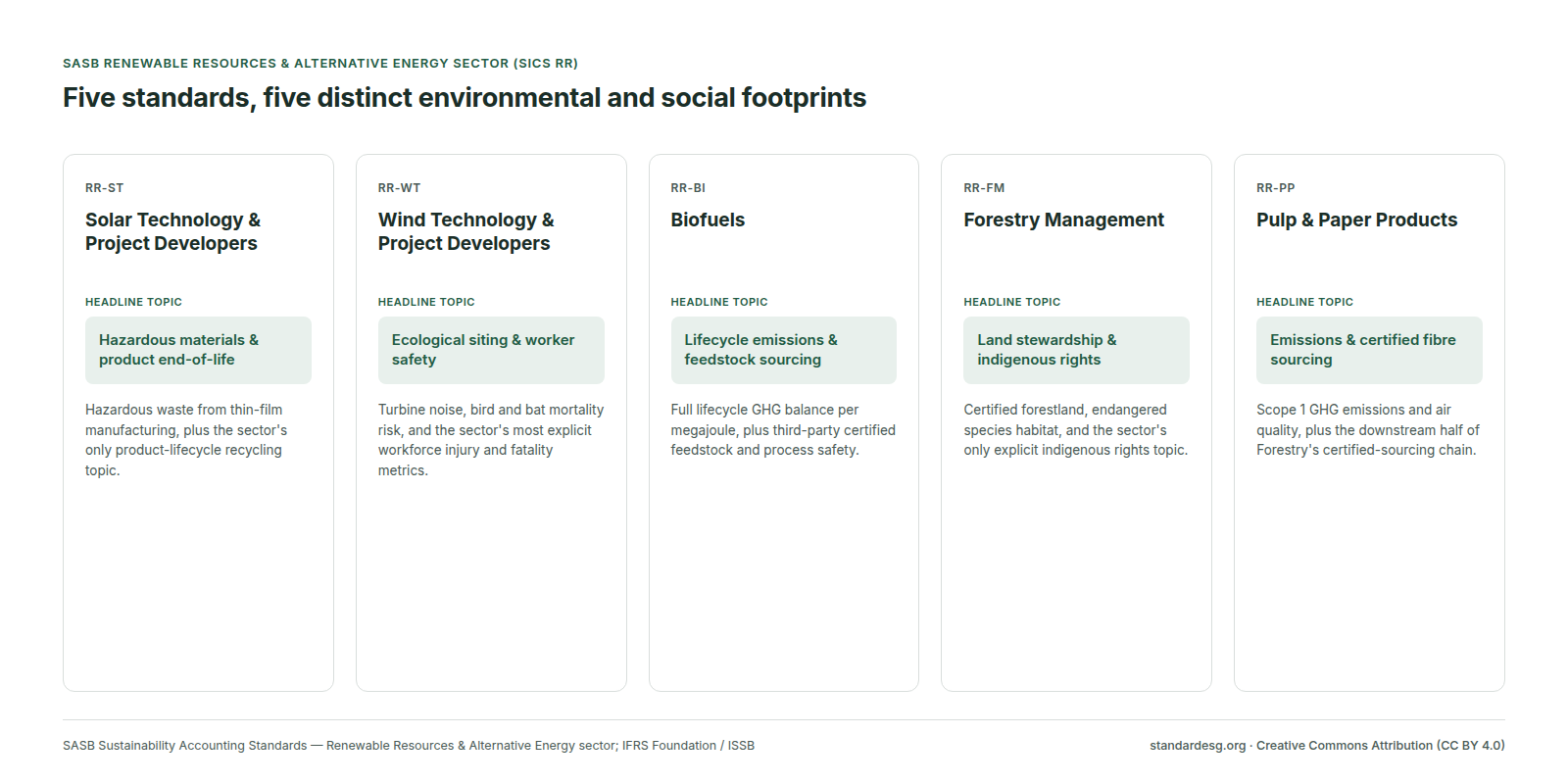
The Five SASB Renewable Resources Standards at a Glance
Each standard organizes its material risks into a small set of named disclosure topics, each with its own accompanying metrics (SASB's own terms: disclosure topics describe a specific sustainability-related risk or opportunity; metrics quantify or describe an entity's performance against a topic; activity metrics normalize company size so metrics can be compared across entities):
- Solar Technology & Project Developers — Energy Management in Manufacturing, Water Management in Manufacturing, Hazardous Waste Management, Ecological Impacts of Project Development, Management of Energy Infrastructure Integration & Related Regulations, Product End-of-Life Management, Materials Sourcing.
- Wind Technology & Project Developers — Workforce Health & Safety, Ecological Impacts of Project Development, Materials Sourcing, Materials Efficiency.
- Biofuels — Air Quality, Water Management in Manufacturing, Lifecycle Emissions Balance, Sourcing & Environmental Impacts of Feedstock Production, Management of the Legal & Regulatory Environment, Operational Safety, Emergency Preparedness & Response.
- Forestry Management — Ecosystem Services & Impacts, Rights of Indigenous Peoples, Climate Change Adaptation.
- Pulp & Paper Products — Greenhouse Gas Emissions, Air Quality, Energy Management, Water Management, Supply Chain Management.
Four clear threads run across multiple standards despite each having its own industry-specific framing: land use and ecological impact (Solar's and Wind's Ecological Impacts of Project Development, Forestry's Ecosystem Services & Impacts), water management in water-stressed regions (Solar, Biofuels, and Pulp & Paper all carry near-identical water-withdrawal metrics), materials sourcing and supply chain traceability (Solar's and Wind's Materials Sourcing, Pulp & Paper's Supply Chain Management), and worker or process safety (Wind's Workforce Health & Safety, Biofuels' Operational Safety). The sections below work through what each thread actually requires, drawing the metric codes directly from the standards so template authors can trace every claim back to its source.
Land Use and Ecological Impacts of Project Development
Solar's and Wind's Ecological Impacts of Project Development topics are built on near-identical logic even though the metrics differ. Solar requires the number and duration of project delays related to ecological impacts (RR-ST-160a.1) and a description of the entity's efforts, during solar energy system project development, to address both community and ecological impacts — land use, habitat disruption, water consumption, wildlife fatalities, property-valuation concerns, visual aesthetics, and construction noise are all named explicitly (RR-ST-160a.2). Wind's version adds a genuinely distinctive angle unique to turbines: the average A-weighted sound power level of delivered turbines, by wind turbine class (RR-WT-410a.1), since turbine noise is one of the most common sources of community opposition to wind projects. Wind also requires the quantity of turbine order backlog subject to cancellation specifically because of community or ecological impacts (RR-WT-410a.2) — a metric that turns community and ecological risk into a number with direct commercial consequences, tying lost bookings straight back to the underlying sustainability risk — alongside a description of how turbine design itself addresses ecological and community impacts, including bird and bat mortality risk (RR-WT-410a.3). Neither Biofuels, Forestry, nor Pulp & Paper carries an equivalent project-development topic, since none of the three builds fixed installations the way Solar and Wind's project-developer business model does.
Forest Stewardship and Indigenous Rights
Forestry Management's two disclosure topics are the richest social-and-environmental content anywhere in the RR sector, and neither has a direct counterpart in the other four standards. Ecosystem Services & Impacts requires the area of forestland certified to a third-party forest management standard, broken out by scheme — the Forest Stewardship Council (FSC), the Sustainable Forest Initiative (SFI), the Programme for the Endorsement of Forest Certification (PEFC), or the American Tree Farm System (ATFS) — and the percentage certified to each (RR-FM-160a.1); the area of forestland with protected conservation status (RR-FM-160a.2) and the area located in endangered species habitat (RR-FM-160a.3); and a description of how the entity optimizes the opportunities created by the ecosystem services — carbon sequestration, water purification, recreation — its forestlands provide (RR-FM-160a.4). Rights of Indigenous Peoples is more direct still: the area of forestland located on indigenous land (RR-FM-210a.1), and a description of the entity's engagement processes and due diligence practices with respect to human rights, indigenous rights, and the local community (RR-FM-210a.2) — language that puts indigenous consultation and consent squarely inside a sustainability accounting standard rather than treating it as a purely legal or reputational matter handled elsewhere. A third topic, Climate Change Adaptation, requires a description of the entity's strategy to manage the risks and opportunities climate change presents for forest management and timber production (RR-FM-450a.1) — recognizing that a forestry company's own operations are exposed to the same climate risk its products can help mitigate elsewhere in the economy.
Water Management Across Manufacturing and Refining
Solar, Biofuels, and Pulp & Paper each carry a Water Management topic built from essentially the same two-metric structure, reflecting how water-intensive manufacturing, refining, and pulping processes all are regardless of what they produce. All three require total water withdrawn and total water consumed, with the percentage of each occurring in regions of High or Extremely High Baseline Water Stress as classified by the World Resources Institute's Aqueduct tool (RR-ST-140a.1 / RR-BI-140a.1 / RR-PP-140a.1), plus a description of water management risks and the strategies used to mitigate them (RR-ST-140a.2 / RR-BI-140a.2 / RR-PP-140a.2). Biofuels carries one addition the other two don't: the number of incidents of non-compliance associated with water quality permits, standards, and regulations (RR-BI-140a.3), reflecting that biorefinery wastewater — carrying salts, organic compounds, dissolved solids, and phosphorus — is a more directly regulated discharge stream than solar manufacturing's or pulp production's. Wind and Forestry don't carry a standalone water topic; wind turbine manufacturing isn't particularly water-intensive, and forest management's water interaction is folded into Forestry's broader Ecosystem Services topic instead of measured as a discrete withdrawal-and-consumption metric.
Materials Sourcing and Supply Chain Traceability
Solar, Wind, and Pulp & Paper each require some form of supply-chain and materials disclosure, but the framing shifts by business model. Solar's Materials Sourcing topic requires a description of how the entity manages risk associated with critical materials generally (RR-ST-440a.1) and, distinctively, a second discussion focused specifically on environmental risk in the polysilicon supply chain (RR-ST-440a.2) — polysilicon production is energy- and chemical-intensive, and its supply chain has drawn documented human-rights scrutiny in some sourcing regions. Wind's version pairs a similar critical-materials risk-management discussion (RR-WT-440a.1) with a materials-efficiency angle no other RR standard carries: the top five materials consumed by weight (RR-WT-440b.1), the average top-head mass per turbine capacity, by wind turbine class (RR-WT-440b.2), and a description of the entity's approach to optimizing materials efficiency in turbine design (RR-WT-440b.3) — treating a lighter, more material-efficient turbine as a disclosure-worthy sustainability outcome in its own right, not just an engineering preference. Pulp & Paper's Supply Chain Management topic closes the loop from the sourcing side: the percentage of wood fibre sourced from third-party certified forestlands, broken out by certification scheme, plus the percentage meeting other fibre-sourcing standards (RR-PP-430a.1), and the amount of recycled and recovered fibre procured (RR-PP-430a.2). Read alongside Forestry's own Ecosystem Services topic, this is the same third-party-certification logic measured from both ends of one supply chain — a paper company's RR-PP-430a.1 percentage is, in effect, asking how much of its fibre came from land a Forestry Management entity would report under RR-FM-160a.1 — a chain-of-custody structure closely paralleling Sustainable Sugarcane Production: The Bonsucro Standard Explained's own certified-sourcing requirements for a different commodity.
Emissions, Air Quality, and Energy Management
Climate performance is measured differently depending on which side of the "clean energy" story a standard sits on. Biofuels' Lifecycle Emissions Balance topic requires disclosure of lifecycle greenhouse gas emissions, in grammes of CO₂-equivalent per megajoule, by biofuel type (RR-BI-410a.1) — a full lifecycle figure rather than a Scope 1/2/3 split, because a biofuel's climate value depends on the net balance between the carbon it releases when burned and the carbon its feedstock absorbed while growing. Pulp & Paper, by contrast, reports its own direct operational footprint in conventional terms: gross global Scope 1 emissions (RR-PP-110a.1) and a discussion of its emissions-reduction strategy and performance against targets (RR-PP-110a.2) — the same Scope 1/2/3 framework covered in general terms in Measuring Greenhouse Gas Emissions and the GHG Protocol. Both Biofuels and Pulp & Paper also carry near-identical Air Quality topics, requiring disclosure of NOx, SOx, volatile organic compounds, particulate matter, and hazardous air pollutants released from refining or pulping operations (RR-BI-120a.1 / RR-PP-120a.1), with Biofuels additionally requiring the number of air-quality non-compliance incidents (RR-BI-120a.2). Solar's and Pulp & Paper's Energy Management topics both require total energy consumed, the percentage from grid electricity, and the percentage from renewable sources (RR-ST-130a.1 / RR-PP-130a.1) — the slightly uncomfortable but genuinely disclosed reality that manufacturing the equipment or material inputs behind a renewable-energy or forest-products supply chain still draws on the same grid, and the same fuel mix, everyone else does.
Workforce and Process Safety
Two standards carry an explicit safety topic, framed around the specific hazard each industry's frontline work involves. Wind's Workforce Health & Safety topic requires the total recordable incident rate (TRIR) and fatality rate, split between direct and contract employees (RR-WT-320a.1) — reflecting that wind turbine installation and operations-and-maintenance work involves falls from height, moving mechanical parts, and electrical hazards, and that owners and developers routinely factor a manufacturer's or service provider's safety record into tender decisions. Biofuels' Operational Safety, Emergency Preparedness & Response topic instead measures process safety at the refinery level: the Process Safety Incidents Count, the Process Safety Total Incident Rate (PSTIR), and the Process Safety Incident Severity Rate (PSISR) (RR-BI-540a.1), with a requirement to discuss the root cause and corrective action for any incident rated Severity 1 or 2 — a chemical-process-industry framing closer to industrial-accident prevention than to a conventional workplace-injury metric. Solar, Forestry, and Pulp & Paper don't carry a standalone safety topic of their own, though nothing about their operations is inherently lower-risk — SASB's own materiality judgment simply concentrated the sector's explicit safety disclosure in the two standards where the underlying hazard rate is highest.
What's Distinct to Each Standard
Beyond the shared threads above, three of the five standards carry at least one topic entirely their own, and these are often the most operationally specific content in the whole set:
- Solar — Management of Energy Infrastructure Integration & Related Regulations: a description of the risks associated with integrating solar energy into existing energy infrastructure and the entity's efforts to manage them (RR-ST-410a.1), plus a discussion of the risks and opportunities energy policy creates for that integration (RR-ST-410a.2) — the sector's only topic that treats grid-level policy risk, rather than the entity's own operations, as the disclosure subject.
- Solar — Product End-of-Life Management: the percentage of products sold that are recyclable or reusable, the weight of end-of-life material recovered and the percentage recycled, and the percentage of products by revenue containing declarable substances such as arsenic, antimony, or beryllium compounds (RR-ST-410b.1–3), plus a description of the entity's approach to designing products for high-value recycling (RR-ST-410b.4) — a genuine product-lifecycle topic no other RR standard carries.
- Biofuels — Sourcing & Environmental Impacts of Feedstock Production: a discussion of the entity's strategy to manage environmental risks associated with feedstock production (RR-BI-430a.1), and the percentage of biofuel production, by litres, that is third-party certified to an environmental sustainability standard (RR-BI-430a.2) — Biofuels' own version of the certified-sourcing logic Forestry and Pulp & Paper apply to wood fibre, applied instead to agricultural feedstock.
- Biofuels — Management of the Legal & Regulatory Environment: the amount of subsidies received through government programmes (RR-BI-530a.1), and a discussion of the entity's corporate positions on government regulations or policy proposals affecting the industry (RR-BI-530a.2) — reflecting how directly biofuels demand is shaped by renewable-fuel mandates and blending requirements, a policy dependence none of the other four standards discloses as its own named topic.
- Forestry Management — its activity metrics (forestland area owned, leased, or managed; standing timber inventory; timber harvest volume) are the only place in the sector where the underlying "production" being measured is a living, renewable natural-resource stock rather than manufactured or installed capacity.
Mapping to Standard ESG Subjects
These five standards' disclosure topics deepen the Environmental pillar more broadly, and more unevenly across subjects, than a single E1/S1 pairing would suggest — mapped here to what the standards actually measure rather than to a starting assumption. E2 — Resource use: energy, water, materials is deepened by the shared Water Management topics, Solar's and Pulp & Paper's Energy Management topics, and the materials-sourcing content above. E3 — Emissions & climate is deepened directly by Biofuels' Lifecycle Emissions Balance and Pulp & Paper's Scope 1 GHG Emissions topics. E4 — Waste, circularity & pollution prevention is deepened by Solar's Hazardous Waste Management and Product End-of-Life Management topics and by the Air Quality topics shared between Biofuels and Pulp & Paper. E5 — Biodiversity & land use is deepened most substantially of all, by Solar's and Wind's Ecological Impacts of Project Development topics and by the whole of Forestry's Ecosystem Services & Impacts topic. On the Social side, S2 — Occupational health & safety is deepened by Wind's Workforce Health & Safety and Biofuels' Operational Safety topics; the sector's genuinely distinctive social content, however, is Forestry's Rights of Indigenous Peoples topic, which maps not to a generic labour-practices subject but to S3 — Human rights & due diligence — the same subject Human Rights Due Diligence: The UN Guiding Principles Explained covers generically, with Forestry's indigenous-land-area and engagement-process metrics giving it concrete, checkable content specific to land-based industries. Many of the topics above — energy management, water management, hazardous waste — are also exactly the kind of output a certified environmental management system is built to produce; see Building an Environmental Management System: An ISO 14001 Primer for how that underlying Standard ESG E1 evidence works in general, even though none of the five RR standards names an EMS as its own disclosure topic the way IFC Performance Standard 1 does.
Which SEIC Sectors This Deepens Coverage For
These five standards carry the most weight for SEIC groups whose core business sits directly in solar or wind equipment manufacturing and project development, biofuel production and refining, forest and timber land management, or pulp, paper, and packaging manufacturing. A vertically integrated company spanning more than one stage — a forestry operator that also runs its own pulp mill, or a biofuels producer that also manages its own feedstock plantations — should, per SASB's own guidance, consider the disclosure topics of every relevant standard rather than only its primary SICS industry. Outside this sector, the certified-sourcing logic above has a direct analogue in Sustainable Sugarcane Production: The Bonsucro Standard Explained, and the land-use and ecological-impact themes discussed earlier parallel the biodiversity and land acquisition standards covered in Managing Environmental and Social Risk in High-Impact Industries: The IFC Performance Standards — both worth cross-referencing for a company whose renewable-energy or forestry project also touches resettlement or biodiversity-offset questions the RR standards themselves don't fully cover on their own.
Getting Started
A renewable-resources or alternative-energy company building out its E2–E5 and S2/S3 evidence base can work through these five standards' shared threads roughly in order of how directly they touch physical operations:
- Identify which of the five standards (or which combination, for a vertically integrated business) matches your actual operations, and pull that standard's full disclosure-topic table as a first-pass gap check against what you already disclose.
- If you develop or manufacture physical installations — solar or wind — document your community and ecological impact assessment process first, including any social impact assessments and stakeholder engagement records, since this is the sector's most consistently recurring environmental exposure.
- If your operations touch forestland directly, confirm whether any part of it sits on indigenous land, and document your engagement and due-diligence process against Forestry's own human-rights framing, not just a generic land-rights checklist.
- Map your water withdrawal and consumption against the World Resources Institute's Aqueduct tool to identify any operations in High or Extremely High Baseline Water Stress regions before treating water metrics as a single global aggregate.
- Trace your materials and fibre sourcing back to its origin — critical-materials risk for Solar and Wind, third-party certification percentage for Biofuels and Pulp & Paper — since certified-sourcing disclosure is the thread with the most direct evidentiary reuse for Standard ESG Level 2 document review.
See What Is SASB? Industry-Specific Materiality and the Standards Behind Standard ESG's Templates for how these standards fit into SASB's broader 77-industry system, and The Standard ESG Certification Protocol: A Public Overview for how industry templates fit into the full pillar and subject architecture.
Standard ESG (standardesg.org) draws on SASB's five Renewable Resources & Alternative Energy sector standards to deepen subjects E2 through E5 and S2/S3 for solar, wind, biofuels, forestry, and pulp and paper companies, alongside ISO 14001 and the UN Guiding Principles for the rest of the Environmental and Social pillars. See The Standard ESG Certification Protocol: A Public Overview for how industry-dependent subjects fit into the full pillar and subject architecture.
Was this page useful?