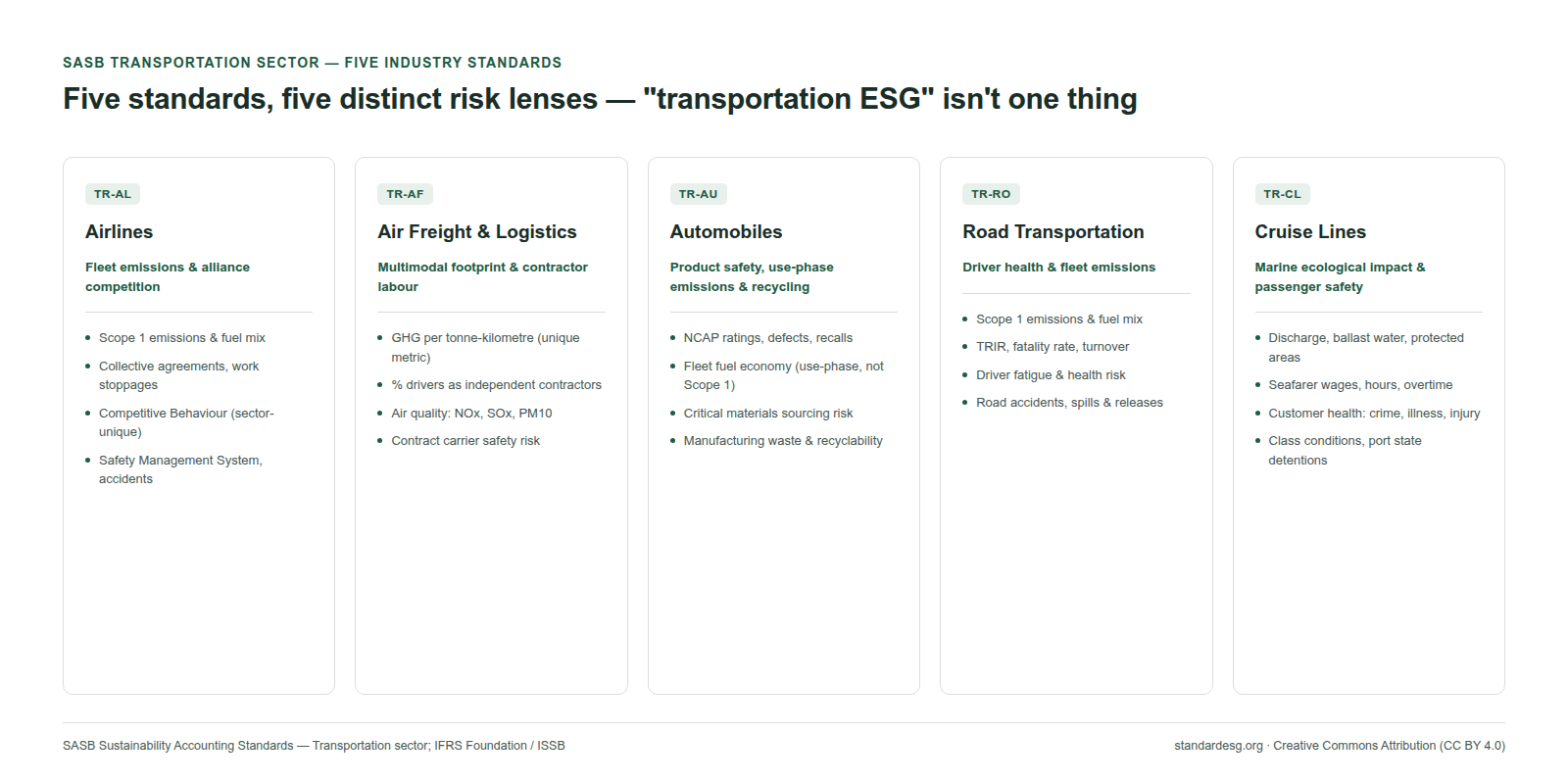
The Five Standards at a Glance
All five standards share SASB's usual five-part structure — industry description, disclosure topics, metrics, technical protocols, and activity metrics — but the topic sets diverge sharply once you look past the shared "transportation" label. Airlines and Road Transportation are built almost entirely around a fleet's own operating footprint: fuel burned, accidents, and the workforce that runs it. Air Freight & Logistics sits across two modes at once (road and air) and carries a distinct supply chain topic no other standard in the set has. Automobiles is the odd one out structurally: it's a manufacturer's standard, not an operator's, so its material topics are about the vehicles it designs and sells (safety ratings, recalls, fuel economy, recyclability) rather than about running a fleet day to day. Cruise Lines carries the most topics of any of the five — seven, against three or four for the others — because a cruise ship simultaneously exposes a workforce (seafarers), paying customers, and a marine environment to risk in ways no other Transportation standard has to account for at once.
Fuel and Emissions: Four Framings, Not One Metric
Every one of the five standards treats fuel or emissions as materially important, but the actual disclosure topic — and the unit it's measured in — differs enough that a single cross-standard emissions chart would misrepresent what's actually being compared. Airlines, Road Transportation, and Cruise Lines each carry a Greenhouse Gas Emissions topic built around the same core metric: gross global Scope 1 emissions in metric tonnes of CO₂-equivalent (TR-AL-110a.1, TR-RO-110a.1, TR-CL-110a.1), plus total fuel consumed in gigajoules and the percentage that's alternative, sustainable, or renewable (TR-AL-110a.3, TR-RO-110a.3, TR-CL-110a.3). Cruise Lines adds a fourth metric none of the others has: the average Energy Efficiency Design Index (EEDI) for new ships, a design-stage intensity figure in grammes of CO₂ per ton-nautical mile (TR-CL-110a.4) that only applies to vessels built after 2013. Air Freight & Logistics folds its own version of the Scope 1 metric into the same topic (TR-AF-110a.1), but its most distinctive emissions figure actually sits under a different topic entirely — Supply Chain Management's total GHG footprint across transport modes, expressed as metric tonnes of CO₂-equivalent per tonne-kilometre (TR-AF-430a.2), a genuine intensity metric none of the other four standards requires. Automobiles breaks the pattern completely: it has no Greenhouse Gas Emissions topic at all. Its equivalent is Fuel Economy & Use-phase Emissions (TR-AU-410a.1–3), reported in miles per gallon, litres per 100 kilometres, or grammes of CO₂ per kilometre depending on the region — a measure of what the vehicles an automaker sells will emit once a customer is driving them, not what the automaker's own Scope 1 operations emit. That's not an oversight; it reflects where an automaker's real climate exposure actually sits, the same logic Measuring Greenhouse Gas Emissions and the GHG Protocol describes for Scope 3 more generally — a car manufacturer's own factories are rarely its largest source of climate impact, the millions of vehicles it puts on the road over their lifetime are. Absolute Scope 1 tonnes, a per-tonne-kilometre intensity ratio, a design-stage index, and a use-phase fuel-economy figure are four different things, and treating any one of them as directly comparable to another would misstate what each standard is actually asking for.
Air Quality: Local Pollutants Alongside Global Emissions
Air Freight & Logistics, Road Transportation, and Cruise Lines each carry a standalone Air Quality topic requiring the same three pollutants in metric tonnes: oxides of nitrogen excluding N₂O (NOx), oxides of sulphur (SOx), and particulate matter 10 micrometres or smaller (PM10) — TR-AF-120a.1, TR-RO-120a.1, and TR-CL-120a.1 are worded almost identically. These are local, health-relevant pollutants distinct from the global-warming-focused GHG topic, which is exactly why SASB treats them as a separate disclosure line even for entities that already report Scope 1 emissions. Airlines and Automobiles don't carry a standalone Air Quality topic: Airlines folds the concern implicitly into its GHG Emissions topic's fuel-consumption metrics, and Automobiles folds it into Fuel Economy & Use-phase Emissions, whose own topic summary explicitly names nitrogen oxides, volatile organic compounds, and particulate matter as use-phase pollutants alongside CO₂ — consistent with the earlier point that Automobiles' whole emissions framing runs through the vehicle's use phase rather than the manufacturer's own operations.
Labour Practices Across Four Very Different Workforces
Four of the five standards carry a Labour Practices topic, and each is shaped by who the industry's workforce actually is. Airlines and Automobiles require near-identical metrics — the percentage of the active workforce employed under collective agreements, and the number of work stoppages plus total days idle (TR-AL-310a.1/.2, TR-AU-310a.1/.2) — reflecting two industries with large, often unionized direct workforces. Air Freight & Logistics asks a structurally different question: TR-AF-310a.1 requires the percentage of drivers classified as independent contractors, because the industry's central labour risk isn't collective bargaining but worker misclassification — whether the applicable jurisdiction's employee protections actually reach the couriers doing the driving — alongside TR-AF-310a.2's monetary losses from legal proceedings tied to labour law violations. Cruise Lines' four Labour Practices metrics are the most specific of any standard in the sector: average hourly wage for seafarers by region (TR-CL-310a.1), the percentage working maximum hours (TR-CL-310a.2), the percentage paid for overtime (TR-CL-310a.3), and monetary losses from labour law violations (TR-CL-310a.4) — a wage-and-hours framing that reflects the maritime industry's well-documented flag-of-convenience and seafarer labour-standard concerns, closer in spirit to SA8000's working-hours and remuneration elements than to the collective-bargaining framing Airlines and Automobiles use. Road Transportation is the one standard without a named Labour Practices topic; its closest equivalent — voluntary and involuntary employee turnover rate (TR-RO-320a.2) — sits instead inside a broader Workforce Conditions, Health & Safety topic, discussed next.
Health and Safety: Workforce, Passengers, and the Vehicle Itself
Every standard in the sector treats health and safety as material, but each draws the boundary of "who" differently. Air Freight & Logistics and Road Transportation both require the total recordable incident rate (TRIR) and fatality rate, split between direct and contract employees (TR-AF-320a.1, TR-RO-320a.1) — Road Transportation adds turnover rate and a discussion of driver health risks like fatigue and sleep apnoea (TR-RO-320a.2/.3), reflecting how central driver retention and wellbeing are to that industry's own risk profile. Cruise Lines requires a seafarer lost time incident rate (TR-CL-320a.1) for its workforce, but — uniquely in the sector — also carries a separate Customer Health & Safety topic covering the paying passengers aboard: the number of alleged crime incidents (TR-CL-250a.1), the percentage of fleet sanitation inspections failed (TR-CL-250a.2), and serious injuries per million passengers alongside the number of voyages with a gastrointestinal illness count exceeding two percent (TR-CL-250a.3). No other Transportation standard asks about the safety of the people being carried, because no other standard in the set has a business model built around thousands of passengers living aboard the same vessel for days at a time. Automobiles takes yet a third angle: its Product Safety topic asks about the safety of the vehicle itself before a customer ever gets behind the wheel — the percentage of vehicle models with an overall five-star crash-test rating by region (TR-AU-250a.1), the number and investigation rate of safety-related defect complaints (TR-AU-250a.2), and the number of vehicles recalled (TR-AU-250a.3).
Accident and Safety Management Systems
Airlines, Air Freight & Logistics, and Road Transportation each require a description of a formal Safety Management System (SMS) — Airlines' TR-AL-540a.1 and Air Freight's TR-AF-540a.1 both reference the International Civil Aviation Organization's five-level SMS maturity model directly, plus a count of aviation accidents (TR-AL-540a.2, TR-AF-540a.2) and governmental enforcement actions (TR-AL-540a.3). Air Freight adds road accidents and incidents as a separate count (TR-AF-540a.3), reflecting its dual-mode operations, and Road Transportation's own TR-RO-540a.1 covers the same ground for a road-only fleet, paired with TR-RO-540a.3's count of spills and releases to the environment. Cruise Lines' Accident Management topic is built around a vessel's own seaworthiness rather than a generic SMS: the number of Conditions of Class or Recommendations issued by a ship's classification society (TR-CL-540a.1), port state control deficiencies and detentions (TR-CL-540a.2), and marine casualties, split by how many were classified as very serious (TR-CL-540a.3) — maritime-specific regulatory mechanisms with no equivalent in aviation or road transport. Automobiles is the one standard in the sector without an Accident & Safety Management topic of its own; its Product Safety topic covers the equivalent ground from the manufacturer's side — defects and recalls rather than fleet operating accidents.
What's Distinct to Each Standard
Beyond the overlapping themes above, each standard also carries at least one topic found nowhere else in the sector, and these are usually the clearest signal of what makes that particular business model's risk profile genuinely different:
- Airlines — Competitive Behaviour: the total amount of monetary losses from legal proceedings associated with anti-competitive behaviour regulations (TR-AL-520a.1) — the only standalone antitrust topic anywhere in the Transportation sector, reflecting how consolidated the airline-alliance and slot-allocation landscape has become.
- Air Freight & Logistics — Supply Chain Management: beyond the per-tonne-kilometre GHG footprint already covered above, TR-AF-430a.3 requires a discussion of policies and strategies to manage business disruption risks associated with contract carrier safety — a distinctly logistics-specific concern about the safety practices of carriers the entity doesn't directly employ but depends on.
- Automobiles — Materials Sourcing and Materials Efficiency & Recycling: a description of the management of risks associated with critical materials (TR-AU-440a.1), the total amount and percentage recycled of manufacturing waste (TR-AU-440b.1), the weight and percentage recycled of end-of-life material recovered (TR-AU-440b.2), and the average recyclability of vehicles sold (TR-AU-440b.3) — the only physical-manufacturing, materials-lifecycle topics anywhere in the sector, because Automobiles alone is a manufacturer's standard rather than an operator's.
- Cruise Lines — Discharge Management & Ecological Impacts: the total amount of ship waste discharged to the environment and the percentage treated prior to discharge (TR-CL-160a.1), the percentage of the fleet implementing ballast water exchange and treatment (TR-CL-160a.2), cruise duration spent in marine protected areas or areas of protected conservation status (TR-CL-160a.3), and the number of notices of violations received for dumping (TR-CL-160a.4) — a topic with no equivalent anywhere else in the Transportation sector, because no other standard in the set operates vessels that discharge waste directly into ocean ecosystems.
Mapping to Standard ESG Subjects
The shared themes above map cleanly onto four Standard ESG subjects, though not always the way a first-pass reading of the sector might suggest. E3 — Emissions & climate is deepened directly by the Greenhouse Gas Emissions and Air Quality topics running through the sections above — Scope 1 tonnes, fuel-source percentages, and local pollutants give a template author concrete, checkable indicator language for a transport or logistics SEIC group. Automobiles is the one standard whose flagship emissions metric sits awkwardly against E3 as written: since Standard ESG's E3 requires Scope 1–2 disclosure and only encourages Scope 3, Fuel Economy & Use-phase Emissions — a measure of what customers will emit driving the vehicles sold, closer to a voluntary Scope 3 category-11 disclosure — deepens E3's encouraged Scope 3 layer rather than its required core. S1 — Labour practices & decent work is deepened by the Labour Practices topics discussed above, and S2 — Occupational health & safety by the workforce-facing metrics in the health-and-safety and accident-management sections (TRIR, fatality rate, SMS implementation, seafarer LTIR). E2 — Resource use is deepened more narrowly, and only by Automobiles: its Materials Sourcing and Materials Efficiency & Recycling topics are the sector's only disclosure content built around materials use rather than fuel or emissions. Three topics fall outside this original four-subject scope entirely, and are worth naming rather than forcing: Airlines' Competitive Behaviour topic is a G2 — Ethics, anti-corruption & fair operating practices concern, not an E- or S-pillar one; Automobiles' Product Safety topic (NCAP ratings, defect complaints, recalls) sits inside S5 — Consumer/end-user responsibility, the same industry-dependent subject Consumer and Product Responsibility introduces generically; and Cruise Lines' Discharge Management & Ecological Impacts topic is squarely E4 — Waste, circularity & pollution prevention and E5 — Biodiversity & land use territory (ballast water, marine protected areas), not E2 or E3. A template author working from these five standards should expect richer subject coverage than "fuel and labour" alone.
Which SEIC Transport and Logistics Groups This Deepens Coverage For
These five standards carry the most weight for exactly the SEIC groups their SICS codes name directly: passenger airlines, air and road freight carriers, vehicle manufacturers, road haulage and trucking operators, and cruise operators. A company that spans more than one — an airline with a significant cargo division, or a logistics group running both road and air legs — should, per SASB's own guidance, consider the disclosure topics of every relevant standard rather than only its primary SICS industry, the same cross-standard applicability principle What Is SASB? Industry-Specific Materiality and the Standards Behind Standard ESG's Templates describes generally. Outside transport and logistics, a company with its own large owned or leased vehicle fleet — a retailer running last-mile delivery, for instance — may still find the Road Transportation standard's Labour Practices and Workforce Health & Safety topics a useful reference point even if it isn't primarily a SEIC transport group, since driver-workforce risk doesn't disappear just because moving goods isn't the company's core business.
Getting Started
A transport or logistics company building out its E3 and S2 evidence base can work through these five standards roughly in order of how directly they touch daily operations:
- Identify which of the five standards matches your primary business model, and pull its full disclosure-topic table as a first-pass gap check — a company spanning more than one mode should check every standard that applies.
- Establish a consistent Scope 1 GHG emissions calculation methodology aligned with the GHG Protocol before treating fuel-source percentages or intensity metrics in isolation — every emissions-related topic in the sector assumes this foundation already exists.
- If you operate a fleet directly or through contract carriers, document how you classify and track your workforce (direct employees versus independent contractors versus contract carriers) — this distinction drives which Labour Practices and Workforce Health & Safety metrics actually apply to you.
- Inventory your existing safety management documentation — an SMS, a classification society's Conditions of Class, or an equivalent — since the accident and safety topics assume a formal system is already in place to describe, not built from scratch for the disclosure itself.
- If you manufacture rather than operate — building vehicles, not running a fleet — shift focus to Automobiles' product-safety, use-phase-emissions, and materials-recycling topics instead of the operator-focused topics that dominate the rest of the sector.
See What to Expect from an On-Site ESG Assessment (Level 3) for how fleet safety records and emissions data like this get checked physically on site.
Standard ESG (standardesg.org) draws on SASB's five Transportation-sector standards to deepen subjects E3 and S2 for airlines, freight and logistics operators, vehicle manufacturers, road transport operators, and cruise lines, alongside E2, G2, and S5 for the sector's materials, competitive-behaviour, and product-safety exposure. See The Standard ESG Certification Protocol: A Public Overview for how industry-dependent subjects fit into the full pillar and subject architecture.
Was this page useful?