One Standard, a Full Value Chain
SASB — now maintained by the International Sustainability Standards Board (ISSB) as part of the IFRS Foundation — treats waste management as one industry rather than splitting it by activity. The Waste Management standard applies to entities that collect, transfer, recycle, compost, incinerate, or landfill municipal, commercial, industrial, and residential waste, regardless of which of those activities a given entity actually performs — a pure-play recycler and a company that owns landfills and a collection fleet both report against the same topic set, disclosing only what applies to their own operations. That breadth is deliberate: the standard's own activity metrics ask entities to report their customer mix (municipal, commercial, industrial, residential), fleet size, and facility count (landfills, transfer stations, recycling centres, composting centres, incinerators) precisely so a reader can size a company's exposure to each topic against what it actually operates, rather than assuming every disclosed metric applies uniformly across the industry.
The Standard at a Glance
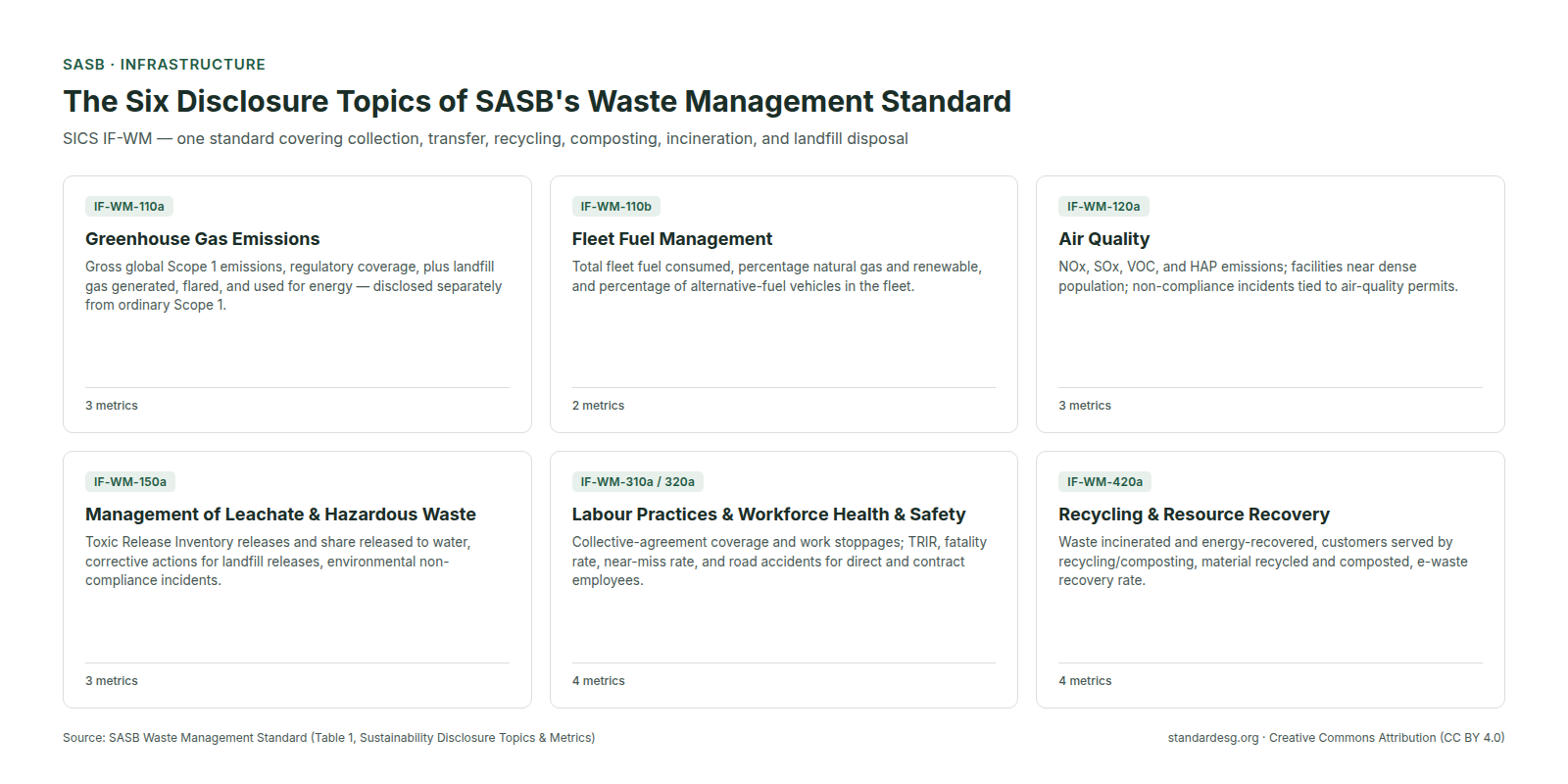
The standard organizes its material risks into six named disclosure topics, each with its own metrics (SASB's own terms: disclosure topics describe a specific sustainability-related risk or opportunity; metrics quantify or describe an entity's performance against a topic): Greenhouse Gas Emissions, Fleet Fuel Management, Air Quality, Management of Leachate & Hazardous Waste, Labour Practices, Workforce Health & Safety, and Recycling & Resource Recovery — seven names, but Workforce Health & Safety is counted separately from Labour Practices in the standard's own table despite sharing a numbering block, giving six substantive risk areas across those seven topic headings. Two things stand out reading the set as a whole: landfill methane gets its own dedicated metrics distinct from ordinary Scope 1 accounting, and the standard's closest approach to a community-facing topic is folded into Air Quality rather than named on its own — a structural choice worth flagging before working through the topics in detail, since it shapes what a template built from this standard can and can't claim to cover.
Greenhouse Gas Emissions and Fleet Fuel Management
Greenhouse Gas Emissions requires the now-familiar SASB core: gross global Scope 1 emissions, the percentage covered under emissions-limiting regulation, and the percentage covered under emissions-reporting regulation (IF-WM-110a.1), plus a discussion of the entity's strategy for managing Scope 1 emissions and its performance against reduction targets (IF-WM-110a.3). See Measuring GHG Emissions: Scope 1, 2 and 3 for how Scope 1 boundaries and consolidation work in general. What's specific to this industry is a second metric sitting inside the same topic: total landfill gas generated, the percentage flared, and the percentage used for energy (IF-WM-110a.2) — landfill methane is disclosed separately from, and in addition to, the entity's ordinary Scope 1 figure, reflecting that landfill gas capture and combustion technology is itself a material capital-expenditure and risk-management decision for the industry, not just an input to a single aggregate emissions number.
Fleet Fuel Management is a distinct topic covering the vehicle fleets that collection and transfer operations depend on: total fleet fuel consumed, the percentage that is natural gas, and the percentage that is renewable fuel (IF-WM-110b.1), plus the percentage of alternative-fuel vehicles in the fleet (IF-WM-110b.2). Both metrics are scoped to vehicles the entity owns or operates — a company that outsources collection to contracted haulers reports a correspondingly smaller fleet footprint, which is exactly what the activity metric on fleet size (IF-WM-000.B) lets a reader check against.
Air Quality and Facility Siting
Air Quality requires emissions of four pollutant categories — NOx (excluding N2O), SOx, volatile organic compounds, and hazardous air pollutants — each in metric tonnes (IF-WM-120a.1), reflecting that landfills, incinerators, and waste-treatment plants are recognized sources of both regulated pollutants and nuisance odour. Alongside that quantitative emissions metric sits one with no equivalent anywhere in this library's oil-and-gas companion guides: the number of facilities in or near areas of dense population, defined as urbanised areas with more than 50,000 residents or within 5 kilometres of one (IF-WM-120a.2). That's a facility-siting and exposed-population metric, not an emissions-volume one — it discloses how many of an entity's landfills and waste-to-energy facilities sit close enough to a populated area that its air emissions are likely to reach residents directly, which is precisely the kind of environmental-justice-adjacent exposure that recurs across this industry's history of landfill siting disputes. The topic closes with a straightforward compliance count: the number of non-compliance incidents tied to air-quality permits, standards, and regulations (IF-WM-120a.3), disclosed regardless of whether the incident triggered a formal enforcement action.
Management of Leachate and Hazardous Waste
Landfills generate leachate — liquid that has percolated through waste and can carry contaminants into soil and groundwater if not contained — and this topic is built entirely around the risk of that containment failing. It requires total Toxic Release Inventory (TRI) releases and the percentage of those releases to water (IF-WM-150a.1); the number of corrective actions implemented for landfill releases, covering both active and closed landfills (IF-WM-150a.2); and the number of non-compliance incidents tied to environmental impacts excluding air pollution — covering water contamination, hazardous waste transport, and leachate handling specifically (IF-WM-150a.3). Unlike the air-quality non-compliance metric above, this one is scoped to incidents that resulted in a formal enforcement action, a narrower bar than "any incident regardless of outcome." Read together, the three metrics trace a single risk arc: what leaked or was released, what the entity did about it, and how often regulators formally intervened — a structure a template author can use directly as a three-part evidence checklist for a landfill operator.
Labour Practices and Workforce Health and Safety
These are two separate topics in the standard's own table, and they measure different things. Labour Practices requires the percentage of the active workforce employed under collective agreements (IF-WM-310a.1), plus the number of work stoppages involving 1,000 or more workers and the total days idle as a result (IF-WM-310a.2) — a labour-relations topic, not a safety one, reflecting how significant organised labour is across the industry's collection and transfer workforce. Workforce Health & Safety is the topic the industry's own risk profile makes unavoidable: SASB's standard notes directly that waste management carries higher fatality rates than most industries, driven primarily by transportation incidents, contact with hazardous equipment, and exposure to harmful substances. It requires total recordable incident rate (TRIR), fatality rate, and near-miss frequency rate, each split between direct and contract employees (IF-WM-320a.1), plus a road-accidents-and-incidents count specific to this industry's vehicle-heavy operations (IF-WM-320a.3) — notably, the standard's own numbering skips directly from .a.1 to .a.3 within this topic, with no .a.2 management-systems discussion metric defined, unlike the paired quantitative-plus-discussion structure most other SASB safety topics use. See Occupational Health & Safety Management: An ISO 45001 Primer for the general OH&S management-system framework this topic's metrics sit on top of, and Labour Practices and Decent Work: An SA8000 Primer for the broader labour-rights framework Labour Practices' collective-bargaining metric draws from.
Recycling and Resource Recovery
The standard's one topic framed around opportunity rather than risk mitigation. Recycling & Resource Recovery requires the amount of waste incinerated, the percentage that was hazardous, and the percentage used for energy recovery (IF-WM-420a.1); the percentage of customers receiving recycling and composting services, broken out by customer type (IF-WM-420a.2); the amount of material recycled, composted, and processed as waste-to-energy (IF-WM-420a.3); and, distinctly, the amount of electronic waste collected and the percentage recovered through recycling (IF-WM-420a.4) — e-waste gets its own metric separate from general recycling volume, reflecting the distinct hazardous-materials handling e-waste requires relative to ordinary municipal recyclables. Taken together, these four metrics let a reader assess how much of an entity's business model is landfill diversion versus landfill disposal — the industry's central circular-economy question, and the one place in this standard where growing the disclosed number (more recycled, more composted, more customers served) is straightforwardly the better outcome rather than a risk being minimised.
What the Standard Doesn't Cover: The Community Gap
Worth naming plainly rather than assuming: this standard has no topic named Community Relations, Community Involvement, or anything comparable — a real gap given how central landfill and incinerator siting disputes are to this industry's actual public-facing risk, and how often those disputes track directly onto environmental-justice concerns about who lives near a facility. The closest the standard comes is Air Quality's facilities-near-dense-population metric (IF-WM-120a.2) — a facility-count disclosure, not a metric about community consultation, engagement processes, or local opposition to new permits, the kind of content this library's oil-and-gas standard guides carry under their own named community and human-rights topics. A company or template built from this standard alone should treat that silence as a known limitation to fill with judgment and other evidence, not as a signal that community exposure isn't material to a waste operator's actual risk profile.
Mapping to Standard ESG Subjects
The Greenhouse Gas Emissions and Fleet Fuel Management topics map to E3 — Emissions & climate. Air Quality's pollutant-emissions metric and the Management of Leachate & Hazardous Waste topic map to E4 — Waste, circularity & pollution prevention, alongside the Recycling & Resource Recovery topic's circularity metrics — the same subject carrying both the industry's pollution-control and its resource-recovery content, since both are fundamentally about what happens to material after it's discarded. Labour Practices maps to S1 — Labour practices & decent work, a subject the original scope for this task didn't anticipate but that the standard's own table makes unambiguous — collective-bargaining coverage and work-stoppage disclosure are core S1 territory, not a stretch mapping. Workforce Health & Safety maps cleanly to S2 — Occupational health & safety. Air Quality's facility-siting metric and the community gap identified above are the one place this mapping should stay honest about its limits: that single metric is too thin on its own to justify a full S4 — Community involvement & development rating, and a template author should treat S4 evidence for this SEIC group as needing to be built from sources beyond this standard rather than assuming IF-WM-120a.2 alone covers it.
Which SEIC Sectors This Deepens Coverage For
This standard carries the most weight for exactly the SEIC group its SICS code names: waste collection, transfer, recycling, composting, incineration, and landfill-disposal operators (IF-WM). A company that also operates water or electricity infrastructure alongside waste operations should additionally consult a utilities-specific standard for that side of the business — SASB's pure-play design means an integrated infrastructure operator applies each relevant standard to its corresponding segment rather than picking one to cover everything.
Getting Started
A waste management company building out its E3, E4, S1, and S2 evidence base can work through this standard's topics roughly as follows:
- Separate landfill methane accounting from ordinary Scope 1 emissions and fleet fuel management — these are three distinct metrics under two topics, not one combined figure.
- Inventory facility locations against population density and count non-compliance incidents for both air quality and broader environmental impacts separately — the standard draws a real line between the two.
- Build separate evidence trails for labour relations (collective-agreement coverage, work stoppages) and workforce safety (TRIR, fatality rate, road incidents) — these are two distinct topics measuring different things, not one undifferentiated "people" category.
- Quantify landfill diversion — recycling, composting, waste-to-energy, and e-waste recovery rates — as the core evidence for circularity performance.
- Don't rely on this standard alone for community-relations evidence; treat the facility-siting metric as a starting point, not a complete picture.
See What to Expect from an On-Site ESG Assessment (Level 3) for how facility-level safety and environmental evidence like this gets verified physically on site.
Standard ESG (standardesg.org) draws on SASB's Waste Management standard to deepen subjects E3 and E4 for waste collection, treatment, and disposal companies, alongside S1 and S2 for the sector's labour and workforce-safety exposure. See The Standard ESG Certification Protocol: A Public Overview for how industry-dependent subjects fit into the full pillar and subject architecture.
Was this page useful?