What Bonsucro Is
Bonsucro — "the global sugarcane platform" — is a global multi-stakeholder, not-for-profit initiative dedicated to reducing the environmental and social impacts of sugarcane production while recognizing the need for economic viability. Its mission is a sugarcane sector that is continuously improving and verified as sustainable, built around the same three-pillar logic — economic, social, and environmental — that underlies most credible sustainability standards. What distinguishes Bonsucro from a generic sustainability framework is precisely its narrowness: every criterion and indicator in the standard is written specifically for sugarcane cultivation and processing, at both mill and farm level, giving it a level of operational detail neither ISO 26000 nor a generic ESG questionnaire could offer for this one crop.
How the Standard Is Structured
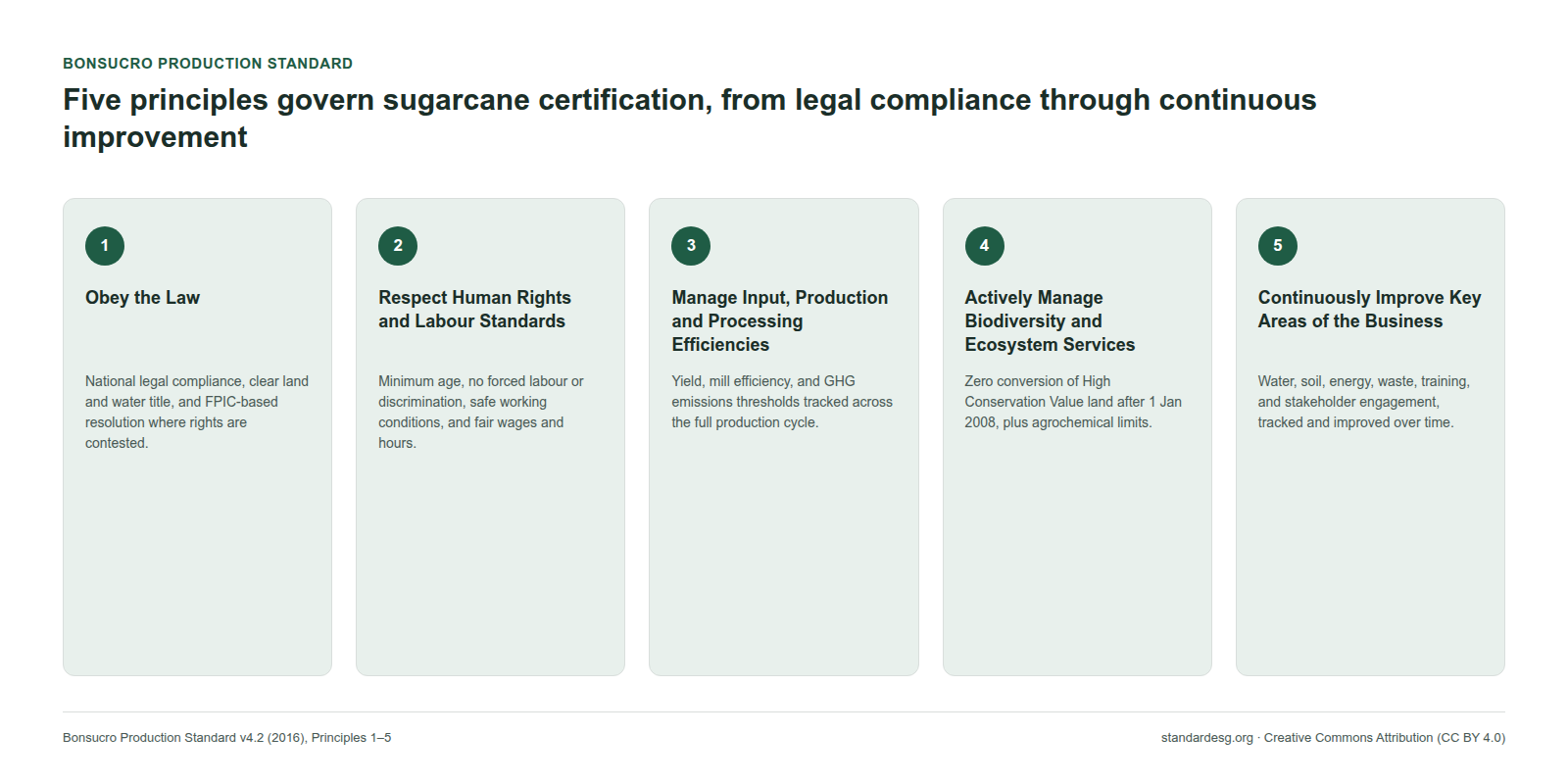
The Bonsucro Production Standard is organized into five core principles, each broken down into criteria and — beneath those — specific, individually measurable indicators. This is what most sharply distinguishes Bonsucro's structure from a narrative standard like ISO 26000: nearly every indicator carries a numeric threshold a mill or farm must meet, not just a described practice. An indicator might specify a maximum GHG emissions figure in kilograms of CO2-equivalent per tonne of cane, a minimum percentage of workers trained in health and safety, or a hard zero-tolerance limit on banned agrochemicals — verified per indicator as either a yes/no compliance check or a measured value against a defined standard. Some indicators are flagged as core indicators — a designation that generally signals the indicator addresses one of the standard's most fundamental sustainability hotspots, from child labour and forced labour through high-conservation-value land protection.
Two Certification Tiers: Bonsucro and Bonsucro EU
Bonsucro's certification system distinguishes between two tiers. "Bonsucro" certification means compliance with the core Bonsucro requirements described in this guide. "Bonsucro EU" certification means compliance with those same requirements plus additional criteria needed to satisfy the EU Renewable Energy Directive (RED) — relevant specifically to sugarcane-derived ethanol sold into the EU biofuels market, where land-use-change compliance and GHG accounting have to meet the Directive's own specific rules. Achieving Bonsucro EU certification automatically satisfies core Bonsucro certification; the reverse isn't true. This two-tier structure is itself a useful illustration of a pattern common across commodity standards: a general sustainability baseline, with a narrower regulatory-compliance layer bolted on top for operators selling into a specific regulated market.
Principle 1: Obey the Law
Bonsucro's first principle is the most foundational and least negotiable: compliance with applicable national laws, spanning waste, pollution and environmental protection, nature conservation and high-conservation-value area protection, water quality and extraction, energy and GHG emissions, labour conditions, occupational health and safety, social wellbeing, land and water title and use rights, soil protection, agricultural and processing practices, and transportation — with the stricter regulation prevailing wherever national and Bonsucro requirements overlap. A second criterion under this principle requires operators to demonstrate clear title to land and water in accordance with national practice and law, recognizing both formal legal ownership and customary rights (with reference to ILO Conventions 169 and 117 for guidance on the latter) — and where land rights have been relinquished for the operator's benefit, that decision must have been taken through Free, Prior, and Informed Consent and negotiated resolution, not imposed. Land or water that is legitimately contested by other users — meaning a conflict formally registered and accepted by a recognized justice system — must sit at zero hectares or cubic meters under certification.
Principle 2: Respect Human Rights and Labour Standards
Principle 2 draws directly on the same ILO convention foundations found throughout SA8000 (see Labour Practices and Decent Work for the closely parallel structure), translated into sugarcane-specific numeric thresholds. Core indicators require: a minimum working age of 18 for hazardous work and 15 (or 14, depending on national provisions) for non-hazardous work, verified through an operator-implemented age-checking system; absolute absence of forced or compulsory labour and of discrimination, covering both permanent and contracted workers; and respect for workers' rights to form and join trade unions and bargain collectively. Health and safety criteria set a maximum lost-time accident frequency (fewer than 15 per million hours worked at the mill, fewer than 45 in agriculture), require documented risk assessment and mitigation, and require over 90% of staff to receive health and safety training at start of employment and at least every five years. Wage and hours criteria require pay at or above minimum wage plus legally required benefits, overtime paid at a premium rate and capped by national law or a 60-hour weekly ceiling, and a written contract or equivalent document for every worker covering hours, pay, notice, and rest periods.
Principle 3: Manage Input, Production, and Processing Efficiencies
Principle 3 addresses the resource-efficiency and climate side of sugarcane production with concrete, mill-and-farm-specific metrics: total raw materials consumed per kilogram of product, agricultural yield (tonnes of cane per hectare, benchmarked against the local climatic zone rather than a single global figure), mill processing time efficiency, and factory and industrial performance indices measuring how much recoverable sugar is actually recovered from the cane processed. Its climate-specific criterion sets maximum net GHG emissions thresholds — under 40 kg CO2-equivalent per tonne of cane at the agricultural stage, under 0.4 tonnes CO2-equivalent per tonne of sugar and under 24 grams CO2-equivalent per megajoule of ethanol fuel at the processing stage — giving Bonsucro-certified GHG figures a directly comparable, standardized denominator across different operations' product mixes.
Principle 4: Actively Manage Biodiversity and Ecosystem Services
Principle 4 is where Bonsucro most directly deepens what a generic ESG questionnaire can offer on biodiversity for a land-intensive crop. Its central core indicator sets an absolute zero-tolerance threshold: no expansion of sugarcane cultivation onto land classified nationally or internationally as High Conservation Value (HCV categories 1–6, covering areas of outstanding biological, ecological, social, or cultural significance) or onto legally protected land, after a fixed cut-off date of 1 January 2008 — a bright-line rule that closes off exactly the kind of retroactive "we didn't know it was protected" justification a vaguer standard would leave open. Beyond land conversion, operators must implement an environmental impact and management plan covering biodiversity, ecosystem services, soil, water, air, climate change, agrochemical use, artificial fertilizer use, cane burning, and noise, with over 90% of relevant areas covered and progress actively monitored. Agrochemical criteria set a maximum application rate (under 5 kg of active ingredient per hectare per year) and an absolute zero-tolerance threshold on banned agrochemicals — substances listed under the Stockholm and Rotterdam Conventions, the Montreal Protocol, and the World Health Organization's most hazardous pesticide classifications.
Principle 5: Continuously Improve Key Areas of the Business
The final principle covers the operational disciplines that sustain performance on the first four principles over time, rather than as a one-time achievement: employee training investment, water-use efficiency (net water consumed per unit of product, with separate stricter thresholds for irrigated cultivation), soil health indicators (ground cover retained after harvest, limits on mechanical tillage, and pH maintained within an acceptable range), energy efficiency, emissions and effluent reduction, and waste recycling. Two criteria under this principle connect directly back to the human-rights themes in Principle 2 and the IFC Performance Standards' approach to land-based projects (see Managing Environmental and Social Risk in High-Impact Industries): any greenfield expansion or new sugarcane project must be covered by an environmental and social impact assessment conducted with independent third-party experts and FPIC-based decision-making, and operators must maintain an accessible grievance and dispute-resolution mechanism usable by workers, contracted workers, local communities, and indigenous and tribal people alike, with negotiated agreements also grounded in Free, Prior, and Informed Consent.
Chain of Custody: Tracking Certified Cane Through the Supply Chain
Production-level certification alone doesn't guarantee that sugar, ethanol, or other sugarcane-derived products reaching an end buyer actually came from a certified source — that assurance requires a separate chain-of-custody mechanism tracking certified material as it moves from mill through the rest of the supply chain to the point of sale. Bonsucro maintains its own Chain of Custody Standard as a companion document to the Production Standard covered in this guide, specifically to close that gap for Bonsucro-certified products. This is the same structural concern Standard ESG's own protocol addresses through subject G4: certification of the producer alone doesn't verify what happens to the certified product afterward, which is exactly why supply-chain traceability sits alongside production-standard compliance as a distinct requirement, not a redundant one.
Mapping to Standard ESG Subjects E5, S1, S4, and G4
Bonsucro deepens four Standard ESG subjects at once for sugarcane operations specifically. E5 — Biodiversity & land use (industry-dependent) is deepened directly by Principle 4's HCV protection and environmental impact management plan requirements. S1 — Labour practices & decent work (SA8000 core elements) is deepened by Principle 2's sugarcane-specific wage, hours, and safety thresholds, supplying concrete numeric benchmarks where SA8000 alone describes the underlying principle. S4 — Community involvement & development is deepened by Principle 5's grievance-mechanism and FPIC-based greenfield-expansion requirements. G4 — Sustainable procurement & supply-chain management (ISO 20400 core) is deepened by the chain-of-custody mechanism described in Section 9, which gives a buyer of Bonsucro-certified sugarcane products a concrete, auditable answer to exactly the kind of supplier-assessment question G4 already asks about more generally (see Sustainable Procurement and Supply-Chain Due Diligence). As with the IFC Performance Standards and EITI, Bonsucro doesn't change these subjects' underlying architecture — it supplies field-tested, numerically specific content an industry template author can cite directly when building out indicators, document requirements, and checklist items for sugarcane-sector companies.
Which SEIC Groups This Deepens Coverage For
Bonsucro's relevance is narrow and specific by design: it matters most for companies in Food & Beverage's Agricultural Products group directly growing or milling sugarcane, and for companies in Renewable Resources & Alternative Energy's Biofuels group where sugarcane-derived ethanol is the feedstock — exactly the market the Bonsucro EU tier's RED-compliance requirements were built for (Section 3). It carries secondary relevance further down the value chain — Non-Alcoholic Beverages and Processed Foods companies sourcing sugar as an input ingredient can use a supplier's Bonsucro chain-of-custody certification as concrete Level 2 evidence of responsible sourcing under subject G4, without needing to independently verify sugarcane-specific cultivation practices themselves. Outside sugarcane-linked supply chains entirely, Bonsucro has no applicability — this is deliberately commodity-specific grounding, not a general agriculture standard.
Getting Started
- Confirm legal compliance and clean land/water title first (Principle 1) — this is the foundation every other principle's evidence depends on.
- Audit current labour practices against Principle 2's specific numeric thresholds (minimum wage ratios, maximum working hours, accident frequency) rather than assuming general SA8000 familiarity translates directly — Bonsucro's thresholds are more specific than SA8000's own principle-level language.
- Establish baseline measurement for Principle 3's efficiency and GHG metrics before attempting to demonstrate improvement — you can't show continuous improvement (Principle 5) without a documented starting point.
- Map any operations against HCV land classifications and the 1 January 2008 cut-off date (Principle 4) early, since this is a zero-tolerance, non-negotiable threshold that can block certification outright if triggered.
- If selling into the EU biofuels market, confirm early whether Bonsucro EU's additional RED-compliance requirements apply, since they add real scope on top of core certification (Section 3).
Standard ESG (standardesg.org) draws on the Bonsucro Production Standard to deepen subjects E5, S1, S4, and G4 for sugarcane-linked companies, alongside the IFC Performance Standards for other high-impact and land-based industries. See The Standard ESG Certification Protocol: A Public Overview for how commodity-specific grounding fits into the full pillar and subject architecture.
Cette page vous a-t-elle été utile ?