What This Subject Covers, and Why It's Different
Consumer and product responsibility asks a simple question: does the organization treat the people who use its products and services fairly, safely, and honestly? ISO 26000 — the source standard behind this subject, as it is for most of Standard ESG's Social and Governance criteria — draws a specific distinction here: obligations to customers (typically other businesses, purchasing for commercial purposes) are covered under fair operating practices, while obligations to consumers (people purchasing for private, personal use) get their own dedicated core subject. The term "consumer" in this sense doesn't require a purchase at all — it covers anyone who makes use of an organization's products, services, or decisions, which is why even a free digital service with no purchase price still carries consumer-responsibility obligations. Unlike S1's labour standards or S2's safety inspections, this subject's relevance varies sharply by industry — a business-to-business manufacturer with no direct consumer relationship has far less exposure here than a retailer or a consumer app, which is exactly why Standard ESG treats S5 as industry-dependent (Section 9).
The Consumer Rights Foundation
ISO 26000's treatment of consumer issues is built on the UN Guidelines for Consumer Protection, first adopted by the UN General Assembly in 1985 and expanded in 1999 to include sustainable-consumption provisions — described in ISO 26000 as "the most important international document in the realm of consumer protection." The Guidelines articulate what are commonly referred to as consumer rights: the right to safety (protection from hazardous products), to being informed (adequate information to make informed choices, and protection against misleading advertising), to making choices (a genuine range of products and services at competitive prices), to being heard (the ability to have consumer views represented in decisions that affect them), to redress (fair settlement of legitimate claims), to education (understanding both rights and the impacts of consumption choices), and to a healthy environment. ISO 26000 adds several further principles on top of these — respect for privacy, a precautionary approach to potential harm, and universal design so that products and services are usable by people of varying abilities without needing specialized adaptation. Every one of the seven ISO 26000 consumer issues that follow in this guide traces back to one or more of these foundational rights.
Product Safety and Quality Management
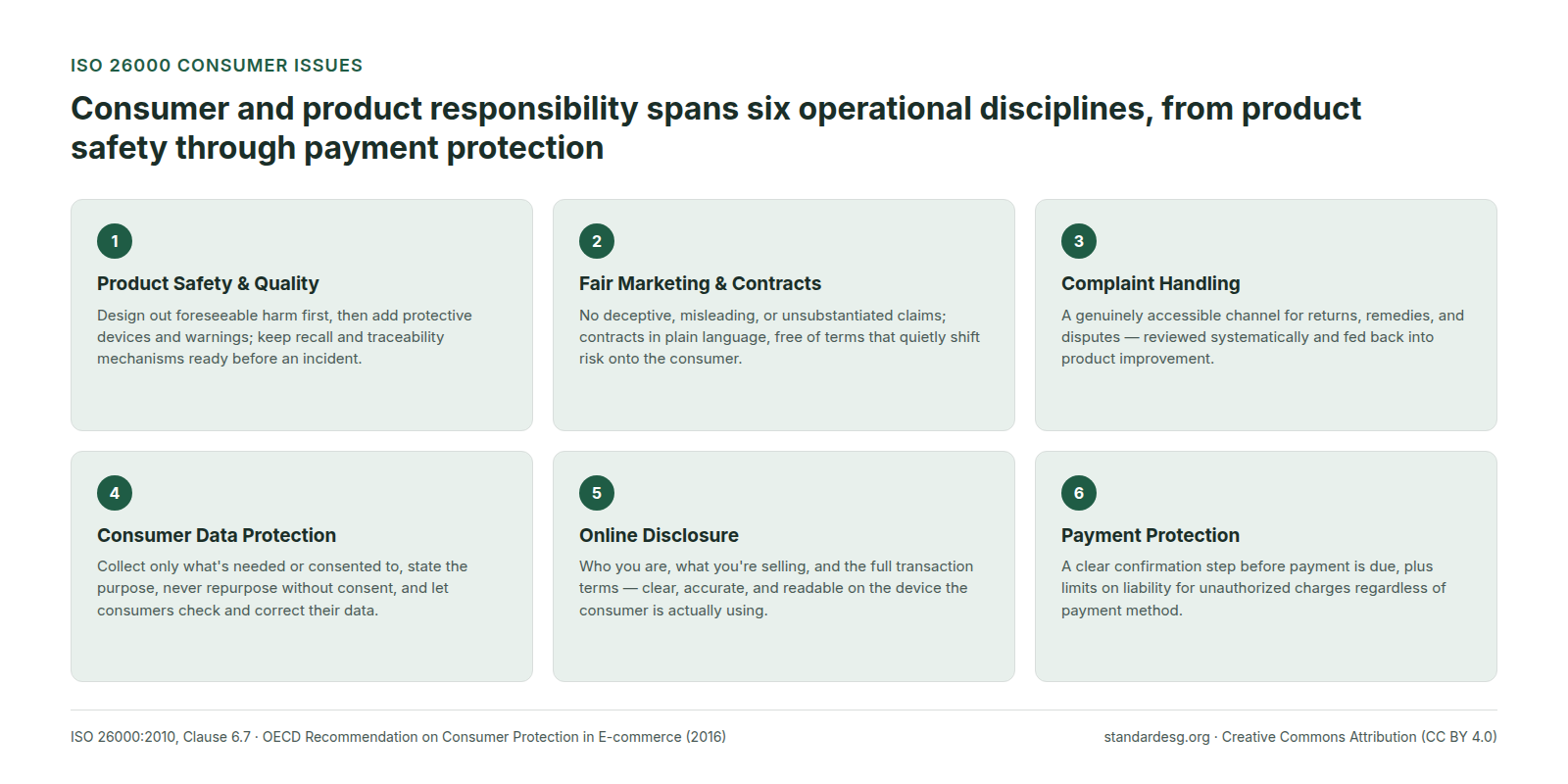
Protecting consumer health and safety means providing products and services that carry no unacceptable risk of harm — covering both intended use and reasonably foreseeable misuse, not just textbook-correct handling. ISO 26000 frames this as a design discipline, not just a compliance checkbox: organizations should identify likely user groups and foreseeable misuse scenarios, estimate the resulting risk (with particular attention to vulnerable users, including children and pregnant women), and reduce that risk following a clear order of priority — first through inherently safer design, then through protective devices, and only then through user-facing warnings and instructions. Safety obligations don't end at the point of sale: because not every risk can be foreseen in advance, an organization needs mechanisms in place for product withdrawal and recall, and needs to be able to trace affected products through its value chain to actually reach the people who bought them. Products containing carcinogenic, mutagenic, or persistently bio-accumulative chemicals should be clearly labelled if they're offered for sale at all — safety information belongs on the product, not buried in a document few consumers will ever read.
Fair Marketing, Advertising, and Contractual Practices
Fair marketing exists to make sure the information consumers rely on to make a purchasing decision is actually true, and that the contract they enter into doesn't quietly work against their own interests. ISO 26000 is direct about what this rules out: organizations should not engage in any practice that is deceptive, misleading, fraudulent, unfair, or that omits critical information, and should be able to substantiate any claim or assertion on request rather than assuming it will never be challenged. Advertising and marketing should be clearly identifiable as such — not disguised as independent content — and should give particular care to vulnerable groups, including children, who may not have the capacity to fully evaluate what they're being shown. Contracts should be written in clear, understandable language and should avoid the kind of unfair terms that quietly shift risk onto the consumer: the unilateral right to change prices or conditions after the fact, unreasonably long lock-in periods, or predatory credit terms dressed up as ordinary financing. The underlying test throughout is substance over form: a technically true claim that creates a false overall impression is treated the same as an outright false one.
Complaint-Handling and Dispute Resolution
Even well-designed products and honest marketing don't eliminate every consumer problem, so ISO 26000 treats consumer service, support, and complaint handling as its own dedicated issue. Organizations should make it genuinely easy for consumers to raise a problem — offering the option to return a faulty product or obtain another remedy within a specified period, providing clear information on how to access support and dispute-resolution channels, and offering warranties suited to the expected life of the product rather than the legal minimum. Complaints aren't just a service cost to minimize: reviewing them systematically and feeding what's learned back into product and process improvements is what turns a complaint channel into an actual quality signal rather than a dead end. Where a complaint can't be resolved directly, ISO 26000 points to a family of guidance standards purpose-built for this — ISO 10001 on codes of conduct, ISO 10002 on complaints handling, and ISO 10003 on dispute resolution external to the organization — as a systematic approach any organization can draw on regardless of size. Alternative dispute resolution should be free or low-cost to the consumer, and should never require a consumer to waive their right to pursue legal recourse as the price of using it.
Consumer Data Protection in Digital Commerce
Consumer data protection sits at the intersection of ISO 26000's general consumer-privacy principle and a much more detailed, digital-commerce-specific body of guidance: the OECD's Recommendation of the Council on Consumer Protection in E-commerce (revised 2016), which updates the OECD's original 1999 e-commerce guidelines for a market now built on mobile devices, non-monetary data-for-service transactions, and platforms that blur the line between consumer and seller. ISO 26000's own baseline is straightforward: organizations should limit the personal data they collect to what's essential or explicitly consented to, obtain data only by lawful and fair means, state clearly what it's being collected for, never repurpose it for something else (marketing included) without informed consent, protect it with adequate security safeguards, and give consumers a real ability to check what data is held about them and correct it. The OECD Recommendation sharpens this for e-commerce specifically: businesses should manage digital security risk with measures proportionate to the actual risk involved, and should recognize that the "free" transactions increasingly common online — where a consumer pays with their data rather than money — fall within scope of consumer protection exactly the same as a monetary purchase does, including a consumer's right to redress if something goes wrong.
Online Disclosure: What a Consumer Needs to See Before They Buy
The OECD Recommendation is unusually specific about what "informed choice" means in practice for an online transaction, which makes it a useful operational checklist for any organization selling online. Disclosures should be clear, accurate, and accessible in plain language, available at a relevant point in the purchase flow, and account for the technical limitations of the device being used — a disclosure that only works on a desktop screen doesn't meet the bar on a phone. At minimum, a business should make readily available: who it actually is (legal name, trading name, contact details, location), what it's selling (functionality, technical or contractual limitations, safety information, any age restrictions), and the full terms of the transaction itself — total price including all mandatory charges, delivery terms, cancellation and return conditions, and where dispute resolution can be sought. Where a business offers multiple languages for the transaction itself, the same disclosures need to be available in each of them — a business shouldn't be able to conduct a sale in a language it declines to disclose terms in.
Payment Protection and the Confirmation Process
Two further OECD provisions round out digital-commerce-specific consumer protection. The confirmation process should give a consumer a clear, unambiguous point at which they're actually committing to a transaction — with an opportunity to review the summary, catch and correct errors, and confirm with express, informed consent before payment is due; a transaction a consumer didn't clearly agree to isn't a transaction they should be bound by. Payment protection recognizes that different payment mechanisms carry different levels of built-in consumer protection, and calls for minimum protections regardless of which mechanism is used — including limits on a consumer's liability for unauthorized or fraudulent charges, and access to chargeback mechanisms where appropriate. Both provisions exist for the same underlying reason as the disclosure requirements in Section 7: an informed, freely given "yes" is only meaningful if the consumer actually understood what they were agreeing to and can recover if something goes wrong afterward.
Which SEIC Sectors This Matters Most For
Consumer and product responsibility is deliberately industry-dependent in Standard ESG's methodology (Section 10), and its weight varies sharply by SEIC sector. It bears most heavily on Consumer Goods — E-Commerce, Multiline and Specialty Retailers & Distributors, Household & Personal Products, Apparel, Accessories & Footwear, and Appliance Manufacturing, where product safety, accurate labelling, and complaint handling sit at the center of the business rather than at its periphery. It's equally central to Technology & Communications — Internet Media & Services, Software & IT Services, Hardware, and Telecommunication Services — where consumer data protection and digital-commerce disclosure (Sections 6–8) are often the dominant consumer-facing risk, sometimes outweighing product-safety concerns entirely for a purely digital service. And it carries real weight across Financials — Consumer Finance, Commercial Banks, Insurance, and Mortgage Finance in particular — where fair marketing, transparent contract terms, and functioning dispute resolution (Sections 4–5) map closely onto long-standing financial-consumer-protection concerns like predatory lending and unclear credit terms. By contrast, an organization with no direct consumer relationship — a business-to-business industrial supplier, say — will find most S5 indicators tagged non-applicable, with fair operating practices toward its business customers instead carried under the Governance pillar's G2 subject.
Mapping to Standard ESG Subject S5
Standard ESG's Social pillar carries consumer and product responsibility as S5 — Consumer/end-user responsibility, explicitly marked industry-dependent alongside E5 (biodiversity & land use) — the two subjects in the protocol whose relevance is judged by sector rather than applying uniformly to every certified company. Typical S5 indicators cover: whether the organization has a documented product-safety and quality-management process, including recall procedures; whether its marketing and advertising claims are substantiated and free of the deceptive practices described in Section 4; whether it operates a complaint-handling and dispute-resolution process consumers can actually use, ideally following a recognized framework like the ISO 10001–10003 family (Section 5); and, for any organization handling consumer data, whether it has documented data-protection practices consistent with Section 6. Indicators not applicable to a given company's industry or business model — a pure business-to-business manufacturer with no direct consumer channel, for instance — are excluded from scoring entirely, not scored as a zero, consistent with how the protocol treats every industry-dependent subject.
Getting Started
- If you sell a physical product, confirm you have a documented process for identifying foreseeable misuse and hazards, and a recall procedure ready before you need it — not improvised after an incident.
- Review your marketing materials and standard contract terms for anything that would fail the "substantiate on request" test in Section 4, and fix what doesn't hold up.
- Set up (or formalize) a complaint channel with a clear internal process for reviewing and acting on what comes in, not just logging it.
- If you collect any consumer data, write down — even briefly — what you collect, why, how it's protected, and how a consumer can ask what you hold about them.
- If you sell online, walk your own checkout flow against Sections 7–8's disclosure and confirmation checklist; gaps here are usually easy and cheap to close once they're actually identified.
See Getting Started with ESG: A Practical Guide for SMEs for how consumer-responsibility basics fit into a broader first-90-days plan, and Corporate Governance, Ethics and Anti-Corruption for the parallel fair operating practices obligations toward business customers rather than consumers.
Standard ESG (standardesg.org) carries consumer and product responsibility as Social pillar subject S5, weighted by industry alongside E5. See The Standard ESG Certification Protocol: A Public Overview for how industry-dependent subjects are handled across the full pillar and subject architecture.
Cette page vous a-t-elle été utile ?