Overview
ESG feels like a recent term, but its roots run back a century. Understanding how we got from corporate philanthropy to mandatory climate disclosure explains not just where the field is today, but why independent certification — verifying claims rather than just requiring more of them — was the predictable next step. This is that history.
Before the Acronym: Philanthropy and Early CSR
Corporate responsibility didn't begin with a three-letter acronym. Businesses have practised philanthropy for centuries — funding hospitals, schools, and civic institutions — largely as a separate activity from core operations, driven by owners' personal values rather than any systematic framework. The twentieth century formalized this somewhat into corporate social responsibility (CSR): companies' voluntary commitments to contribute to society, typically expressed through charitable giving, volunteering programmes, and community initiatives run alongside, rather than integrated into, the core business. CSR asked "what good can we contribute?" — a question with no inherent connection to how the company actually conducted its operations.
2004: "Who Cares Wins" and the Birth of ESG
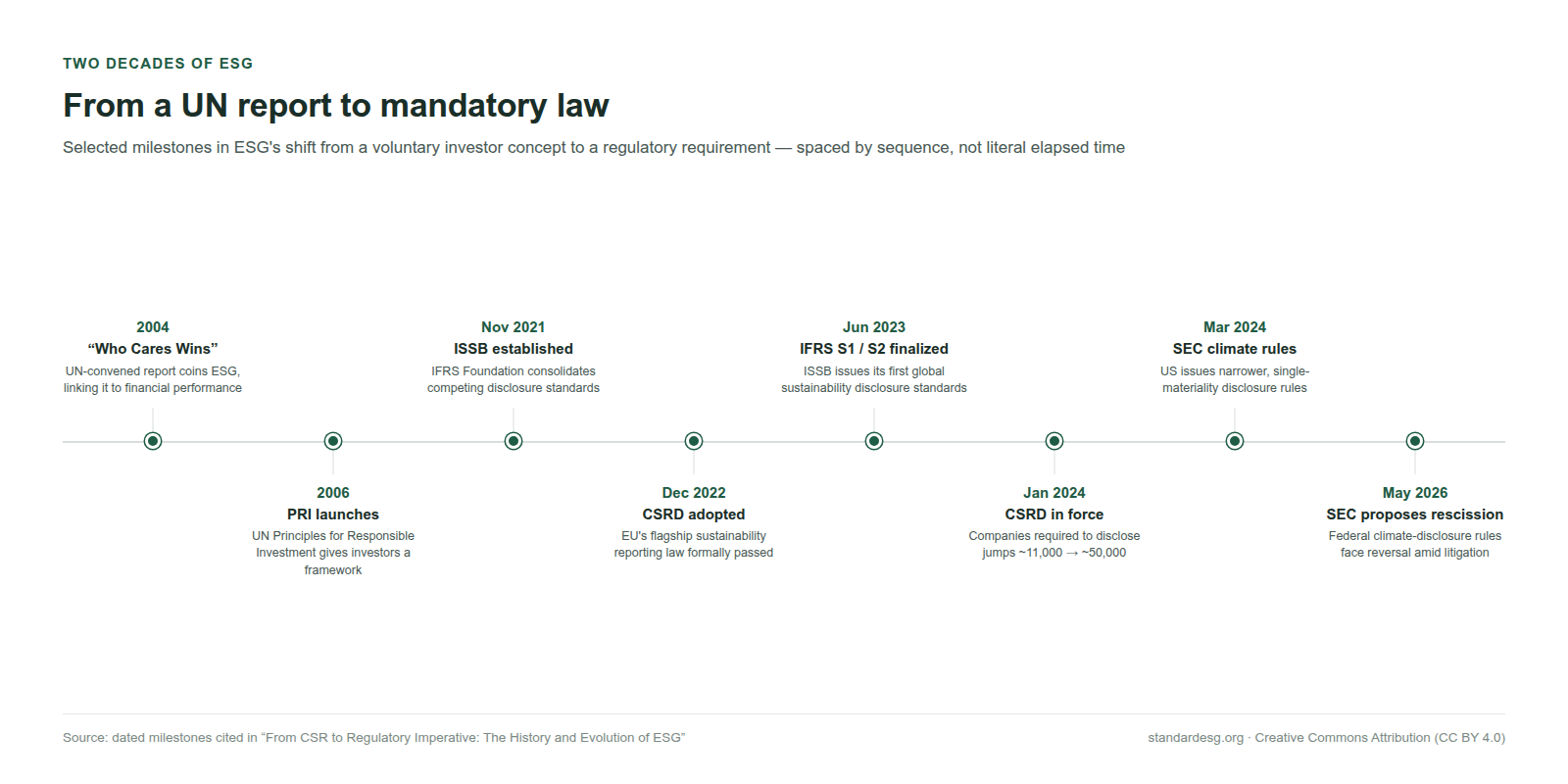
The modern term arrived at a specific moment: a 2004 UN-convened initiative under Secretary-General Kofi Annan published Who Cares Wins, and this report's contribution was a genuine reframing, not just a new acronym. For the first time, environmental, social, and governance criteria were explicitly linked to corporate financial performance evaluation — the report argued that managing these issues well was integral to overall management quality and to shareholder value creation, not a charitable add-on running alongside the "real" business. This is the conceptual break between CSR and ESG: CSR was a values statement; ESG was, from its coinage, framed as a performance and risk-management lens.
Two years later, the launch of the UN Principles for Responsible Investment (PRI) in 2006 gave institutional investors a structured framework for actually acting on this idea — turning the concept from an argument in a report into an operational commitment that asset owners and managers could sign and be measured against. By the time the Standard ESG Protocol was written, the PRI had more than 5,300 signatories representing over EUR 120 trillion of assets under management — a scale that reflects just how far the idea travelled from its 2004 starting point.
The Standards Track Matures: GRI, ISO, PRI
Alongside the investor-facing track, a separate but complementary standards track developed the vocabulary and structure ESG still uses today. The Global Reporting Initiative built what became the world's most widely used sustainability-reporting standards — see Sustainability Reporting with GRI for how its universal and topic-specific standards are organized. ISO published guidance standards that remain foundational: ISO 26000:2010 on social responsibility introduced the seven core subjects — organizational governance, human rights, labour practices, the environment, fair operating practices, consumer issues, and community involvement and development — that still shape how ESG topics get organized across the field, including in Standard ESG's own pillar structure. ISO 20400:2017 carried these same principles into procurement and supply chains (see the ISO 20400 primer). Management-system standards like ISO 14001 (environmental) and ISO 45001 (occupational health and safety), and the SA8000 social-accountability standard, gave organizations concrete, auditable frameworks for the underlying practices these principles described in the abstract.
The 2010s: Adoption Without Enforcement
Through the 2010s, ESG adoption grew steadily — more investors signed the PRI, more companies published sustainability reports, ESG rating agencies proliferated — but almost entirely on a voluntary basis. Disclosure was encouraged, not required; companies chose what to report, how, and against which of the (already numerous) competing frameworks. This period built genuine momentum and market infrastructure, but it also built the specific vulnerability that would define the next era: a market full of ESG claims with no common baseline for what those claims actually meant or how reliable they were.
2020-2024: From Voluntary to Mandatory
The period after 2020 marks the field's decisive inflection point: a shift from voluntary adoption driven by investor sentiment to a landscape increasingly defined by mandatory regulation — though not uniformly, and with distinct regional philosophies emerging in parallel (Section 8).
The scale of the shift is best illustrated by the EU's flagship regulation, the Corporate Sustainability Reporting Directive (CSRD), formally adopted in December 2022 and entering into force on 1 January 2024. It expanded the number of companies required to disclose sustainability information from roughly 11,000 to around 50,000 — a nearly fivefold increase in scope within a single legislative act, covering a vast share of the European and global economy, including subsidiaries of non-EU companies operating within the bloc.
The Global Convergence Effort: ISSB
A parallel development addressed a different problem: even where disclosure was required, competing frameworks made disclosures incomparable across companies and jurisdictions. The International Sustainability Standards Board (ISSB), established by the IFRS Foundation in November 2021, consolidated market-led initiatives from bodies like the Climate Disclosure Standards Board and the Sustainability Accounting Standards Board. In June 2023 it finalized its inaugural standards — IFRS S1 (general sustainability-related disclosure requirements) and IFRS S2 (climate-related disclosures) — effective for annual reporting periods beginning January 2024, built on the widely adopted Task Force on Climate-related Financial Disclosures (TCFD) recommendations. By late 2025, more than 30 jurisdictions — representing a majority of the world economy — had adopted or signalled adoption of ISSB standards, including Australia, Canada, Japan, Brazil, Malaysia, Nigeria, Pakistan, and Türkiye.
Regional Divergence: The EU and the US Diverge Sharply
Global convergence at the ISSB level coexists with sharp regional divergence in regulatory philosophy. The EU's CSRD codifies double materiality — requiring companies to report both how sustainability issues affect their own financial prospects and how their activities affect society and the environment, a holistic, "inside-out and outside-in" view. The United States, by contrast, has historically adhered to single materiality — disclosure only where information is financially relevant to an investor's decision, rooted in Supreme Court precedent and aligned with the SASB tradition. The SEC issued climate-disclosure rules in March 2024 under this narrower test, but the rules were quickly mired in litigation; the SEC announced it would end its defense of them in March 2025 and proposed their complete rescission in May 2026, leaving significant uncertainty at the federal level. Into that vacuum, state-level action stepped forward — most notably California's SB 253 and SB 261, mandating that large companies report full Scope 3 emissions and detailed climate-related financial risks, setting a stringent benchmark that may shape future national policy regardless of federal inaction. See The Global ESG Disclosure Regulation Guide for the detailed jurisdiction-by-jurisdiction comparison.
Emerging Markets Chart Their Own Course
Adoption outside the EU and US has been heterogeneous rather than uniform. China moved from voluntary exchange-level guidance to mandatory sustainability reporting rules across all three of its major exchanges in 2024. India's Business Responsibility and Sustainability Report framework mandates its top 1,000 listed companies to report against nine ESG principles, with its Core metrics deliberately designed to map to both ISSB and GRI frameworks. Chile has mandated ISSB-standard adoption for 2027, and Mexico's securities commission for 2026; Tanzania and Zambia have implemented local rules based on ISSB standards. The pattern is not linear, however — Brazil initially signalled mandatory ISSB-aligned reporting from 2026 but later reversed to a voluntary, "comply or explain" approach, illustrating how politically contingent even well-advanced regulatory plans can remain.
The Missing Piece: Who Checks the Claims?
Every development traced above — from "Who Cares Wins" through CSRD and ISSB — answers the question "what should companies disclose?" None of it, by itself, answers a different and equally important question: is what's being disclosed actually true? This gap became impossible to ignore as ESG's stakes grew. A 2021 MIT Sloan study found correlations between different ESG rating providers' scores as low as 0.38 — far below the roughly 0.92 correlation seen in traditional credit ratings — attributable mainly to differing measurement methodologies rather than differing data sources. A European Commission review found 42% of examined corporate sustainability claims misleading or unverifiable. More than 600 competing ESG reporting frameworks have been counted globally, creating both a compliance burden for companies and a comparability problem for everyone reading the results. See Greenwashing and the Trust Problem for the full scale of this credibility gap.
Certification as the Next Step in the Trust Chain
Disclosure regulation solves "companies must say more." It does not, on its own, solve "what they say can be trusted." That's the gap independent, evidence-based certification exists to close — and it's a genuinely different mechanism from either disclosure law or ratings, not a redundant layer on top of them. Where CSRD and ISSB compel disclosure, and ratings aggregate opinions about those disclosures, a certification protocol verifies specific claims against evidence, at a stated and checkable depth.
The Standard ESG Certification Protocol is a direct answer to exactly this gap in the history above. It's built on the same standards lineage this history has traced — ISO 20400 as its structural backbone, ISO 26000's seven core subjects organizing its criteria, GRI shaping its disclosure and evidence expectations, SA8000 and ISO 45001 grounding its labour and safety verification — but it adds the piece the regulatory history never provided: three levels of increasing verification depth (self-assessment, document review, on-site audit), a public 1–10 score, and a publicly checkable certificate. Where the last two decades built the language and the legal requirement to speak it, certification exists to confirm that what's being said is actually so.
Standard ESG (standardesg.org) sits at the point this history arrives at: a protocol built on the standards this article traces, adding the verification layer that disclosure regulation alone doesn't provide. See What is ESG? A Complete Introduction for the conceptual foundation, and The Standard ESG Certification Protocol: A Public Overview for how the protocol itself works.
Cette page vous a-t-elle été utile ?
Socially Responsible Investing: Values as a Screen
Parallel to CSR, a distinct investment tradition emerged: socially responsible investing (SRI), which applied ethical exclusion screens to portfolios — avoiding tobacco, weapons, or companies operating in politically objectionable regimes. SRI was values-driven rather than performance-driven; it asked "does this company violate our principles?" rather than "how well does this company manage its risks and impacts?" — a narrower, binary logic that ESG would later replace with something more granular and performance-oriented.