What the IFC Performance Standards Are
The International Finance Corporation (IFC) — the World Bank Group's private-sector lending arm — requires every company it directly finances to meet eight Performance Standards on Environmental and Social Sustainability throughout the life of the investment. Together with IFC's Policy on Environmental and Social Sustainability and its Access to Information Policy, the Performance Standards make up IFC's "Sustainability Framework." Their influence extends far beyond IFC's own lending book: because dozens of commercial banks adopted the closely related Equator Principles, built directly on the Performance Standards, as their own project-finance risk framework, the eight standards have become the de facto global benchmark for environmental and social risk management in large infrastructure, extractives, energy, and agriculture projects — the exact category of high-impact industry Standard ESG's generic 15-subject seed content is least equipped to differentiate on its own.
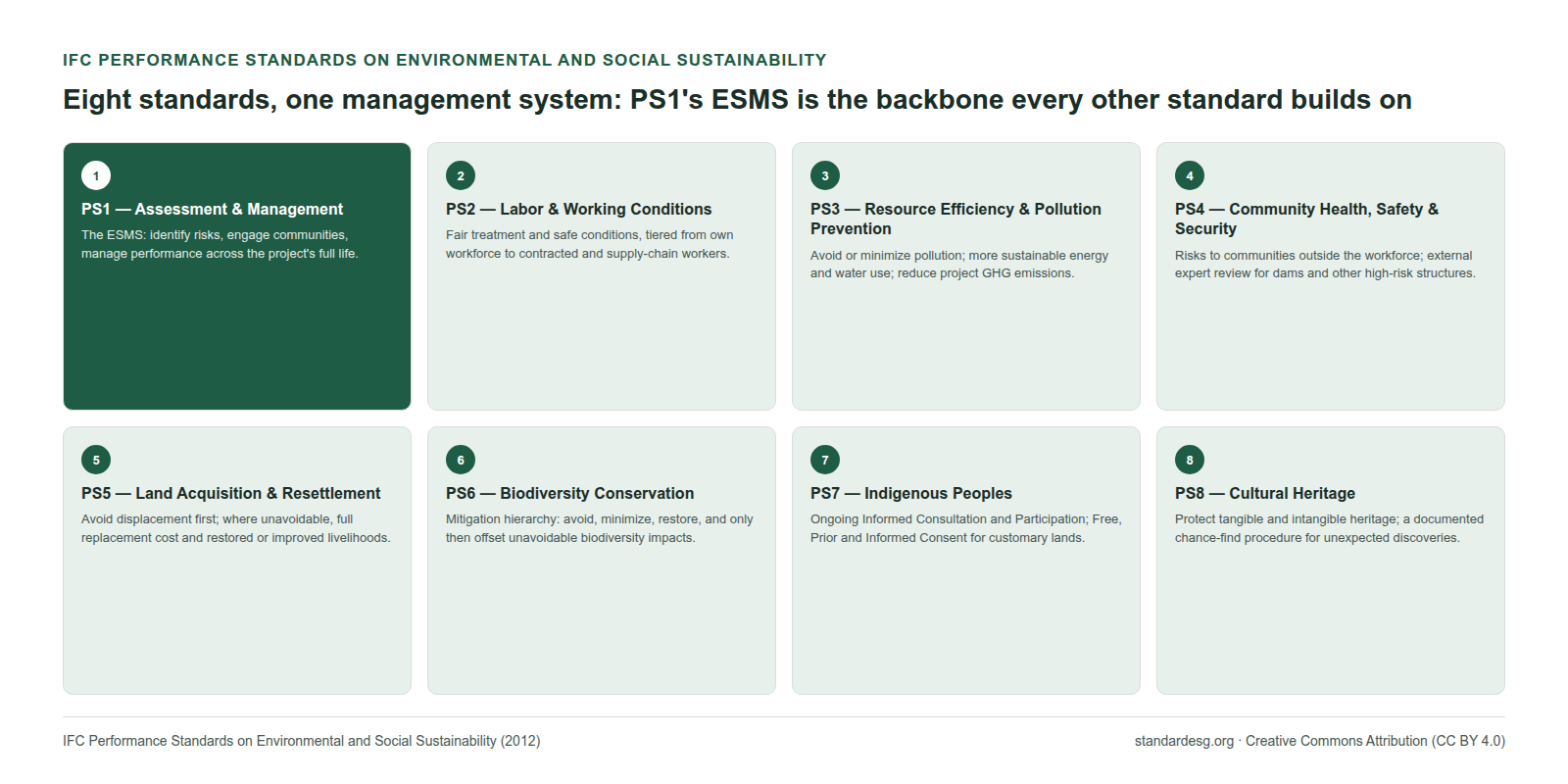
PS2: Labor and Working Conditions
PS2 requires fair treatment, non-discrimination, and equal opportunity for workers; a sound worker-management relationship; compliance with national labour law; protection of vulnerable worker categories including children and migrant workers; safe and healthy working conditions; and avoidance of forced labour — drawing directly on ILO conventions covering freedom of association, forced labour, minimum age, and discrimination. What distinguishes PS2 from a typical labour-standards checklist is its scope: it applies not only to workers directly engaged by the client, but, with a narrower set of specific requirements, to contracted workers and — for primary suppliers whose goods or materials are essential to core business processes — supply chain workers as well. This graduated, tiered-by-relationship structure is close kin to the graduated own-operations/direct-supplier/indirect-supplier structure found in supply-chain due-diligence law (see Human Rights Due Diligence: The UN Guiding Principles Explained for the closely parallel LkSG structure).
PS3: Resource Efficiency and Pollution Prevention
PS3 addresses the resource-consumption and pollution side of high-impact operations: avoiding or minimizing adverse impacts on human health and the environment from project-related pollution, promoting more sustainable use of energy and water, and reducing project-related GHG emissions. Its central operating concept is pollution prevention — not zero emissions, but avoidance where possible and, where avoidance isn't achievable, minimization to the point where the standard's objectives are still satisfied — implemented through technically and financially feasible measures tailored to the project's ambient conditions and good international industry practice. Like PS4–PS8, its baseline reference is the World Bank Group's Environmental, Health, and Safety Guidelines, with the client required to meet whichever of the EHS Guidelines or applicable host-country regulation is more stringent.
PS4: Community Health, Safety, and Security
PS4 covers risks to communities outside a project's own workforce — the people living near a mine, a pipeline, or a power plant rather than the people working there. Objectives include anticipating and avoiding adverse impacts on the health and safety of affected communities across the project's life, and ensuring that the safeguarding of personnel and property is carried out consistent with human rights principles. Structural elements posing elevated risk — dams, tailings dams, ash ponds — specifically require external expert review, separate from the project's own design and construction team, precisely because their failure can threaten community safety at a scale routine inspection processes aren't built to catch. PS4 explicitly notes that risk is elevated in conflict and post-conflict areas, where a project can exacerbate an already fragile local situation and strain scarce resources — a consideration that carries forward directly into PS7's treatment of Indigenous Peoples in similarly vulnerable contexts.
PS5: Land Acquisition and Involuntary Resettlement
PS5 governs one of the most consequential risks in high-impact project development: land acquisition and the involuntary displacement — physical or economic — that can follow it. Involuntary resettlement is treated as something to be avoided first, and only carefully managed as a last resort: the standard's objectives explicitly prioritize exploring alternative project designs to avoid displacement altogether, avoiding forced eviction, and, where displacement is genuinely unavoidable, providing compensation at full replacement cost (not depreciated or market value, but what it would actually cost affected people to replace what they lost) and restoring or improving — not merely maintaining — displaced persons' livelihoods and living standards. This last point is a meaningfully higher bar than simple compensation: PS5 asks whether people are better or at least no worse off after resettlement, not just whether they were paid.
PS6: Biodiversity Conservation and Sustainable Management of Living Natural Resources
PS6 addresses biodiversity and ecosystem services — drawing its definitions directly from the Convention on Biological Diversity — with objectives to protect and conserve biodiversity, maintain the benefits ecosystems provide, and promote sustainable management of living natural resources through practices that integrate conservation needs with development priorities. Its central analytical tool is a mitigation hierarchy: avoidance of biodiversity impacts is the priority, with minimization, restoration, and — only where impacts genuinely can't be avoided or fully mitigated — offsetting considered in that order, applied adaptively as monitoring reveals how actual project impacts compare to what was predicted. PS6 applies with particular force to projects that produce living natural resources directly — agriculture, animal husbandry, fisheries, forestry — where the project's core business activity is the resource being managed, not just an incidental site impact.
PS7: Indigenous Peoples
PS7 recognizes Indigenous Peoples as social groups with a distinct identity from mainstream national society, often among the most marginalized and vulnerable populations a project can affect — with limited capacity, in many cases, to defend their own rights to the lands and natural resources their identity and livelihoods depend on. Its objectives go further than avoiding harm: ensuring the development process fosters full respect for Indigenous Peoples' human rights, dignity, aspirations, culture, and natural-resource-based livelihoods; anticipating and avoiding adverse impacts or, where unavoidable, minimizing and compensating for them; and promoting culturally appropriate development benefits. Two specific consultation standards run throughout PS7: an ongoing relationship based on Informed Consultation and Participation (ICP) with affected Indigenous communities across the project's life, and, in the specific circumstances the standard defines — most consequentially, projects on lands traditionally owned by or under customary use of Indigenous Peoples — the higher bar of Free, Prior, and Informed Consent (FPIC), meaning consent obtained without coercion, ahead of key decisions, and based on genuine disclosure of relevant information.
PS8: Cultural Heritage
PS8 protects tangible cultural heritage (archaeological, historical, artistic, and religious sites, structures, and objects), unique natural features embodying cultural value (sacred groves, sites, waterfalls), and specific intangible cultural forms proposed for commercial use, with objectives to protect cultural heritage from adverse project impacts and support its preservation, and to promote equitable sharing of benefits from its use. A practical, frequently applicable requirement here is the chance find procedure: a documented process a client must have ready in advance for situations where cultural heritage is unexpectedly discovered during construction or operation — work must stop on the discovery until a qualified professional assessment is complete, rather than proceeding on the assumption that an unplanned find is someone else's problem to manage later.
Mapping to Standard ESG Subjects E5, S3, and S4
The Performance Standards don't map onto a single Standard ESG subject — they deepen three at once, each for the same underlying reason: these are exactly the subjects Standard ESG's protocol already flags as industry-dependent or context-sensitive rather than uniform across every certified company. E5 — Biodiversity & land use (industry-dependent) is directly deepened by PS6's mitigation-hierarchy approach and PS5's land-acquisition framework. S3 — Human rights & due diligence is deepened by PS7's Indigenous Peoples framework and PS2's tiered labour requirements, extending Standard ESG's own UNGPs-derived due-diligence expectations (see Human Rights Due Diligence: The UN Guiding Principles Explained) into the specific, higher-stakes context of land-based and resource-extraction projects. S4 — Community involvement & development is deepened by PS4's community health and safety framework and PS8's cultural-heritage protections, giving the generic S4 questionnaire concrete, checkable content for exactly the kind of project where community impact is most severe. For an extractives, infrastructure, or agriculture SEIC group, the Performance Standards are a directly citable source for indicator language, document requirements, and on-site checklist items in these three subjects specifically — not a generic gesture toward "environmental and social risk," but eight standards' worth of field-tested specifics.
Which SEIC Sectors This Deepens Coverage For
The Performance Standards carry the most weight for SEIC groups where land use, natural resource extraction, or large physical footprints are inherent to the business, not incidental to it. In Extractives & Minerals Processing — Metals & Mining, Coal Operations, Oil & Gas Exploration & Production, Oil & Gas Midstream — PS5's resettlement framework, PS6's biodiversity mitigation hierarchy, and PS4's structural-safety requirements (tailings dams, ash ponds) are frequently the dominant E&S risks a company faces. In Infrastructure — Engineering & Construction Services, Electric Utilities & Power Generators, Water Utilities & Services, Real Estate — PS4's community health and safety framework and PS5's land-acquisition requirements apply directly to siting, construction, and major-asset operation. In Renewable Resources & Alternative Energy — Forestry Management, Solar Technology & Project Developers, Wind Technology & Project Developers — and Food & Beverage's Agricultural Products group, PS6's living-natural-resources provisions and PS5's land-related requirements apply with particular force, since production of the resource itself is the core activity PS6 was written to address. A company outside these sectors — a software or financial-services business, say — will find little in the Performance Standards beyond PS1's and PS2's general applicability; this is specialized, high-impact-industry content, not a universal layer every certified company needs.
Getting Started
- Establish (or formalize) an ESMS along PS1's plan-do-check-act structure before treating any individual risk category in isolation — every other standard assumes this management system already exists.
- Map your workforce, including contracted and supply-chain workers, against PS2's tiered scope, and confirm your labour practices meet the underlying ILO conventions — see Labour Practices and Decent Work for the closely related SA8000 detail.
- If your project involves any land acquisition or use restriction, work through PS5's avoid-first hierarchy before assuming resettlement is unavoidable, and document how compensation was calculated against full replacement cost.
- If your operations touch natural or critical habitat, or involve production of living natural resources directly, apply PS6's mitigation hierarchy — avoidance, minimization, restoration, offset, in that order — and document why each stage couldn't fully address the impact before moving to the next.
- Identify early whether any affected communities qualify as Indigenous Peoples under PS7's criteria, since FPIC requirements (Section 9) can materially affect project timelines if identified late rather than during initial risk assessment.
See What to Expect from an On-Site ESG Assessment (Level 3) for how community, land, and supply-chain due diligence get checked physically on site.
Standard ESG (standardesg.org) draws on the IFC Performance Standards to deepen subjects E5, S3, and S4 for high-impact industries, alongside SA8000, ISO 45001, and ISO 20400 for the rest of the Social and Governance pillars. See The Standard ESG Certification Protocol: A Public Overview for how industry-dependent subjects fit into the full pillar and subject architecture.
Cette page vous a-t-elle été utile ?