Overview
Two standards now sit at the center of the global sustainability-disclosure landscape: IFRS S1 and IFRS S2, issued by the International Sustainability Standards Board (ISSB) in June 2023. The Global ESG Disclosure Regulation Guide covers them briefly as one piece of a wider comparative landscape; this guide goes further into how the two standards are actually built — the shared four-pillar core content architecture, IFRS S1's general disclosure rules, IFRS S2's climate-specific requirements, and how a company preparing either one should actually read them.
Why Two Standards, One Architecture
IFRS S1, General Requirements for Disclosure of Sustainability-related Financial Information, and IFRS S2, Climate-related Disclosures, were issued together and are meant to be read together — IFRS S2's own text explicitly states it should be read "in the context of its objective, the Basis for Conclusions and IFRS S1." S1 is the cross-cutting rulebook: it defines what "sustainability-related risks and opportunities" means, how materiality works, and the general disclosure structure every future ISSB standard will use. S2 is the first (and so far most developed) topic-specific standard built on top of that rulebook, covering climate because climate-related financial risk was judged the most urgent and best-understood sustainability topic to standardise first. Understanding S1 first is what makes S2 legible — nearly every requirement in S2 is a climate-specific instance of a general rule S1 already establishes.
The Objective: Decision-Useful Information for Investors
Both standards state their objective in nearly identical language: to require an entity to disclose information about its sustainability-related (S1) or climate-related (S2) risks and opportunities that is useful to primary users of general purpose financial reports — defined as existing and potential investors, lenders, and other creditors — in making decisions about providing resources to the entity. This framing matters because it draws a clear boundary: both standards are investor-decision-focused disclosure regimes, not general-purpose sustainability-performance reporting frameworks aimed at the full range of a company's stakeholders. Only risks and opportunities that could reasonably be expected to affect an entity's cash flows, access to finance, or cost of capital over the short, medium, or long term are in scope — the standards explicitly exclude sustainability topics that don't plausibly connect back to the entity's own financial prospects.
Materiality: A Single-Materiality, Financially-Focused Test
IFRS S1 defines information as material if omitting, misstating, or obscuring it "could reasonably be expected to influence decisions that primary users of general purpose financial reports make." This is a single-materiality test — it asks only how sustainability issues affect the entity financially, not how the entity's activities affect the environment or society (the "impact" side of the double-materiality test used by the EU's CSRD/ESRS regime). This is the single most consequential design choice distinguishing ISSB from the EU's regime, and it's worth being precise about: it's not that ISSB ignores environmental or social impact information entirely, but that such information only enters ISSB disclosure if it's also expected to be financially material to the reporting entity itself. See The Global ESG Disclosure Regulation Guide §6 for how this single distinction cascades into most of the practical differences between the ISSB and CSRD regimes.
The Four-Pillar Core Content Structure
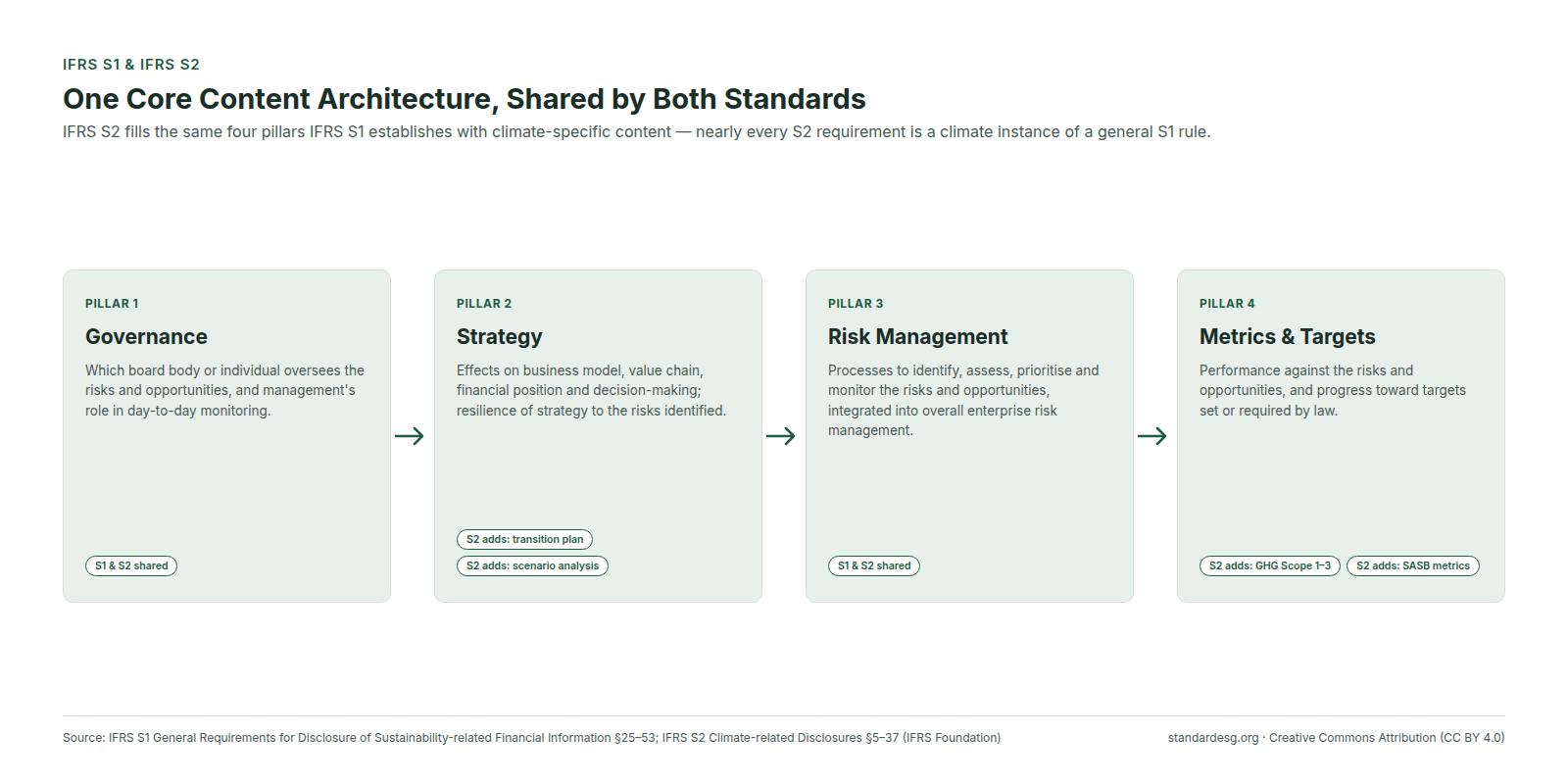
Both IFRS S1 and IFRS S2 organise their required disclosures around the same four core content pillars — a structure inherited directly from the Task Force on Climate-related Financial Disclosures (TCFD) framework that IFRS S2 explicitly builds on:
- Governance: the governance processes, controls, and procedures the entity uses to monitor and manage sustainability-related (or climate-related) risks and opportunities, including which board-level body or individual has oversight and what role management plays in day-to-day monitoring.
- Strategy: the entity's approach to managing the risks and opportunities: how they affect the business model and value chain, how they factor into strategy and decision-making, their current and anticipated financial effects, and the resilience of the entity's strategy to them.
- Risk management: the processes the entity uses to identify, assess, prioritise, and monitor the risks and opportunities, and how those processes integrate into the entity's overall enterprise risk management.
- Metrics and targets: the entity's actual performance against the risks and opportunities, including any targets set (or required by law or regulation) and progress toward them.
Every other requirement in both standards is essentially a more specific instance of one of these four pillars. This shared architecture is also why a company already reporting under one recognised framework — TCFD in particular, but also CDP or an integrated report following the ⟨IR⟩ Framework's governance/strategy structure (see Corporate Governance, Ethics and Anti-Corruption) — usually finds much of its existing disclosure maps cleanly onto ISSB's four pillars rather than requiring an entirely new reporting exercise.
IFRS S1: The General Disclosure Rules
Beyond the four-pillar structure, IFRS S1 sets several cross-cutting rules that apply to every sustainability-related disclosure a company makes, regardless of topic:
- Fair presentation and connected information: a complete set of disclosures must present fairly all sustainability-related risks and opportunities that could reasonably affect the entity's prospects, and must show the connections between disclosures — how governance, strategy, risk management, and metrics relate to each other, and how sustainability disclosures connect to the entity's financial statements.
- Same reporting entity, same reporting period: sustainability-related disclosures must cover the same reporting entity and period as the related financial statements — there's no separate sustainability-reporting boundary distinct from the financial one.
- Sources of guidance: where no IFRS Sustainability Disclosure Standard specifically covers a topic, an entity must refer to and consider the applicability of SASB Standards' disclosure topics, and may additionally consider CDSB Framework guidance, other standard-setters' recent pronouncements, and industry peer disclosure.
- Location and timing: disclosures are typically located in an entity's management commentary (or equivalent) alongside its general purpose financial reports, reported at the same time and covering the same period as those financial statements — not released on a separate, later timeline the way many voluntary sustainability reports historically have been.
- An unreserved statement of compliance: an entity may only claim IFRS Sustainability Disclosure Standards compliance if it meets all applicable requirements — there's no partial-compliance claim available, though the standard does provide narrow relief where law prohibits disclosure or information is genuinely commercially sensitive.
IFRS S2: What's Different About Climate
IFRS S2 follows the identical four-pillar structure but fills each pillar with climate-specific content. Its strategy pillar requires an entity to classify each identified climate risk as either a climate-related physical risk (acute, event-driven risks like storms and floods, or chronic, longer-term shifts like changing precipitation patterns) or a climate-related transition risk (policy, legal, technological, market, and reputational risks arising from the shift to a lower-carbon economy) — a categorisation IFRS S1's general risk framework doesn't require for other sustainability topics, because it's specific to how climate risk actually manifests. IFRS S2 also introduces a distinct concept not present in S1's general framework: the climate-related transition plan — an aspect of an entity's overall strategy laying out its targets, actions, and resources for transitioning toward a lower-carbon economy, including how the entity is resourcing that transition and its progress against previously disclosed plans.
GHG Emissions: Scope 1, 2, and 3
IFRS S2's metrics and targets pillar requires disclosure of absolute gross greenhouse gas emissions, expressed in metric tonnes of CO₂ equivalent, classified into the three scopes familiar from the GHG Protocol (see Measuring GHG Emissions for the full mechanics): Scope 1 (direct emissions from sources the entity owns or controls), Scope 2 (indirect emissions from purchased electricity, steam, heating, or cooling), and Scope 3 (all other indirect emissions across the value chain, spanning the 15 upstream and downstream categories defined in the GHG Protocol's Corporate Value Chain standard — everything from purchased goods and business travel to the use and end-of-life treatment of sold products). Unless a jurisdictional regulator or stock exchange requires a different method, entities must measure emissions using the GHG Protocol Corporate Accounting and Reporting Standard, and must disclose Scope 1 and Scope 2 emissions split between the consolidated accounting group and other investees (associates, joint ventures, unconsolidated subsidiaries). Scope 2 emissions must be reported on a location-based basis, with additional information about contractual instruments (such as renewable energy certificates) that affect how a reader should interpret the figure. For entities in asset management, commercial banking, or insurance, Scope 3 disclosure additionally covers financed emissions — the portion of an investee's or counterparty's emissions attributable to the loans and investments the entity has made. This directly deepens Standard ESG's subject E3 (emissions & climate, which requires Scope 1–2 and encourages Scope 3) with the specific classification and measurement discipline a company would need for either framework.
Climate Resilience and Scenario Analysis
IFRS S2's most demanding forward-looking requirement is its climate resilience disclosure: an entity must assess and disclose how resilient its strategy and business model are to climate-related changes, developments, and uncertainties, using climate-related scenario analysis appropriate to its circumstances. This isn't a simple narrative exercise — the standard requires disclosure of which scenarios were used and why, whether the analysis included a diverse range of scenarios (including one aligned with the latest international climate agreement), the time horizons and scope of operations covered, and the key assumptions made about climate policy, macroeconomic trends, regional variables, energy mix, and technology developments. The entity must also disclose the practical implications for its strategy — its capacity to redeploy, repurpose, or decommission assets, and the availability and flexibility of its financial resources to respond to what the scenario analysis reveals. This scenario-based resilience testing has no direct equivalent among IFRS S1's general requirements — it's a climate-specific tool because climate risk is unusually well suited to structured scenario modelling compared with most other sustainability topics.
SASB Industry-Based Metrics
Both standards point toward the same solution for industry-specific granularity: SASB Standards, developed by the Sustainability Accounting Standards Board and now consolidated into the IFRS Foundation. IFRS S1 requires entities to refer to and consider the applicability of SASB disclosure topics wherever no ISSB standard directly covers a risk, and IFRS S2 goes further, requiring disclosure of industry-based metrics "associated with particular business models, activities, or other common features that characterise participation in an industry," determined by reference to the Industry-based Guidance on Implementing IFRS S2 — SASB's industry classification system applied specifically to climate metrics. This is the direct mechanism by which ISSB standards avoid a one-size-fits-all metric set: a bank, an oil and gas producer, and a retailer each face genuinely different climate-related risks, and SASB's industry-specific disclosure topics are what let IFRS S2's otherwise-generic cross-industry metric categories (Section 7) be supplemented with metrics that actually fit each sector's business model.
Jurisdictional Adoption Status
As covered in more depth in The Global ESG Disclosure Regulation Guide §2 and §9, ISSB standards function as a genuinely global baseline rather than a single jurisdiction's law: more than 30 jurisdictions had adopted or signalled adoption by late 2025, including Australia, Canada, Japan, Brazil, Malaysia, Nigeria, Pakistan, and Türkiye, with Chile mandating ISSB-standard adoption from 2027 and Mexico's securities commission from 2026. Because IFRS S1 and S2 are principles-based standards rather than prescriptive rules, individual jurisdictions retain some latitude in how they phase in effective dates, scope companies in by size or listing status, and handle transition relief — a company operating across several ISSB-adopting jurisdictions should confirm the specific transition provisions each jurisdiction has layered on top of the underlying standards, rather than assuming a single global effective date applies everywhere.
Where This Fits with Standard ESG
A company already producing IFRS S1/S2-compliant disclosures has, in effect, already built the governance, strategy, risk-management, and metrics documentation that Standard ESG's own assessment structure asks for — the four-pillar architecture in Section 4 maps closely onto the kind of evidence Standard ESG's Level 2 document review looks for across governance subjects (G1, G5) and climate-specific evidence for subject E3. A company's IFRS S2 Scope 1–3 GHG inventory, scenario analysis, and transition plan are directly reusable as Level 2 evidence for E3, in the same way CSRD- or California-compliant emissions data is (see The Global ESG Disclosure Regulation Guide §10). The relationship runs in one direction, though: IFRS S1/S2 compliance demonstrates disclosure, not independent verification — a company can produce a fully compliant IFRS S2 report that later turns out to rest on inaccurate underlying data. That's precisely the gap Standard ESG's document-verification and on-site assessment levels are built to close; see How Third-Party Certification Complements Regulation for the fuller case.
Standard ESG (standardesg.org) treats IFRS S1/S2-compliant disclosure as strong, directly reusable evidence for Level 2 certification, particularly for subject E3. See The Standard ESG Certification Protocol: A Public Overview for how evidence from any recognised disclosure regime fits into the underlying scoring architecture.
Cette page vous a-t-elle été utile ?