Two Standards, One Sector, Different Scope
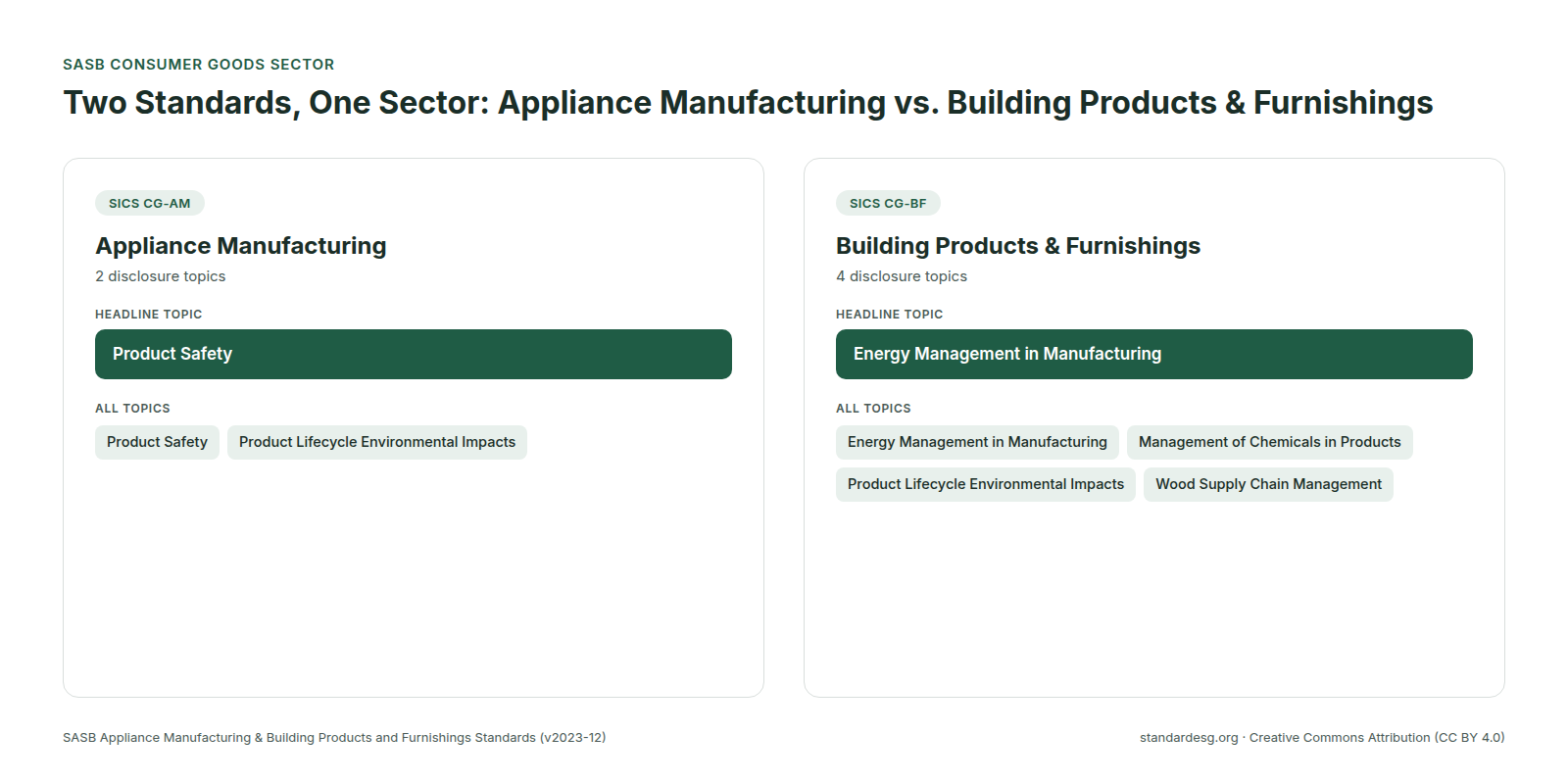
SASB — now maintained by the International Sustainability Standards Board (ISSB) as part of the IFRS Foundation — groups both industries under its Consumer Goods sector. Appliance Manufacturing (SICS CG-AM) covers entities that design and manufacture household appliances and hand tools, sold primarily through retailers. Building Products & Furnishings (SICS CG-BF) covers entities that design and manufacture home improvement products, home and office furnishings, and structural wood building materials — flooring, ceiling tiles, furniture, wood trusses, plywood, panelling, and lumber — sold through distributors, retailers, and dealerships. The headline finding worth naming up front: Appliance Manufacturing is one of the narrowest SASB standards in the sector, with only two disclosure topics and no operations-facing content at all, while Building Products & Furnishings carries twice as many topics, including two — energy use in manufacturing and wood sourcing — that Appliance Manufacturing has no equivalent for whatsoever. A template author should not read the appliance standard's brevity as appliances being lower-impact; it reflects a standard whose disclosure topics are built entirely around the product itself, not the factory that makes it.
The Two SASB Standards at a Glance
Each standard organizes its material risks into a set of named disclosure topics, each with its own metrics (SASB's own terms: disclosure topics describe a specific sustainability-related risk or opportunity; metrics quantify or describe an entity's performance against a topic):
- Appliance Manufacturing — Product Safety, Product Lifecycle Environmental Impacts. Two topics total.
- Building Products & Furnishings — Energy Management in Manufacturing, Management of Chemicals in Products, Product Lifecycle Environmental Impacts, Wood Supply Chain Management. Four topics total.
The one topic both standards share by name — Product Lifecycle Environmental Impacts — turns out to measure different things in each. Neither standard carries a Greenhouse Gas Emissions topic at all: this entire cluster of the Consumer Goods sector has no Scope 1/2 GHG-accounting requirement, a real gap worth flagging rather than assuming implicitly covered elsewhere.
Energy Management: Present in One Standard, Absent in the Other
Building Products & Furnishings' Energy Management in Manufacturing requires total energy consumed in gigajoules, the percentage from grid electricity, and the percentage from renewable sources (CG-BF-130a.1) — a facility-operations metric, grounded in a topic summary that names purchased electricity as the industry's largest energy cost and flags how narrow profit margins make energy efficiency a direct driver of financial performance. See Measuring GHG Emissions: Scope 1, 2 and 3 for how consumption figures like this one feed into a full GHG inventory, though note the standard itself stops at consumption and renewable share — it does not ask for an emissions figure.
Appliance Manufacturing has no equivalent topic. Nothing in CG-AM asks about the entity's own facility energy consumption, fuel mix, or manufacturing-process emissions. The closest thing the appliance standard offers is a product-level metric — the percentage of revenue from products certified to an energy efficiency certification (CG-AM-410a.1) — which measures how efficient the products sold are, not how much energy the factory that made them consumed. A template author covering an appliance manufacturer's own operational energy footprint should not expect this standard to ask for it directly; that evidence has to be built by drawing on general energy-management practice rather than a CG-AM-specific metric.
Product Safety: Appliance Manufacturing's Own Ground
Product Safety is Appliance Manufacturing's lead topic, and it has no analogue anywhere in Building Products & Furnishings. It requires the number of recalls issued and total units recalled (CG-AM-250a.1), with a note directing entities to discuss notable recalls — those affecting a significant number of units, or involving serious injury or fatality; a discussion of the process used to identify and manage safety risks associated with product use (CG-AM-250a.2), scoped explicitly to end-consumer risks during the use phase, with the standard naming fire, electric shock, appliance tipping, and carbon monoxide emissions as the risk categories it has in mind; and the total monetary losses from legal proceedings tied to product safety incidents (CG-AM-250a.3), covering settlements, judgments, and regulatory penalties, with a note asking for a brief description of the nature and context of each loss and any corrective action taken. The topic summary is explicit about why this sits at the top of the standard: a malfunctioning appliance can cause fire, injury, or death, exposing the manufacturer to litigation and reputational risk that can move revenue and market share.
Chemical Management in Products: Building Products' Route to the Same Concern
Building Products & Furnishings carries its own version of a product-safety topic, but built around a different hazard. Management of Chemicals in Products requires a discussion of the processes used to assess and manage risks from chemicals in the entity's products — including whether the entity's approach is hazard-based, risk-based, or a mix of the two, and how it prioritizes chemicals for reduction or elimination (CG-BF-250a.1) — and the percentage of eligible products, by revenue, meeting volatile organic compound (VOC) emissions and content standards (CG-BF-250a.2), scoped to products used in enclosed indoor environments: flooring, wall coverings, acoustical ceilings, panelling, insulation, and freestanding office/school furniture. The topic summary names the underlying concern plainly: VOCs and other substances of concern in building products and furnishings can affect the health of the people who occupy the buildings they go into, and reputational or regulatory risk follows from that exposure — the same "protect the end user from the product itself" logic that drives Appliance Manufacturing's Product Safety topic, just built around indoor air quality and chemical content rather than mechanical or electrical failure. This is a genuine deviation worth naming: the original scope for this task treated chemical/hazardous-substance management as circularity-adjacent content (E4), but the standard's own framing is squarely about protecting the product's end user, not about environmental release.
Product Lifecycle, Certification, and End-of-Life
Both standards carry a topic named Product Lifecycle Environmental Impacts, and the overlap is real but not exact — each asks for a different mix of certification-based and material-flow evidence. Appliance Manufacturing's version requires the percentage of eligible product revenue certified to an energy efficiency certification (CG-AM-410a.1); the percentage of eligible product revenue certified to a third-party environmental product lifecycle standard covering design, materials, manufacturing, and end-of-life (CG-AM-410a.2); and a description of efforts to manage products' end-of-life impacts, including safe disposal or recycling of constituent materials such as toxic heavy metals, rigid polymers, and refrigerants, and participation in extended producer responsibility (EPR) programs (CG-AM-410a.3). Building Products & Furnishings' version is narrower in what it certifies but more quantitative on the back end: a description of efforts to manage lifecycle impacts and meet demand for sustainable products, including use of Life Cycle Assessment and Environmental Product Declarations (CG-BF-410a.1), plus a hard number the appliance standard never asks for — the actual weight of end-of-life material recovered, in metric tonnes, and the percentage of that recovered material actually recycled or remanufactured (CG-BF-410a.2), with explicit exclusions for landfilled and incinerated material. Where the appliance standard stops at "what percentage of revenue is certified," the building-products standard goes one step further and asks how much material actually came back and got reused.
Wood Supply Chain Management: Ground Building Products Carries Alone
Building Products & Furnishings' fourth topic has no appliance-standard equivalent at all, for the plain reason that appliance manufacturing isn't built around a forest-product input the way structural lumber, plywood, and wood furniture are. Wood Supply Chain Management requires the total weight of wood fibre materials purchased, the percentage sourced from forestlands certified to a third-party forest management standard (naming the Forest Stewardship Council, Sustainable Forest Initiative, and Programme for the Endorsement of Forest Certification among others), a breakdown by which standard applies, and the percentage certified to other wood fibre standards such as controlled-wood or recycled-fibre standards (CG-BF-430a.1). The technical protocol's note asks for something broader than the headline percentages: a description of sourcing practices for uncertified wood, verification policies for suppliers, and — notably — how sourcing practices account for wood legality, protected conservation areas, endangered-species habitat, indigenous peoples' land, and the forestry management practices of suppliers. That last cluster of criteria is why this topic reads as more than a pure procurement metric: it embeds real biodiversity and land-rights due diligence inside what is structurally a supply-chain disclosure topic, which is why it maps to two Standard ESG subjects rather than one.
Mapping to Standard ESG Subjects
Building Products & Furnishings' Energy Management in Manufacturing maps to E2 — Resource use, as anticipated, and it is the only genuine operations-energy content between the two standards — Appliance Manufacturing has no counterpart. Both standards' Product Lifecycle Environmental Impacts topics map to E4 — Waste, circularity & pollution prevention, also as anticipated, covering end-of-life material recovery and extended producer responsibility on the building-products side and certification-based lifecycle claims on the appliance side; the energy-efficiency-certification portion of Appliance Manufacturing's version (CG-AM-410a.1) additionally touches E2. Wood Supply Chain Management maps to both E5 — Biodiversity & land use and G4 — Sustainable procurement & supply-chain management, as anticipated, reflecting the topic's dual character: the percentage-certified metrics are procurement disclosure, while the technical protocol's biodiversity, endangered-species, and indigenous-land criteria are squarely E5 content. This is ground Building Products carries entirely alone — Appliance Manufacturing has no supply-chain or materials-sourcing topic of any kind, so G4 does not apply to CG-AM at all, a real asymmetry rather than a research gap.
The genuine deviation from the original scope is in Product Safety and Chemical Management in Products. Appliance Manufacturing's Product Safety and Building Products' Management of Chemicals in Products were both anticipated as circularity-adjacent (E4) content, but both are actually consumer-protection topics — recall management and use-phase injury risk on one side, VOC exposure and chemical hazard management on the other — and map instead to S5 — Consumer/end-user responsibility, a subject the original scope for this task did not anticipate needing at all. The final subject set for this task is E2, E4, E5, S5, and G4 — S5 added, everything else as anticipated, with G4 and E5 applying only to Building Products & Furnishings rather than across both standards.
Which SEIC Sectors This Deepens Coverage For
These two standards carry the most weight for exactly the SEIC groups their SICS codes name: household appliance and hand-tool manufacturers (CG-AM) and building-products, furnishings, and structural-wood-materials manufacturers (CG-BF). A company operating across both — a manufacturer that makes both appliances and cabinetry or furniture, for instance — should expect to work through both standards' topic sets rather than assuming one subsumes the other, given how little topic overlap actually exists between them.
Getting Started
- Confirm which standard — or both — applies, based on whether the entity's products are household appliances/hand tools (CG-AM) or building products/furnishings/structural wood materials (CG-BF).
- If you're a building-products manufacturer, start with Energy Management in Manufacturing — the one genuine operations-facing topic between the two standards, and typically where the most existing utility-billing data is already available internally.
- If you're an appliance manufacturer, don't assume the absence of an energy-management topic means no E2 evidence is needed — build a general facility energy record anyway; the standard's silence reflects SASB's materiality judgment for investors, not an argument that operational energy use doesn't matter for a full ESG evidence base.
- Build the product-safety and chemical-management evidence trail early — recall records, safety testing documentation, and chemical hazard assessments are usually already maintained for regulatory-compliance reasons even before a Standard ESG assessment asks for them.
- If you purchase wood fibre, start the supply-chain certification tracking now — third-party forest certification percentages take time to build up across a supplier base, and the technical protocol's biodiversity/indigenous-land criteria mean this evidence trail is broader than a simple certification checkbox.
See What to Expect from an On-Site ESG Assessment (Level 3) for how manufacturing-facility and supply-chain evidence like this gets verified physically on site.
Standard ESG (standardesg.org) draws on SASB's Appliance Manufacturing and Building Products & Furnishings standards to deepen subjects E2, E4, and E5 for consumer-goods manufacturers, alongside S5 for product-safety and chemical-exposure disclosure and G4 for wood-supply-chain due diligence. See The Standard ESG Certification Protocol: A Public Overview for how industry-dependent subjects fit into the full pillar and subject architecture.
Cette page vous a-t-elle été utile ?