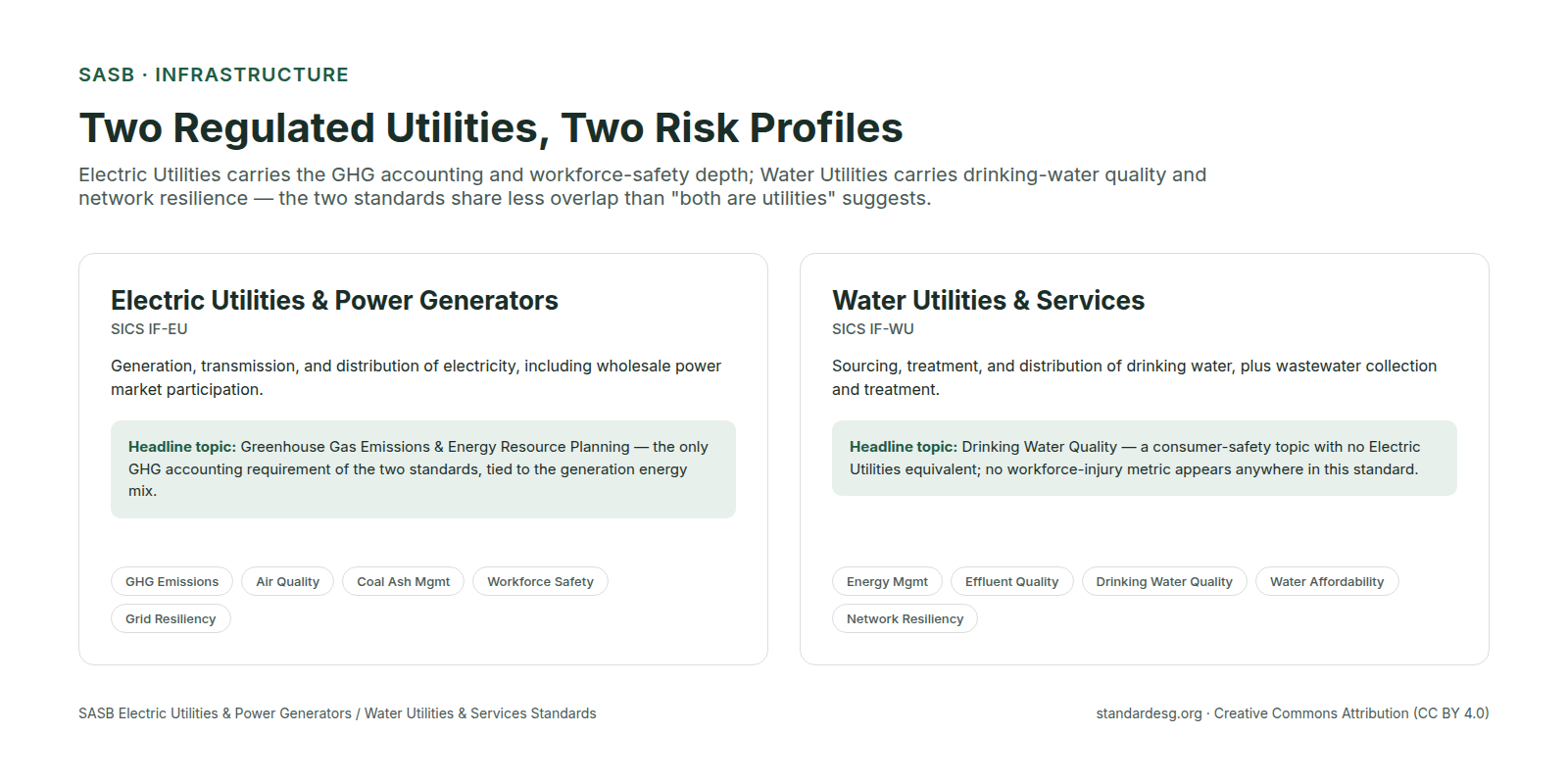
Two Regulated Utilities, Two Different Risk Profiles
SASB — now maintained by the International Sustainability Standards Board (ISSB) as part of the IFRS Foundation — places both utilities in its Infrastructure sector, and both share a regulatory logic: rates are typically set or approved by a public utility commission, service territories are geographically fixed, and disconnecting a non-paying customer from electricity or water carries a different weight than disconnecting a customer from most other products. Electric Utilities & Power Generators (SICS IF-EU) covers entities that generate, transmit, and distribute electricity, including those that also participate in wholesale power markets. Water Utilities & Services (SICS IF-WU) covers entities that source, treat, and distribute drinking water, and that collect and treat wastewater. Despite the shared regulatory posture, the two standards' actual disclosure topics diverge more than the surface-level "both are utilities" framing suggests — most strikingly on emissions and workforce safety.
The Two SASB Utility Standards at a Glance
Each standard organizes its material risks into a set of named disclosure topics, each with its own metrics (SASB's own terms: disclosure topics describe a specific sustainability-related risk or opportunity; metrics quantify or describe an entity's performance against a topic):
- Electric Utilities & Power Generators — Greenhouse Gas Emissions & Energy Resource Planning, Air Quality, Water Management, Coal Ash Management, Energy Affordability, Workforce Health & Safety, End-Use Efficiency & Demand, Nuclear Safety & Emergency Management, Grid Resiliency.
- Water Utilities & Services — Energy Management, Distribution Network Efficiency, Effluent Quality Management, Water Affordability & Access, Drinking Water Quality, End-Use Efficiency, Water Supply Resilience, Network Resiliency & Impacts of Climate Change.
Nine topics against eight is a close count, but the overlap in substance is thinner than the count implies. Neither standard shares a single identically-scoped topic with the other — the closest pairs are structurally similar but measure different things, and two entire risk categories — greenhouse gas accounting and workforce safety — appear in one standard and not the other at all.
Emissions, Energy Mix, and the Absence of a GHG Topic in Water
This is the sharpest asymmetry between the two standards, worth naming plainly rather than assuming symmetry. Greenhouse Gas Emissions & Energy Resource Planning, Electric Utilities' lead topic, requires gross global Scope 1 emissions and the percentage covered under emissions-limiting or emissions-reporting regulation (IF-EU-110a.1); GHG emissions associated with power deliveries specifically, as distinct from generation (IF-EU-110a.2); and a discussion of the entity's strategy for managing Scope 1 emissions and performance against reduction targets (IF-EU-110a.3). Its own Activity Metrics table adds real texture to that emissions figure: total electricity generated, broken down by major energy source — coal, natural gas, nuclear, petroleum, hydropower, solar, wind, other renewables, other gases (IF-EU-000.D) — which is what lets a reader connect a disclosed emissions number to the entity's actual coal-to-renewables generation mix. See Measuring GHG Emissions: Scope 1, 2 and 3 for how Scope 1 boundaries and the GHG Protocol methodology this metric specifies work in general.
Water Utilities has no equivalent topic at all. Its closest analogue, Energy Management, requires total energy consumed, the percentage from grid electricity, and the percentage from renewable sources (IF-WU-130a.1) — a resource-consumption metric, not an emissions-accounting one. There is no Scope 1/2 GHG figure, no emissions-reduction-target disclosure, and no equivalent to Electric Utilities' Air Quality topic (NOx, SOx, particulate matter, lead, mercury, disclosed in tonnes, with the percentage occurring in or near densely populated areas — IF-EU-120a.1) anywhere in the water standard. A template author covering a water/wastewater utility SEIC group should not read this as water utilities being climate-irrelevant — pumping, treatment, and desalination are energy-intensive processes — but the SASB standard as written simply doesn't ask for the GHG accounting depth it asks of an electricity generator, since a water utility is a consumer of grid electricity rather than typically a combustion source in its own right.
Pollution, Waste, and Effluent Management
Both standards carry a topic aimed at what leaves the facility as a byproduct, but scoped to what each industry actually produces. Electric Utilities' Coal Ash Management requires the amount of coal combustion products (CCPs) generated and the percentage recycled (IF-EU-150a.1), plus a description of CCP management policies and procedures for both active and inactive operations (IF-EU-150a.3) — a topic that applies only to entities still running coal generation, but a significant one where it applies, given how coal ash impoundment failures have driven regulatory attention in this sector. Water Utilities' analogue is Effluent Quality Management: the number of incidents of non-compliance with water effluent quality permits, standards, and regulations (IF-WU-140b.1), plus a discussion of strategies to manage effluents of emerging concern — pharmaceuticals, microplastics, and PFAS compounds not yet subject to conventional treatment standards (IF-WU-140b.2). The two topics don't overlap in substance — one is about a solid combustion byproduct, the other about what a treatment plant discharges — but both sit in the same conceptual slot: what does this entity release into the environment beyond what its headline emissions or water-use metrics already capture.
Resource Use: Water Management and Distribution Efficiency
Electric Utilities' Water Management topic requires total water withdrawn and consumed, with the percentage of each occurring in regions of High or Extremely High Baseline Water Stress (IF-EU-140a.1), the number of non-compliance incidents tied to water quality permits (IF-EU-140a.2), and a discussion of water management risks and mitigation strategies (IF-EU-140a.3) — reflecting how much water thermal generation actually consumes for cooling. Water Utilities' own resource-use ground splits across two topics instead of one: Distribution Network Efficiency requires the water main replacement rate (IF-WU-140a.1) and the volume of non-revenue real water losses — water that is withdrawn, treated, and then lost to leaks before reaching a paying customer (IF-WU-140a.2) — a loss-prevention metric with no real Electric Utilities counterpart, since electricity transmission loss isn't a named SASB topic the way water loss is. End-Use Efficiency, on the water side, requires the percentage of utility revenue from rate structures designed to promote conservation (IF-WU-420a.1) and customer water savings from efficiency measures by market (IF-WU-420a.2) — closely paralleling Electric Utilities' own End-Use Efficiency & Demand topic, which requires the percentage of electric load served by smart-grid technology (IF-EU-420a.2) and customer electricity savings from efficiency measures by market (IF-EU-420a.3). This pair is one of the few places the two standards genuinely line up: both ask an entity to disclose not just how much resource it delivers, but how much it helps customers use less of it.
Affordability and Access
Both standards carry an affordability topic with near-identical structure, reflecting the shared "essential service, captive customer base" logic. Electric Utilities' Energy Affordability requires the average retail electric rate for residential, commercial, and industrial customers (IF-EU-240a.1); the number of residential customer disconnections for non-payment and the percentage reconnected within 30 days (IF-EU-240a.3); and a discussion of how external factors — including the service territory's economic conditions — affect customer affordability (IF-EU-240a.4). Water Utilities' Water Affordability & Access mirrors this almost metric-for-metric: average retail water rate by customer class (IF-WU-240a.1), residential disconnections for non-payment and reconnection rate (IF-WU-240a.3), and the same affordability-context discussion requirement (IF-WU-240a.4). This is the cleanest one-to-one topic match between the two standards in this guide — a genuine signal that SASB treats disconnection-for-non-payment as a comparable social-exposure metric regardless of which essential service is being disconnected.
Safety: Workforce Injury Versus Drinking-Water Quality
Where the two standards diverge sharply again is on what "safety" means for each. Electric Utilities' Workforce Health & Safety measures people, not infrastructure: total recordable incident rate (TRIR), fatality rate, and near miss frequency rate (NMFR), each split between direct and contract employees (IF-EU-320a.1) — grounded in a topic summary that names electrocution risk and work at height in transmission and distribution line construction and maintenance as the industry's defining hazards. Water Utilities carries no equivalent workforce-safety topic at all — no TRIR, fatality rate, or injury metric appears anywhere in its standard. In its place, Water Utilities carries a topic Electric Utilities has no analogue for: Drinking Water Quality, requiring the number of non-compliance incidents tied to drinking-water quality standards and regulations (IF-WU-250a.1) and a discussion of strategies to manage contaminants of emerging concern (IF-WU-250a.2) — a consumer-safety topic about what reaches the customer's tap, not an occupational one about what happens to the workforce. The asymmetry runs in both directions: a water utility's own field and treatment-plant workforce still faces real occupational hazards even though the standard doesn't ask for injury-rate disclosure, and an electric utility's end customers still face real exposure from what the grid delivers even though the standard's safety topic is entirely workforce-facing. Template authors covering either SEIC group should treat this as a genuine coverage gap to flag, not assume the other standard's safety framing quietly extends to fill it.
Infrastructure Resilience and Emergency Preparedness
Both standards close with a resilience-focused topic, and here the parallel is closer than the safety split above, though the specific threats named differ. Electric Utilities' Grid Resiliency requires the number of non-compliance incidents with physical or cybersecurity standards protecting electricity infrastructure (IF-EU-550a.1) and three reliability indices — System Average Interruption Duration Index (SAIDI), System Average Interruption Frequency Index (SAIFI), and Customer Average Interruption Duration Index (CAIDI), inclusive of major event days (IF-EU-550a.2) — with a topic summary naming both extreme weather and cyberattack as the driving threats. Electric Utilities separately carries Nuclear Safety & Emergency Management for entities operating nuclear generation: the number of nuclear units broken down by results of the most recent independent safety review (IF-EU-540a.1) and a discussion of nuclear safety and emergency-preparedness efforts (IF-EU-540a.2) — a topic with no water-utility analogue, for the obvious reason that water utilities don't operate nuclear plants. Water Utilities' Network Resiliency & Impacts of Climate Change covers comparable ground with a different emphasis: wastewater treatment capacity located in 100-year flood zones (IF-WU-450a.1); the number and volume of sanitary sewer overflows and the percentage of volume recovered (IF-WU-450a.2); the number of unplanned service disruptions and customers affected, by duration category (IF-WU-450a.3); and a discussion of efforts to manage climate-related risks to distribution and wastewater infrastructure (IF-WU-450a.4). Water Utilities also carries a second, narrower resilience topic — Water Supply Resilience — requiring the volume of water sourced from High/Extremely High Baseline Water Stress regions and the percentage purchased from a third party (IF-WU-440a.1), the volume of recycled water delivered to customers (IF-WU-440a.2), and a discussion of strategies to manage supply risk (IF-WU-440a.3), reflecting a topic summary that names drought, source contamination, and aqueduct/canal infrastructure failure as its driving threats — no cybersecurity metric appears here, unlike the electric standard's Grid Resiliency topic.
Mapping to Standard ESG Subjects
The shared GHG/emissions topic maps to E3 — Emissions & climate for Electric Utilities, which carries the only GHG accounting requirement between the two standards; Water Utilities' Energy Management topic maps instead to E2 — Resource use, since it asks for consumption and renewable-share figures rather than an emissions inventory. Air Quality and both standards' pollution/waste topics — Coal Ash Management and Effluent Quality Management — map to E4 — Waste, circularity & pollution prevention, a deviation from the original scope for this task, which anticipated only E2/E3: air pollutants and combustion/effluent byproducts are pollution-prevention content, not climate accounting, and keeping them under E4 rather than folding them into E3 keeps the climate subject reserved for genuine GHG/energy-transition disclosure. Water Management, Distribution Network Efficiency, and both End-Use Efficiency topics map to E2. Both affordability topics map to S4 — Community involvement & development, as anticipated. Electric Utilities' Workforce Health & Safety maps to S2 — Occupational health & safety — also a deviation from the original scope, which didn't anticipate a safety-specific subject for this task — while Water Utilities' Drinking Water Quality maps to S5 — Consumer/end-user responsibility, the industry-dependent subject that gets concrete content here in a way the electric standard has no equivalent for. Grid Resiliency, Nuclear Safety & Emergency Management, Water Supply Resilience, and Network Resiliency & Impacts of Climate Change all map to G5 — Risk management & compliance, as anticipated, reflecting their shared character as infrastructure and continuity-risk disclosures rather than operational-performance metrics.
Which SEIC Sectors This Deepens Coverage For
These two standards carry the most weight for exactly the SEIC groups their SICS codes name: electricity generation, transmission, and distribution companies (IF-EU) and water/wastewater utilities (IF-WU). Complementary evidence on the general GHG-accounting methodology both standards' energy metrics build on is covered in Measuring GHG Emissions: Scope 1, 2 and 3; this guide is the sector-specific layer on top of that general framework.
Getting Started
A power or water utility building out its E2, E3, E4, S2, S4, S5, and G5 evidence base can work through these two standards' shared and distinct ground roughly as follows:
- Confirm which standard applies — Electric Utilities for generation/transmission/distribution, Water Utilities for water sourcing/treatment/distribution and wastewater treatment.
- If you're an electric utility, start with GHG accounting and generation-mix disclosure — the emissions topic with no water-utility equivalent, and typically the most regulator- and investor-scrutinized metric in the standard.
- If you're a water utility, don't assume "no GHG topic" means no climate work needed — build out Energy Management and Network Resiliency & Impacts of Climate Change instead, since that's where the water standard actually places its energy and climate-adaptation content.
- Build the affordability evidence trail early — disconnection counts and reconnection rates are metrics regulators already track closely for both essential-service industries, so this data is often already captured internally even before a Standard ESG assessment asks for it.
- Treat workforce safety and drinking-water/consumer safety as genuinely separate evidence trails, not interchangeable "safety" content — the two standards don't overlap here at all.
See What to Expect from an On-Site ESG Assessment (Level 3) for how infrastructure and safety evidence like this gets verified physically on site.
Standard ESG (standardesg.org) draws on SASB's Electric Utilities & Power Generators and Water Utilities & Services standards to deepen subjects E2, E3, and E4 for power and water utility companies, alongside S2, S4, S5, and G5 for the sector's safety, affordability, and resilience exposure. See The Standard ESG Certification Protocol: A Public Overview for how industry-dependent subjects fit into the full pillar and subject architecture.
Cette page vous a-t-elle été utile ?