The Two SASB Standards at a Glance
Each standard organizes its material risks into a set of named disclosure topics, each with its own metrics (SASB's own terms: disclosure topics describe a specific sustainability-related risk or opportunity; metrics quantify or describe an entity's performance against a topic).
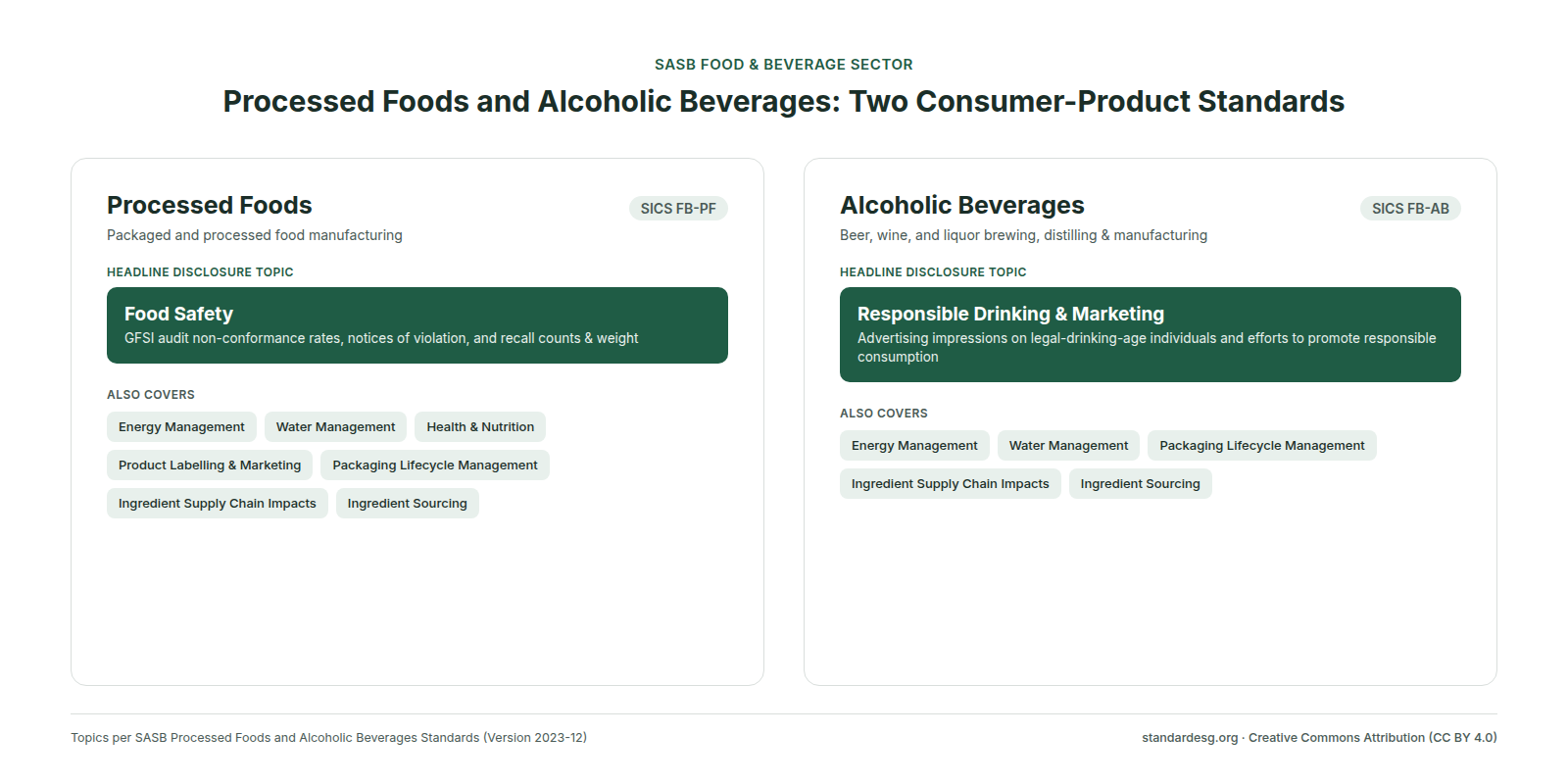
Processed Foods: Energy Management, Water Management, Food Safety, Health & Nutrition, Product Labelling & Marketing, Packaging Lifecycle Management, Environmental & Social Impacts of Ingredient Supply Chain, Ingredient Sourcing.
Alcoholic Beverages: Energy Management, Water Management, Responsible Drinking & Marketing, Packaging Lifecycle Management, Environmental & Social Impacts of Ingredient Supply Chain, Ingredient Sourcing.
Six topics against eight — and the difference is entirely concentrated in the consumer-facing ground. The first two (Energy, Water) and the last three (Packaging, Supply Chain Impacts, Ingredient Sourcing) are near-identical in structure and, in most cases, identically worded between the two standards. The middle of the table is where the two standards actually diverge: Processed Foods carries three consumer/market-facing topics (Food Safety, Health & Nutrition, Product Labelling & Marketing) where Alcoholic Beverages carries exactly one (Responsible Drinking & Marketing) — not a simplified version of the same content, but a genuinely different framing.
Processed Foods' Two Consumer Topics: Food Safety and Health & Nutrition
Processed Foods splits its consumer-facing risk across two separate topics, and the split is a real structural choice, not redundancy. Food Safety is a contamination and traceability topic: Global Food Safety Initiative (GFSI) audit non-conformance rates and corrective-action rates, split by major and minor severity (FB-PF-250a.1); the percentage of ingredients sourced from Tier 1 supplier facilities certified to a GFSI-recognized food safety programme (250a.2); the total number of food safety violation notices received and the percentage corrected (250a.3); and the number of recalls issued plus the total weight of food product recalled, with a required discussion of any notable recall tied to significant product volume or serious illness/fatality (250a.4). This is squarely an operational-quality-control topic — it measures whether the product is safe to eat, not what claims are printed on it.
Health & Nutrition, by contrast, is a labelling-and-positioning topic: revenue from products labelled or marketed to promote health and nutrition attributes (FB-PF-260a.1), plus a required discussion of the entity's process for identifying and managing products and ingredients tied to nutritional and health concerns among consumers — which the technical protocol explicitly invites entities to frame around the WHO/FAO's Codex Alimentarius or the WHO Global Strategy on Diet, Physical Activity and Health (260a.2). A separate Product Labelling & Marketing topic sits alongside these two and is closer to a regulatory-compliance topic than a consumer-safety one: the percentage of advertising impressions made on children and the percentage of those that promote products meeting dietary guidelines (270a.1); revenue from GMO-labelled versus non-GMO products (270a.2); the number of non-compliance incidents with labelling or marketing codes (270a.3); and total monetary losses from legal proceedings tied to labelling or marketing practices (270a.4). Three distinct concerns — is the food safe, is it honestly marketed as healthy, does its marketing comply with regulation — kept as three distinct topics rather than folded together.
Alcoholic Beverages' One Consumer Topic: Responsible Drinking & Marketing
Alcoholic Beverages has no equivalent to Food Safety at all — no GFSI audit metric, no recall metric, no notice-of-violation metric anywhere in the standard. This is a genuine coverage gap worth flagging directly to a template author covering a brewery, winery or distillery: the standard as written treats contamination/traceability risk as immaterial relative to the industry's defining externality, and doesn't ask for the kind of quality-control evidence Processed Foods requires. In its place sits a single topic, Responsible Drinking & Marketing, that does the work of Processed Foods' Health & Nutrition and Product Labelling & Marketing topics combined, reframed around alcohol's specific harm profile rather than nutrition. Its topic summary names drunk driving, addiction, underage drinking and public-health harm directly, and its metrics mix consumer-protection and marketing-compliance content in one place rather than as two: the percentage of total advertising impressions made on individuals at or above the legal drinking age (FB-AB-270a.1); the number of non-compliance incidents with labelling or marketing codes (270a.2); total monetary losses from legal proceedings tied to marketing or labelling practices (270a.3); and — the one metric with no Processed Foods analogue at all — a required discussion of the entity's efforts to promote responsible consumption of alcohol, including engagement targets for programmes addressing underage drinking, drinking and driving, and binge or chronic over-consumption (270a.4). That last metric is a genuine harm-reduction disclosure, not a compliance one, and is the clearest signal that SASB treats alcohol's social externality as categorically different from the nutrition-and-labelling concerns Processed Foods is built around.
Packaging Lifecycle Management
Both standards share this topic in near-identical form: the total weight of packaging purchased, the percentage made from recycled or renewable materials, and the percentage that is recyclable, reusable or compostable (FB-PF-410a.1 / FB-AB-410a.1), plus a required discussion of the entity's strategy to reduce packaging's environmental impact throughout its lifecycle (410a.2), with both technical protocols pointing to the same external frameworks — ISO 18602 (packaging optimization), ISO 18604 (material recycling), ISO 14855-1/ASTM D6400 (compostability) and ISO 14021 (self-declared environmental claims) — as acceptable bases for that discussion. Both topic summaries name the same underlying tension: packaging is a major cost and a major environmental footprint, and lightweighting or recyclability improvements can cut both at once. This is the second fully identical topic between the two standards, alongside Water Management above.
Ingredient Supply Chain: Certification and Sourcing Risk
The two remaining topics — both tied to where each industry's raw agricultural inputs come from — carry one genuine asymmetry worth flagging. Environmental & Social Impacts of Ingredient Supply Chain requires suppliers' social and environmental responsibility audit non-conformance and corrective-action rates for major and minor non-conformances (FB-PF-430a.2 / FB-AB-430a.1). Processed Foods carries a second metric here that Alcoholic Beverages does not: the percentage of food ingredients sourced that are certified to a third-party environmental or social standard, broken out by standard — Bonsucro, Fairtrade International, Fair Trade USA, RSPO, RTRS, Rainforest Alliance, SA8000, USDA Organic, UTZ Certified (FB-PF-430a.1). Alcoholic Beverages has no equivalent percentage-certified metric at all — only the audit non-conformance rate. Ingredient Sourcing is identically structured across both standards: the percentage of ingredients sourced from regions with High or Extremely High Baseline Water Stress (FB-PF-440a.1 / FB-AB-440a.1), and a required list of priority ingredients with a discussion of sourcing risks tied to environmental and social considerations — climate change, deforestation, water scarcity, and workers' rights among the named examples (440a.2). One existing library resource already covers a single crop's certification scheme in depth: see Bonsucro: The Sugarcane Sustainability Standard (linked below) for how one of the certifications named in FB-PF-430a.1's metric actually works. Both SASB topics here are broader than any single crop scheme — they cover whichever ingredients a given entity sources, not sugarcane specifically — so treat Bonsucro as one certification among several an ingredient-sourcing disclosure might reference, not a substitute for this broader topic.
Mapping to Standard ESG Subjects
Energy Management and Water Management map to E2 — Resource use for both standards — neither carries a GHG-accounting metric, so neither maps to E3 despite both topics being energy-adjacent, consistent with the absence noted above. Packaging Lifecycle Management maps to E4 — Waste, circularity & pollution prevention, as anticipated. Food Safety and Health & Nutrition (Processed Foods only) both map to S5 — Consumer/end-user responsibility, and so does the harm-reduction component of Alcoholic Beverages' Responsible Drinking & Marketing topic — the required discussion of responsible-consumption programmes in FB-AB-270a.4. Product Labelling & Marketing and the compliance/advertising-impressions component of Responsible Drinking & Marketing map instead to G2 — Business ethics & anti-corruption, a deviation from this task's original scope, which anticipated only S5 for both standards' consumer-facing content: non-compliance incident counts and monetary losses from legal proceedings are regulatory-conduct metrics, not product-safety ones, and keeping them under G2 rather than folding everything consumer-facing into S5 preserves that distinction — concretely, it means Alcoholic Beverages' single Responsible Drinking & Marketing topic is the one place in this guide where a single SASB disclosure topic splits across two Standard ESG subjects rather than mapping cleanly to one. Environmental & Social Impacts of Ingredient Supply Chain and Ingredient Sourcing both map to G4 — Supply chain management, as anticipated, reflecting their shared character as sourcing-risk and supplier-governance disclosures rather than operational-performance metrics.
Which SEIC Sectors This Deepens Coverage For
These two standards carry the most weight for exactly the SEIC groups their SICS codes name: packaged and processed food manufacturers (FB-PF) and beer, wine and spirits producers (FB-AB). The certification schemes named in the ingredient supply chain section's metrics connect to Bonsucro: The Sugarcane Sustainability Standard (linked below) for readers who need the mechanics of one specific scheme in depth; this guide is the sector-specific accounting layer both certification schemes and general supply-chain due diligence sit underneath.
Getting Started
- Confirm which standard applies — Processed Foods for packaged/frozen/snack food manufacturing, Alcoholic Beverages for brewing, distilling or wine production.
- Build the shared Energy and Water Management evidence first — identical metric structure across both standards, and the most operationally straightforward data to gather since it's already tracked for utility billing and regulatory compliance.
- If you're a processed foods company, treat Food Safety, Health & Nutrition, and Product Labelling & Marketing as three separate evidence trails, not one combined "consumer risk" file — GFSI audit results, health-claim revenue disclosure, and advertising-compliance records come from different internal teams and different source documents.
- If you're an alcoholic beverage producer, don't assume the absence of a Food Safety topic means no quality-control evidence is needed for a Standard ESG assessment — build it anyway as supporting context, since the SASB standard's silence here reflects a materiality judgement about investor-relevant risk, not an endorsement that food-safety practices don't matter.
- Build the Ingredient Sourcing and supply-chain evidence trail early — priority-ingredient lists and water-stress-region sourcing percentages typically require reaching several tiers into the supply chain, so this data collection tends to take longer than the facility-level metrics covered above.
How This Fits Standard ESG's Protocol
Standard ESG (standardesg.org) draws on SASB's Processed Foods and Alcoholic Beverages standards to deepen subjects E2 and E4 for food and beverage manufacturers, alongside S5, G2, and G4 for the sector's consumer-facing and supply-chain risk. See The Standard ESG Certification Protocol: A Public Overview (linked below) for how industry-dependent subjects fit into the full pillar and subject architecture.
Cette page vous a-t-elle été utile ?