What This RICS Standard Is
RICS' Sustainability and ESG in commercial property valuation and strategic advice is a RICS professional standard — the top tier of RICS' own document hierarchy, setting requirements and expectations for RICS members and regulated firms about how they provide services or the outcomes of their actions. Like every RICS professional standard, it distinguishes mandatory requirements (using "must") from recommended best practice (using "should," where acceptable alternative approaches to best practice may achieve the same or a better outcome), and RICS explicitly notes that regulators, disciplinary panels, and even courts may take a member's compliance with it into account when assessing whether they acted appropriately and with reasonable competence. This gives the standard real teeth for the one profession every real estate transaction, loan, and financial statement ultimately depends on: the valuer whose opinion of worth underpins the deal.
Scope: Valuation, Not Corporate ESG Reporting
The standard is principally intended for valuing commercial property — non-domestic real estate that fulfils an operational or occupational purpose for business and is commonly sold or let in the market, sometimes called "investment property." Rural, residential, public sector, and infrastructure assets outside that definition fall outside its remit. Critically, the standard is explicit about what it does not cover: it does not substantially address ESG disclosure or non-financial reporting, it does not cover business or corporate-level sustainability and net-zero strategies (carbon offsetting included), and it does not treat plant and equipment or life-cycle/circular- economy considerations in detail. This is a genuinely narrower scope than most standards in this library — it's asset-level valuation guidance, not a corporate-sustainability framework — which is exactly why it complements Standard ESG's company-level certification rather than duplicating it: a real estate company can be certified against Standard ESG's full 15-subject framework at the corporate level while this RICS standard governs how its individual buildings get valued.
Carbon Emissions, Net Zero, and Energy Efficiency
Decarbonisation and the aspiration toward "net zero" are, in the standard's own words, among the most prominent factors in the minds of industry stakeholders, driven by regulatory, statutory, and investment criteria of which energy efficiency forms a substantial part. Valuers are advised to obtain relevant carbon assessment and energy efficiency information from the client and third-party or publicly available sources where possible, and to recognize that carbon-efficiency improvements can require substantial capital expenditure that may not always be recovered through operational savings alone — meaning regulatory and investment criteria, not just predicted energy savings, are often the more substantial lever on value. Valuation at the individual asset level typically focuses on Scope 1 emissions (direct emissions the asset itself produces), but valuers are expected to remain aware of Scope 2 and Scope 3 implications particularly when advising on a portfolio rather than a single building — a distinction that runs parallel to Standard ESG's own Scope 1–2-required, Scope 3-encouraged approach under subject E3 (see Measuring GHG Emissions: Scope 1, 2 and 3).
Capital Expenditure: The Cost Side of Sustainability
Meeting market and regulatory sustainability requirements often means real capital expenditure — servicing and replacing construction materials, air-conditioning and heating installations, energy and water efficiency upgrades, and waste management provision — and the standard is direct that cost should not be assumed to equal value: what it costs to bring a building up to standard and what that improvement adds to its worth are two separate questions a valuer has to keep distinct. The suitability of specific technologies and materials varies by property type, age, use, and location, and technology intended to improve sustainability can itself become obsolete, so valuers are expected to be aware of the financing and grant landscape around it, not just its stated performance specifications. Where the underlying technical judgment goes beyond a valuer's own competence, the standard expects them to recognize that and bring in specialist advice — a sustainability assessor, cost consultant, building surveyor, or building services engineer — agreed with the client in advance.
Environmental, Physical, and Transition Risks
The standard distinguishes two related but distinct categories of climate-linked risk a valuer needs to account for. Physical risk covers heightened exposure to flooding, heat, wildfires, and severe storms — a key issue for real estate investment, lending, management, insurance, and development viability globally, not a narrow niche concern — alongside non-climate environmental risks like soil and air pollution and waste materials. Transition risk covers the business-related risk of a changing regulatory framework as governments legislate to mitigate climate change: an asset that can't perform against contemporary or pending sustainability standards and regulation carries a distinct exposure that may need to be mitigated through the same capital expenditure discussed in Section 4. Valuers are expected to gather up-to-date environmental and physical risk information for a subject property and weigh it against comparable evidence — a discipline directly parallel to Standard ESG's own Level 3 site walkthrough, which checks whether environmental controls are physically present and functioning, not just documented (see What to Expect from an On-Site ESG Assessment (Level 3)).
Certification, Rating, and Benchmarking Schemes
Developers, owners, governments, and regulators certify property sustainability and ESG credentials through a range of rating systems, codes, and schemes — the standard names Leadership in Energy and Environmental Design (LEED), the Building Research Establishment's Environmental Assessment Method (BREEAM), the Global Real Estate Sustainability Benchmark (GRESB), and the National Australian Built Environment Rating System (NABERS) as examples, alongside jurisdiction-specific regulatory codes like India's Energy Conservation Building Code or the UK's Minimum Energy Efficiency Standards. The standard's guidance on using these is worth reading carefully: because many schemes are multi-criteria and updated regularly, a past rating may not reflect current performance, and the criteria behind an accreditation can offer useful information about an asset's sustainability features — but should not be the sole determinant of a property's weight as a comparable or of any valuation adjustment. The absence or presence of certification, ESG reporting, or benchmarking detail is explicitly not treated as an absolute measure of a property's sustainability; a valuer is expected to understand what a given scheme actually measures and how current its rating is, the same "read the verification depth, not just the label" discipline Standard ESG applies to its own three certification levels (see The Three Certification Levels Explained).
Green Leases and ESG in Asset Management
Traditional commercial leases create a structural misalignment the standard calls out directly: the landlord typically bears responsibility for capital investment, while the tenant is often the party that benefits from resulting operational savings. Green leases are the market's response — contracts (leases, licenses, management agreements) that encourage or contractually impose sustainable asset-management standards on landlord and tenant, sharing the tenant's savings with the landlord so both sides have an incentive to invest in the asset's sustainable performance. Not every such clause is purely beneficial to the tenant, however: some place potentially onerous liabilities on the tenant around repair, material specification, or hand-back conditions, which could depress a rental bid if a prospective tenant reads the additional cost as a net burden rather than an ESG benefit. Valuers are expected to assess whether any sustainability-linked contractual arrangement has a positive or negative impact on value, analyzing how clauses interrelate with each other and with comparable properties, rather than assuming "green lease" is automatically a value-positive label.
Fiscal, Legislative, and Planning Considerations
Government fiscal and legislative measures — tax breaks and incentives for sustainability-linked improvement, renovation, retrofit, construction, or use, and correspondingly, penalties or value depreciation for non-compliant assets — vary by jurisdiction and can shift transition risk (Section 5) directly. The standard notes that credits from validated, usually registered, schemes relating to carbon emissions could also potentially affect value. Planning and zoning frameworks add a further layer: most jurisdictions have statutory land-use frameworks that increasingly translate sustainability standards — including the UN's 2030 Agenda with its 17 Sustainable Development Goals — into planning and zoning policy, meaning a property's development or redevelopment potential can be directly affected by whether that redevelopment must be delivered to current sustainability standards, and at what capital cost.
Mapping to Standard ESG's Core 15 Subjects
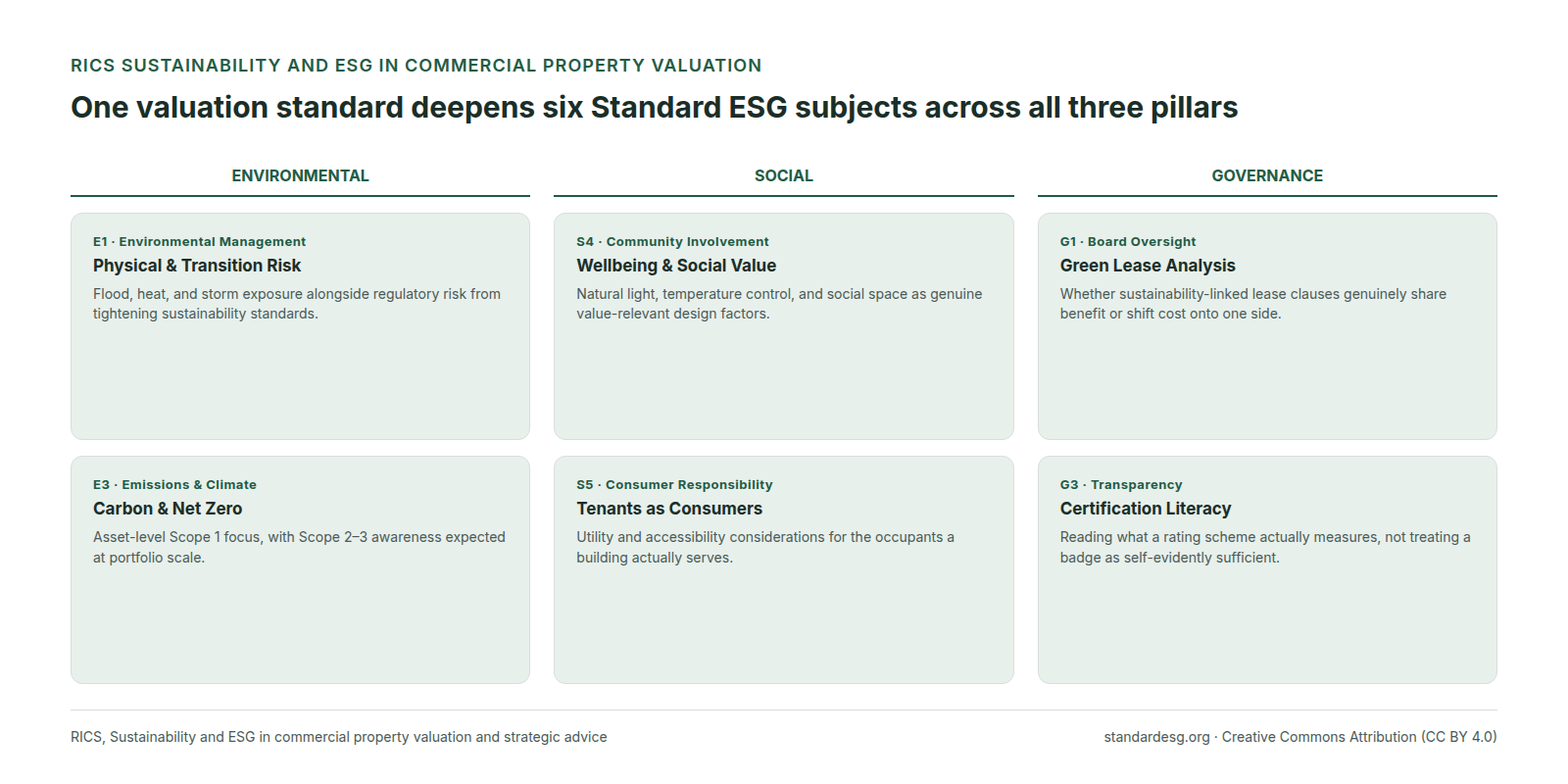
Unlike the IFC Performance Standards or Bonsucro, this RICS standard doesn't deepen a narrow subset of Standard ESG's subjects — because it addresses valuation methodology rather than corporate conduct, it instead supplies real-estate-specific evidence and language across several subjects at once. On the Environmental side, Section 3's carbon and energy-efficiency discussion deepens E1 (environmental management systems, since building-level energy performance is a direct operational control point) and E3 (emissions & climate); Section 5's physical-risk treatment deepens how a real estate company demonstrates its own climate-risk awareness under E1. On the Social side, Section 8's wellbeing and social-value discussion deepens S4 (community involvement & development) and gives concrete content to what "consumer responsibility" (S5) looks like for a real estate services company whose "consumers" are tenants and building occupants rather than retail purchasers (see Consumer and Product Responsibility for the general S5 framework this specializes). On the Governance side, Section 7's green-lease analysis and Section 6's certification-scheme literacy both deepen G1 (board oversight of asset-level sustainability decisions) and G3 (transparency — specifically, transparency about what a certification or rating actually does and doesn't demonstrate, rather than treating a badge as self-evidently sufficient).
Which SEIC Groups This Deepens Coverage For
This standard's relevance is concentrated squarely in Infrastructure's Real Estate and Real Estate Services groups, where building-level ESG performance is the core business asset rather than an operational input — a company in these groups whose own portfolio valuation practices align with this RICS standard is demonstrating exactly the kind of sophisticated, evidence-based sustainability judgment Standard ESG's higher certification levels look for. It carries clear secondary relevance to Home Builders and Engineering & Construction Services, where development and redevelopment decisions (Section 9) directly determine what sustainability standard a new or renovated asset is built to, and to Electric Utilities & Power Generators and Water Utilities & Services where major physical assets face the same physical- and transition-risk exposure (Section 5) as commercial buildings, even though they aren't "real estate" in the conventional sense. A company entirely outside property ownership, development, or management will find little of direct relevance here — like the IFC Performance Standards and Bonsucro, this is specialized, asset-class-specific grounding, not general-purpose ESG content.
Getting Started
- Establish what carbon-assessment and energy-efficiency data you actually hold for each asset (Section 3) before assuming a valuer or investor will accept qualitative claims about sustainability performance.
- Separate "what it costs to improve this asset's sustainability" from "what that improvement adds to its value" explicitly (Section 4) — conflating the two is a documented pitfall the standard warns against directly.
- Document physical and transition risk exposure per asset (Section 5), not just at portfolio level, since regulatory frameworks and physical hazards vary by location.
- Treat any certification or rating your properties hold (Section 6) as informative evidence, not a substitute for understanding what the underlying scheme actually measures and how current the rating is.
- Where you use green leases (Section 7), review whether the specific clauses genuinely share benefit between landlord and tenant, or quietly shift cost onto one side in a way a sophisticated counterparty would price into their rental bid.
Standard ESG (standardesg.org) draws on this RICS standard to deepen real-estate- specific evidence for E1, E3, S4, S5, G1, and G3, alongside the IFC Performance Standards for other high-impact industries. See The Standard ESG Certification Protocol: A Public Overview for how industry-specific grounding fits into the full pillar and subject architecture.
Was this page useful?