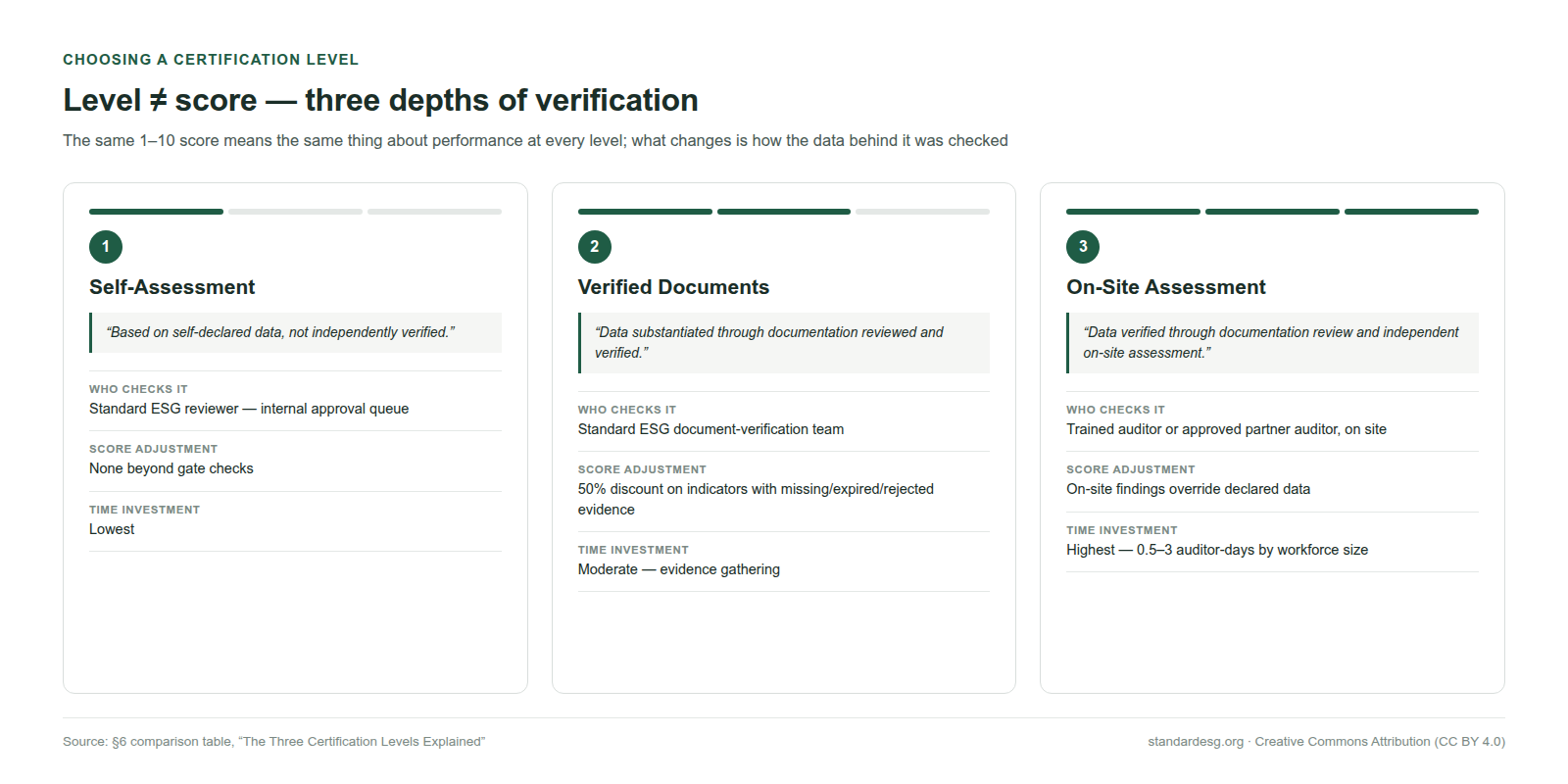
The Core Idea: Level ≠ Score
Every Standard ESG certificate carries two independent pieces of information: a 1–10 score describing how the company performed, and a level describing how that performance was verified. The same 1–10 scale applies at every level — a company can score 8/10 at Level 1 and a different company can score 8/10 at Level 3. Both numbers mean the same thing about performance. What differs is confidence: the Level 3 score has been checked against documents and, further, against physical reality on site; the Level 1 score is the company's own account, reviewed for plausibility but not independently verified.
Understanding the levels, then, is really understanding evidentiary depth — and that's what the rest of this guide walks through.
Level 1 — Self-Assessment
What it is: the company completes an industry-specific questionnaire covering all applicable indicators across the Environmental, Social, and Governance pillars. Submission enters an internal approval queue, where a Standard ESG reviewer checks plausibility, completeness, and the protocol's minimum-requirement gates before approving or rejecting the assessment with comments.
What the certificate says: "Based on self-declared data, not independently verified." That sentence is printed deliberately — Level 1 is not a lesser attempt to hide; it is an honest, useful starting point that names its own limits.
What it's good for: establishing a structured baseline quickly and affordably. Level 1 forces an organization to actually answer, in one place, questions it may never have organized data to answer before — which is often valuable on its own, independent of the certificate.
What it doesn't give you: external proof. A Level 1 certificate tells a reader "this company has thought carefully about its ESG position and passed an internal plausibility check," not "this company's claims have been checked against evidence."
Level 2 — Verified Documents
What it is: the company uploads the industry-specific document set that substantiates its Level 1 answers — legal and registration records, environmental permits and energy data, social records like payroll samples and safety logs, governance policies, and sustainability or audit reports. Standard ESG's internal team verifies each document individually. Scores are then recomputed with a verification adjustment: any indicator whose required document is missing, expired, or rejected is discounted to 50% of its declared value, or flagged for clarification, rather than taken at face value.
What the certificate says: "Data substantiated through documentation reviewed and verified by Standard ESG."
What it's good for: converting claims into checked claims. A Level 2 certificate tells a reader that the underlying paperwork exists, is current, and has actually been looked at by someone independent of the company. Level 2 also unlocks the website badge — a digital collectible the company can display publicly, linked back to its verification page.
What it doesn't give you: physical confirmation. Documents can be authentic and current and still not fully reflect what happens day to day on a site — which is the gap Level 3 closes.
Level 3 — On-Site Assessment
What it is: a trained Standard ESG auditor or an approved partner auditor visits the company's operations in person. The visit covers eight checklist domains: a facility walkthrough, a health-and-safety inspection, a cross-check of labour records against payroll and working-hours data, confidential worker interviews conducted away from management, management interviews on governance and risk oversight, spot-checks of document authenticity against issuing registers, review of supply-chain due diligence practice, and tracing of declared quantitative data — energy, water, waste, accident rates — back to meters, invoices, or logs. Findings are classified minor, major, or critical; majors require a 30-day corrective-action plan before certification, and criticals block it outright. Where an on-site finding contradicts a declared answer, the on-site finding overrides the declaration and the score is corrected accordingly.
What the certificate says: "Data verified through documentation review and independent on-site assessment."
What it's good for: the strongest available claim. A Level 3 certificate tells a reader that trained auditors physically confirmed conditions matched what was declared — including through interviews conducted without management present, which is specifically designed to surface issues a document review alone could miss.
What comes with it: alongside the certificate, the company receives a Findings & Recommendations Report — every finding recorded during the visit, its severity, the indicators it relates to, corrective-action recommendations, the auditors of record and visit dates, and the exact template version and checksum the assessment was scored against. This report stays in the company's dashboard for the life of the tenant relationship — a working document, not just a compliance artifact.
Why Levels Are Cumulative
You cannot jump straight to Level 3. Level 2 requires an approved Level 1 dataset; Level 3 requires verified Level 2 documents. This isn't bureaucracy for its own sake — each level's verification depends on the layer below it existing: an auditor cross-checking labour records on site needs those records to already be part of a verified Level 2 submission; document verification needs declared answers to check documents against in the first place.
You are never required to progress beyond the level you choose. Many organizations hold a Level 1 or Level 2 certificate indefinitely, renewing it annually, and that is a complete, valid certification — just one that states clearly, on its face, how far verification went.
Comparing the Three Levels at a Glance
- What's checked — Level 1: questionnaire answers, for plausibility. Level 2: answers plus supporting documents, individually verified. Level 3: documents plus physical operations, interviews, and data trails.
- Who checks it — Level 1: Standard ESG reviewer (internal approval queue). Level 2: Standard ESG document-verification team. Level 3: trained Standard ESG auditor or approved partner auditor, on site.
- Certificate wording — Level 1: "Based on self-declared data, not independently verified." Level 2: "Data substantiated through documentation reviewed and verified." Level 3: "Data verified through documentation review and independent on-site assessment."
- Score adjustments — Level 1: none beyond gate checks. Level 2: 50% discount on indicators with missing, expired, or rejected evidence. Level 3: on-site findings override declared data.
- Additional deliverable — Level 1: none. Level 2: website badge. Level 3: website badge plus Findings & Recommendations Report.
- Prerequisite — Level 1: none. Level 2: approved Level 1 assessment. Level 3: verified Level 2 documents.
- Typical time investment — Level 1: lowest. Level 2: moderate, evidence gathering. Level 3: highest, a scheduled visit (0.5–3 auditor-days by workforce size).
Validity and Renewal
Every certificate, at every level, is valid for 12 months from issue. Expiry is automatic and reflected immediately as "Expired" on the public verification page — nothing quietly lapses without becoming visible. Renewal repeats the assessment for the level you currently hold, scored against whichever template version is active at renewal time, so your certification always reflects current criteria rather than criteria from years earlier.
How to Choose Your Target Level
A rough decision guide:
- Choose Level 1 if you're formalizing your ESG posture for the first time, need a fast and low-cost starting point, or want an internal baseline before deciding how much further to invest.
- Choose Level 2 if you already have (or can assemble) the underlying documentation — permits, policies, records — and want a certificate that a buyer, lender, or investor can rely on with more confidence than a self-declaration, plus a public badge to display.
- Choose Level 3 if you're in a sector where physical conditions matter most (manufacturing, agriculture, extractives, any labour-intensive operation), your counterparties require the highest available assurance, or you want the independent Findings & Recommendations Report as a genuine improvement roadmap, not just a certificate.
Whichever you choose, the underlying questionnaire and pillar structure is the same — you are never asked to restart from scratch when you move up a level, only to substantiate and then physically demonstrate what you already declared.
Reading Someone Else's Certificate
If you're evaluating a supplier, counterparty, or investment target's Standard ESG certificate, read the level and score together, not the score alone. A high score at Level 1 tells you the company believes it performs well and passed a plausibility check; the same high score at Level 3 tells you trained auditors confirmed it on site. Scan the QR code or visit the verification page to confirm the certificate is currently active — not expired or revoked — before relying on it. See Verify a Certificate for the full walkthrough.
Frequently Asked Questions
Standard ESG (standardesg.org) operates all three levels within one protocol and one public 1–10 score. Ready to start? Registration begins with a Level 1 self-assessment — see How the Standard ESG 1–10 Score Works for how your answers become a score, and The Standard ESG Certification Protocol: A Public Overview for the full methodology.
Was this page useful?