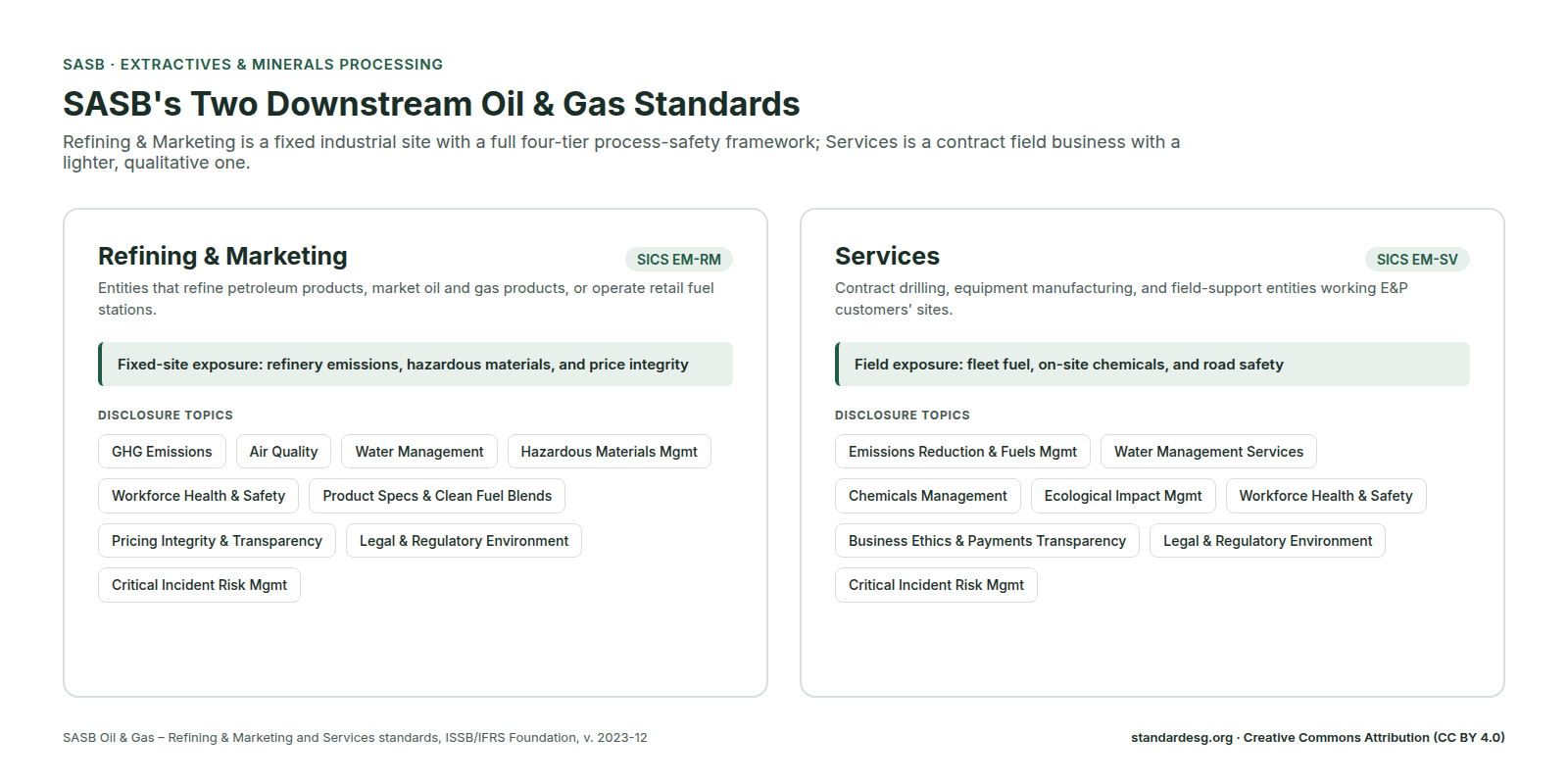
Two Businesses, One Value-Chain Segment
Oil & Gas – Refining & Marketing (SICS EM-RM) covers entities that refine petroleum products, market oil and gas products, or operate retail fuel stations — the fixed-asset, capital-intensive end of downstream, where crude comes in and finished product goes out under one roof. Oil & Gas – Services (SICS EM-SV) covers an entirely different business model: contract drilling, equipment manufacturing, and field support such as seismic surveying, well cementing, and equipment rental, typically performed for Exploration & Production customers on a contract basis rather than against company-owned reserves or refineries. Both standards explicitly note they cover pure-play entities — an integrated major that both refines and provides field services in-house should apply each relevant standard to its corresponding business segment, the same guidance the upstream standards give for E&P and Midstream. Services entities frequently work at wellheads Exploration & Production entities operate, which is why several of Services' topics below (chemicals, land disturbance) read like field-level extraction risks rather than downstream ones — Services carries them because its own crews are the ones physically on site doing the work.
The Two SASB Downstream Standards at a Glance
Each standard organizes its material risks into a small set of named disclosure topics, each with its own accompanying metrics (SASB's own terms: disclosure topics describe a specific sustainability-related risk or opportunity; metrics quantify or describe an entity's performance against a topic):
- Refining & Marketing — Greenhouse Gas Emissions, Air Quality, Water Management, Hazardous Materials Management, Workforce Health & Safety, Product Specifications & Clean Fuel Blends, Pricing Integrity & Transparency, Management of the Legal & Regulatory Environment, Critical Incident Risk Management.
- Services — Emissions Reduction Services & Fuels Management, Water Management Services, Chemicals Management, Ecological Impact Management, Workforce Health & Safety, Business Ethics & Payments Transparency, Management of the Legal & Regulatory Environment, Critical Incident Risk Management.
Only Workforce Health & Safety and Management of the Legal & Regulatory Environment share both a name and a comparable metric structure across the two standards. Everything else that sounds similar on the surface — emissions, water, ethics — turns out to be scoped around a genuinely different business model once read closely.
Emissions and Air Quality: Two Different Framings of the Same Risk
Refining & Marketing's Greenhouse Gas Emissions topic is a standard Scope 1 disclosure: gross global Scope 1 emissions and the percentage covered under an emissions-limiting regulation (EM-RM-110a.1), plus a discussion of the entity's emissions-management strategy and performance against reduction targets (EM-RM-110a.2) — see Measuring GHG Emissions: Scope 1, 2 and 3 for how the underlying scope and boundary methodology works. Its Air Quality topic adds refinery-specific pollutants beyond the usual NOx/SOx/particulate set — hydrogen sulphide (H2S) alongside the standard four (EM-RM-120a.1) — plus a metric with no analogue anywhere else in this guide: the number of the entity's refineries located in or near areas of dense population (EM-RM-120a.2), a direct proxy for how many people are exposed to a refinery's air-quality impact. Services' closest topic, Emissions Reduction Services & Fuels Management, isn't a Scope 1 gross-emissions disclosure at all — it's built around the fuel the entity's own equipment and vehicle fleet consumes: total fuel consumed, the percentage that's renewable, and the split between on-road and off-road equipment (EM-SV-110a.1); the percentage of in-service engines meeting the highest non-road diesel emissions standard (EM-SV-110a.3); and a discussion of the entity's strategy on air-emissions risk (EM-SV-110a.2). SASB's own framing for this topic is telling: it's pitched partly as a competitive metric — a services entity that helps E&P customers cut fugitive and flared emissions can win contracts on that basis — rather than purely a footprint disclosure. A template author should not treat "Emissions Reduction Services & Fuels Management" as Services' equivalent of a GHG inventory; it measures fleet fuel practice, not total emissions.
Water, Chemicals, and Hazardous Materials Management
Refining & Marketing's Water Management topic covers total water withdrawn and consumed, with the percentage of each in regions of High or Extremely High Baseline Water Stress (EM-RM-140a.1), plus the number of non-compliance incidents tied to water quality permits, standards, or regulations (EM-RM-140a.2) — a compliance-incident count that has no counterpart in the upstream E&P standard's water topic. Its Hazardous Materials Management topic is specific to refining-and-retail operations: hazardous waste generated and the percentage recycled (EM-RM-150a.1), plus a set of metrics unique to this standard — the number of underground storage tanks (USTs, the tanks buried at retail fuel stations), the number of UST releases requiring cleanup, and the percentage of tanks in jurisdictions with UST financial-assurance funds (EM-RM-150a.2). Services' water-adjacent topics are scoped to field operations rather than a fixed site: Water Management Services covers total volume of water handled in operations and the percentage recycled (EM-SV-140a.1), and Chemicals Management covers the volume of hydraulic fracturing fluid used and the percentage that's hazardous (EM-SV-150a.1) — a topic that exists because Services entities are frequently the ones physically performing fracturing work under contract for E&P customers, making this the field-level counterpart to the fracturing-chemical-disclosure metric in the companion upstream guide's E&P section.
Land Disturbance: A Services-Only Topic
Ecological Impact Management has no Refining & Marketing counterpart at all — a refinery is a fixed industrial footprint, not a land-intensive drilling operation, so SASB doesn't ask R&M entities for a land-disturbance metric the way it does of upstream and field-services entities. Services' version is compact: average disturbed land area per oil well site and per gas well site, disclosed separately (EM-SV-160a.1), plus a discussion of the entity's strategy for managing ecological-impact risks and opportunities (EM-SV-160a.2). It's a narrower topic than either upstream standard's land/biodiversity content, but it exists for the same underlying reason: Services crews are physically present at the wellhead doing the disturbing, even though the reserve itself belongs to an E&P customer.
Workforce Health and Safety, Plus One Field-Specific Metric
This is the one topic that lines up almost exactly across both standards. Both require total recordable incident rate (TRIR), fatality rate, and near miss frequency rate, split between direct and contract employees (EM-RM-320a.1 / EM-SV-320a.1), plus a discussion of the management systems used to build a safety culture (EM-RM-320a.2 / EM-SV-320a.2). Services adds one metric R&M doesn't carry: the number of road accidents and incidents (EM-SV-320a.3) — a direct consequence of how much of a field-services business's exposure sits in moving crews, rigs, and equipment between well sites rather than operating a single fixed facility. E&P's own Workforce Health & Safety topic, from the companion upstream guide, also includes average training hours per employee — a metric neither downstream standard requires, worth noting for template authors comparing safety evidence requirements across the full value chain.
Product Stewardship, Pricing Integrity, and Business Ethics
Refining & Marketing's Product Specifications & Clean Fuel Blends topic has no Services counterpart: the total addressable market and market share for advanced biofuels and associated infrastructure (EM-RM-410a.2), plus the volumes of renewable fuel produced and purchased for blending (EM-RM-410a.3) — a forward-looking, product-transition disclosure rather than an operational-footprint metric. R&M's Pricing Integrity & Transparency topic requires total monetary losses from legal proceedings tied to price fixing or price manipulation (EM-RM-520a.1) — an antitrust/collusion exposure specific to a business that sets retail fuel prices at scale. Services carries a differently-scoped governance topic instead, Business Ethics & Payments Transparency: net revenue earned in the 20 lowest-ranked countries on Transparency International's Corruption Perception Index (EM-SV-510a.1), plus a description of the anti-corruption management system covering the value chain (EM-SV-510a.2) — a bribery-exposure disclosure closer in structure to E&P's own Business Ethics topic from the companion upstream guide than to anything in R&M. See Corporate Governance, Ethics and Anti-Corruption for the general G2 framework both of these sector-specific topics sit inside.
Regulatory Engagement and Critical Incident Risk Management
Both standards carry a Management of the Legal & Regulatory Environment topic with an identical intent: a discussion of the entity's corporate positions on government regulations or policy proposals affecting environmental and social factors in the industry (EM-RM-530a.1 / EM-SV-530a.1) — one of the few topics in this guide that's genuinely, not just nominally, shared. Critical Incident Risk Management is where the two standards diverge sharply in rigor. Refining & Marketing requires SASB's full four-tier process-safety framework: quantitative Process Safety Event (PSE) rates for both Tier 1 (greater consequence) and Tier 2 (lesser consequence) loss-of-primary-containment events (EM-RM-540a.1), a quantitative Tier 3 "Challenges to Safety Systems" indicator rate (EM-RM-540a.2), and a discussion of how the entity measures Operating Discipline and Management System performance through Tier 4 indicators (EM-RM-540a.3). Services carries only a single qualitative requirement under the same topic name: a discussion of the management systems used to identify and mitigate catastrophic and tail-end risks (EM-SV-540a.1), with none of R&M's quantitative PSE tiers. The difference tracks the two business models: a refinery is a single, densely instrumented site where tiered process-safety-event counting is operationally practical; a services entity's work is distributed across many customer-owned sites, where SASB apparently judged a qualitative systems discussion more tractable to report than a consolidated event-rate metric would be.
Mapping to Standard ESG Subjects
R&M's Greenhouse Gas Emissions and Product Specifications & Clean Fuel Blends topics map to E3 — Emissions & climate; Services' fuel-management topic maps more accurately to E2 — Resource use, given its focus on fleet fuel consumption rather than a Scope 1 inventory — a deliberate deviation from grouping every emissions-adjacent topic under E3 regardless of what it actually measures. Air Quality and Hazardous Materials Management map to E4 — Waste, circularity & pollution prevention; both standards' water and chemicals topics map to E2 — Resource use; and Services' Ecological Impact Management is the sector's one touch on E5 — Biodiversity & land use, narrower here than in either upstream standard. Workforce Health & Safety maps cleanly to S2 — Occupational health & safety for both standards, unlike the safety divergence the companion upstream guide found between E&P and Midstream. Pricing Integrity & Transparency and Business Ethics & Payments Transparency both map to G2 — Ethics, anti-corruption & fair operating practices, despite covering different misconduct types (collusion versus bribery). Management of the Legal & Regulatory Environment and Critical Incident Risk Management both map to G5 — Risk management & compliance, with the process-safety rigor gap noted above worth carrying into any Services-sector template as a documented limitation rather than an assumed equivalence with R&M.
Which SEIC Sectors This Deepens Coverage For
These two standards carry the most weight for refining, fuel marketing, and retail fuel station operators (EM-RM) and contract drilling, oilfield equipment, and field-services providers (EM-SV). A company spanning both downstream businesses, or spanning upstream and downstream alike, should consult ESG in Oil and Gas Upstream: What SASB's Exploration & Production and Midstream Standards Require for the extraction and transport side of the value chain — per SASB's own guidance, an integrated entity applies every relevant pure-play standard to its corresponding segment rather than picking just one.
Getting Started
An oil and gas downstream company building out its E2, E3, E4, S2, and G2 evidence base can work through these two standards' shared and distinct ground roughly as follows:
- Confirm which standard — or both — actually applies: Refining & Marketing for fixed refining/retail operations, Services for contract field work.
- Don't assume a topic name match means a shared metric — the emissions comparison and the governance comparison both show topics that sound alike but measure genuinely different things.
- If you're a refiner, inventory your underground storage tank compliance status and dense-population refinery-siting count — both are R&M-specific disclosures with no Services equivalent.
- If you provide field services, separate your personnel-safety evidence (TRIR, training) from your road-safety evidence and your land-disturbance-per-well-site tracking — three distinct evidence trails your customers' own E&P templates won't cover on your behalf.
- Build your process-safety evidence to the tier the applicable standard actually requires — R&M's quantitative four-tier framework is a materially heavier lift than Services' qualitative systems discussion, so don't over- or under-build relative to what applies to your business.
See What to Expect from an On-Site ESG Assessment (Level 3) for how process-safety and site-level environmental evidence like this gets verified physically on site.
Standard ESG (standardesg.org) draws on SASB's Refining & Marketing and Services standards to deepen subjects E2, E3, and E4 for downstream oil and gas companies, alongside S2 and G2 for the sector's safety and business-ethics exposure. See The Standard ESG Certification Protocol: A Public Overview for how industry-dependent subjects fit into the full pillar and subject architecture.
Was this page useful?