Two Standards for One Value Chain
SASB — now maintained by the International Sustainability Standards Board (ISSB) as part of the IFRS Foundation — splits the oil and gas value chain into four industry standards rather than treating it as one. This guide covers the upstream half: Oil & Gas – Exploration & Production (SICS EM-EP), covering entities that explore for and extract crude oil and natural gas from conventional and unconventional reserves — shale, oil sands, gas hydrates, on-shore and off-shore alike — and Oil & Gas – Midstream (SICS EM-MD), covering entities that gather, process, transport, and store what E&P extracts, by pipeline, rail, truck, or marine tanker. The two standards note their own relationship directly: E&P entities routinely contract with a separate Oil & Gas – Services industry (covered in a companion guide, ESG in Oil and Gas Downstream) for drilling and support work, and Midstream entities exist specifically to move product E&P doesn't itself transport to market. Neither standard applies to integrated oil and gas majors that do both upstream and downstream work in-house — SASB's own guidance for those entities is to apply each relevant pure-play standard to the corresponding segment of the business, not a blended standard covering everything at once.
The Two SASB Upstream Standards at a Glance
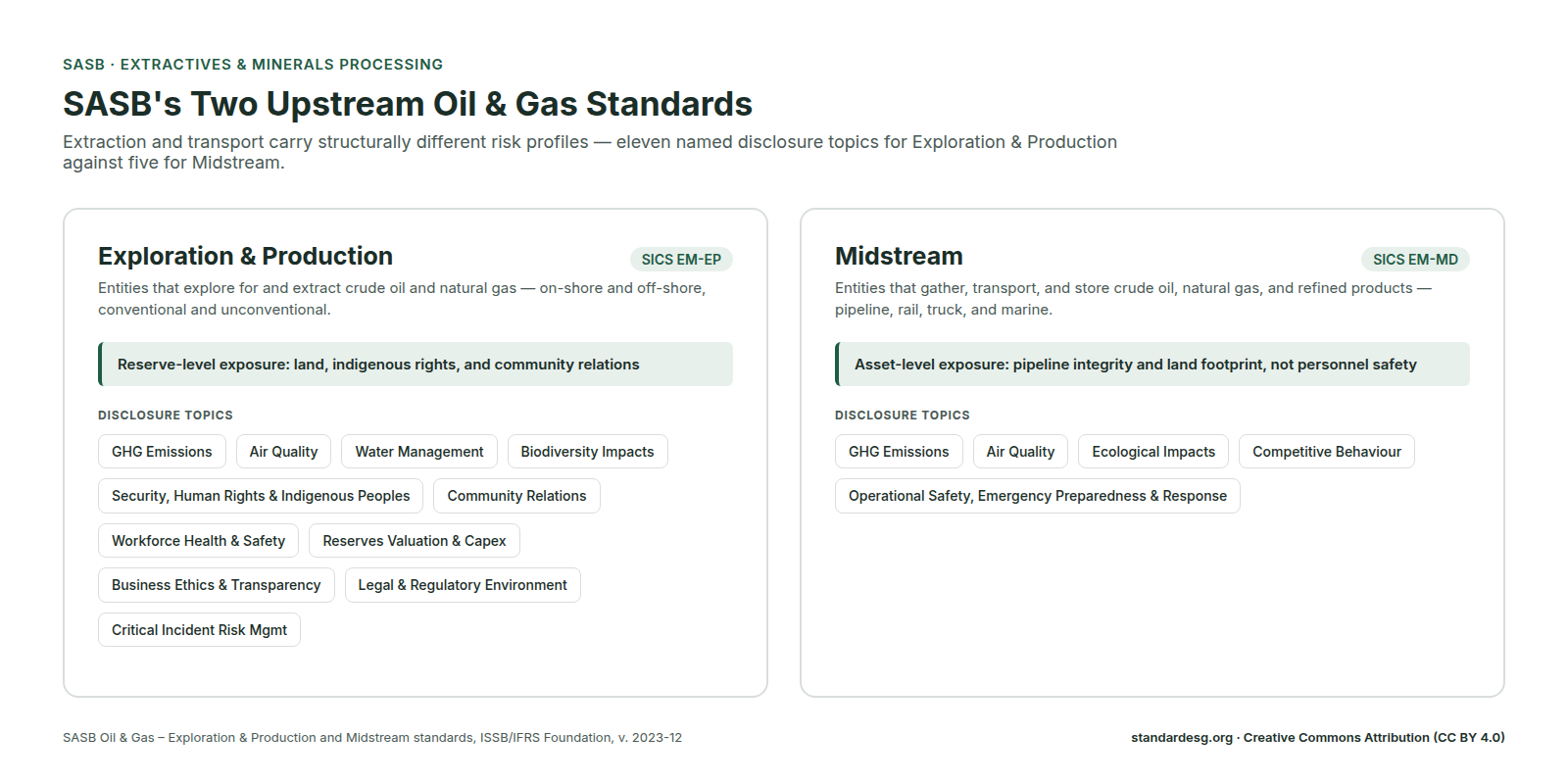
Each standard organizes its material risks into a small set of named disclosure topics, each with its own accompanying metrics (SASB's own terms: disclosure topics describe a specific sustainability-related risk or opportunity; metrics quantify or describe an entity's performance against a topic):
- Exploration & Production — Greenhouse Gas Emissions, Air Quality, Water Management, Biodiversity Impacts, Security, Human Rights & Rights of Indigenous Peoples, Community Relations, Workforce Health & Safety, Reserves Valuation & Capital Expenditures, Business Ethics & Transparency, Management of the Legal & Regulatory Environment, Critical Incident Risk Management.
- Midstream — Greenhouse Gas Emissions, Air Quality, Ecological Impacts, Competitive Behaviour, Operational Safety, Emergency Preparedness & Response.
The gap in topic count is itself informative: E&P carries eleven named topics against Midstream's five, reflecting how much more of the sector's environmental, social, and governance exposure sits at the point of extraction than along the pipe. The two standards share genuine common ground on emissions and air quality and a looser, differently-scoped overlap on land and ecological impact — but on safety, the topic that sounds most comparable on paper, the two standards measure something structurally different.
Greenhouse Gas Emissions and Air Quality
This is the one pair of topics that lines up cleanly between the two standards, right down to the metric structure. Both Greenhouse Gas Emissions topics require gross global Scope 1 emissions, the percentage of those emissions that is methane, and the percentage covered under an emissions-limiting regulation or programme such as cap-and-trade or a carbon tax (EM-EP-110a.1 / EM-MD-110a.1), plus a discussion of the entity's strategy for managing Scope 1 emissions and its performance against reduction targets (EM-EP-110a.3 / EM-MD-110a.2). E&P alone breaks its gross emissions down further by source — flared hydrocarbons, other combustion, process emissions, other vented emissions, and fugitive emissions disclosed separately (EM-EP-110a.2) — a level of source-attribution detail Midstream's standard doesn't require, consistent with flaring and venting being primarily a wellhead-stage practice rather than a pipeline-stage one. See Measuring GHG Emissions: Scope 1, 2 and 3 for how Scope 1 boundaries and consolidation approaches work in general; both upstream standards specify the same GHG Protocol-aligned methodology that article describes. Air Quality is identically scoped across both standards: NOx, SOx, volatile organic compounds, and particulate matter (PM10), each disclosed as a quantity in metric tonnes (EM-EP-120a.1 / EM-MD-120a.1) — the one topic in this guide where the metric itself, not just the topic name, is effectively shared.
Water Management and Hydraulic Fracturing Disclosure
Water Management is an E&P-specific topic with no Midstream counterpart, reflecting that water use and produced-water handling is overwhelmingly an extraction-stage concern. E&P requires total water withdrawn and consumed, with the percentage of each occurring in regions of High or Extremely High Baseline Water Stress (EM-EP-140a.1); the volume of produced water and flowback generated, split by percentage discharged, injected, or recycled, plus the hydrocarbon content of discharged water (EM-EP-140a.2); and two metrics specific to hydraulic fracturing — the percentage of fractured wells with public disclosure of all fracturing fluid chemicals used (EM-EP-140a.3), and the percentage of fracturing sites where ground or surface water quality deteriorated relative to a documented baseline (EM-EP-140a.4). That last metric is unusual among SASB's water topics for requiring a comparison against a baseline rather than a raw volume figure, which makes it one of the more directly falsifiable disclosures in the entire standard — an entity either did or didn't see measurable deterioration relative to what it recorded before drilling began.
Biodiversity, Land, and Ecological Impacts
Both standards carry a land-and-ecosystem topic, but they're scoped to different stages of exposure. E&P's Biodiversity Impacts covers environmental management policy for active sites (EM-EP-160a.1); the number and aggregate volume of hydrocarbon spills, with volume broken out separately for Arctic locations and for shorelines with high Environmental Sensitivity Index rankings (EM-EP-160a.2); and the percentage of proved and probable reserves located in or near sites with protected conservation status or endangered-species habitat (EM-EP-160a.3) — a forward-looking exposure metric based on where the entity's future extraction is likely to happen, not just where it operates today. Midstream's Ecological Impacts topic asks a related but distinct question, suited to a pipeline-and-terminal footprint rather than a well-and-reservoir one: the percentage of land owned, leased, or operated within protected or endangered-species areas (EM-MD-160a.2); terrestrial land area disturbed and the percentage of that area subsequently restored (EM-MD-160a.3); and, like E&P, a spill count and volume metric, though Midstream's version substitutes "sites with high biodiversity significance" for E&P's Arctic/shoreline-ESI framing (EM-MD-160a.4). The throughline across both is straightforward even though the metrics diverge: disclose where your footprint overlaps protected or sensitive land, and disclose what leaks out of your equipment when something goes wrong.
Human Rights, Indigenous Peoples, and Community Relations
This is the sharpest gap between the two standards, and worth naming plainly rather than glossing over: E&P carries two full topics on this ground and Midstream carries none. E&P's Security, Human Rights & Rights of Indigenous Peoples requires the percentage of proved and probable reserves located in or near areas of conflict (EM-EP-210a.1) and in or near indigenous land (EM-EP-210a.2), plus a discussion of the entity's engagement processes and due-diligence practices on human rights, indigenous rights, and operation in conflict areas (EM-EP-210a.3) — see Human Rights Due Diligence: The UN Guiding Principles Explained for the general due-diligence framework this topic asks an E&P entity to apply to its own operations. Community Relations adds a discussion of the entity's process for managing risks and opportunities tied to community rights and interests (EM-EP-210b.1), plus a quantitative count and duration of non-technical delays — project delays caused by community opposition or unresolved local disputes, as distinct from engineering or regulatory delays (EM-EP-210b.2). Midstream's standard is silent on all of this: no named topic covers pipeline routing through indigenous or contested land, community consultation, or delay caused by local opposition, despite pipeline projects being among the industry's most publicly contested infrastructure decisions of the last decade. A company reporting against Midstream alone should not read that silence as license to skip this ground — it's a known limitation of the standard as written, not a signal that the underlying risk doesn't exist for a pipeline operator.
Safety: A Genuine Divergence Between the Two Standards
Workforce Health & Safety, E&P's topic, measures people: total recordable incident rate (TRIR), fatality rate, near miss frequency rate, and average hours of health, safety, and emergency-response training, split between direct and contract employees (EM-EP-320a.1), plus a discussion of the management systems used to build a safety culture across the exploration-and-production lifecycle (EM-EP-320a.2). Midstream's nearest topic, Operational Safety, Emergency Preparedness & Response, measures assets, not people: the number of reportable pipeline incidents and what percentage were significant (EM-MD-540a.1), the percentage of natural gas and hazardous-liquid pipelines inspected (EM-MD-540a.2), the number of accident and non-accident releases from rail transportation (EM-MD-540a.3), and a discussion of the management systems used for safety culture and emergency preparedness (EM-MD-540a.4). Midstream carries no TRIR, fatality rate, or training-hours metric at all — a real and worth-flagging gap, since a pipeline company's own workforce still faces occupational injury risk even though the standard's safety topic is built entirely around pipeline-integrity and incident-response metrics rather than personnel ones. Template authors covering a Midstream SEIC group should not assume "Operational Safety" substitutes for occupational health and safety evidence — it doesn't cover the same ground E&P's topic does.
Reserves, Business Ethics, and Regulatory Exposure
Three of E&P's remaining topics have no real Midstream analogue, for a structural reason: an E&P entity owns hydrocarbon reserves and a Midstream entity generally doesn't. Reserves Valuation & Capital Expenditures requires the sensitivity of reserve levels to future price scenarios that account for a price on carbon (EM-EP-420a.1), the estimated CO2 embedded in proved reserves (EM-EP-420a.2), the amount invested in and revenue generated by renewable energy (EM-EP-420a.3), and a discussion of how hydrocarbon price/demand or climate regulation shapes capital-expenditure strategy for exploration and development (EM-EP-420a.4) — a set of forward-looking, scenario-based disclosures closer in spirit to climate transition-risk reporting than to a typical operational metric. Business Ethics & Transparency requires the percentage of reserves located in the 20 lowest-ranked countries on Transparency International's Corruption Perception Index (EM-EP-510a.1) and a description of the anti-corruption management system covering the value chain (EM-EP-510a.2). Both standards separately carry a Management of the Legal & Regulatory Environment topic, requiring a discussion of the entity's corporate positions on environmental- and social-relevant regulation or policy proposals (EM-EP-530a.1), though the same disclosure intent underlies Midstream's Competitive Behaviour topic below rather than a direct numbered equivalent. Midstream's own governance-adjacent topic, Competitive Behaviour, is narrower and more specific: total monetary losses from legal proceedings tied to pipeline and storage regulation (EM-MD-520a.1) — a compliance-cost metric rather than a corruption-exposure one. Both standards close with a Critical Incident Risk Management topic: E&P requires Process Safety Event (Tier 1) rates and a discussion of management systems for catastrophic/tail-end risk (EM-EP-540a.1, EM-EP-540a.2); Midstream folds the equivalent intent into its Operational Safety topic above rather than naming it separately.
Mapping to Standard ESG Subjects
The shared GHG and air-quality topics map to E3 — Emissions & climate; water and hydraulic-fracturing disclosure maps to E2 — Resource use; and the land/spill/protected-area content in both standards' biodiversity topics maps to E5 — Biodiversity & land use, the industry-dependent subject that gets concrete, checkable content here rather than a generic policy statement. E&P's human rights, indigenous-peoples, and community relations topics map to S3 — Human rights & due diligence and S4 — Community involvement & development respectively — and the gap identified above is a genuine limitation to flag for a Midstream-only SEIC group's template, not something to paper over with S3/S4 indicators the underlying SASB standard doesn't actually support. The safety divergence above means E&P's Workforce Health & Safety maps cleanly to S2 — Occupational health & safety, while Midstream's Operational Safety topic maps more accurately to G5 — Risk management & compliance (asset-integrity and incident-response risk) than to S2 — a deliberate deviation from treating "safety" as a single subject regardless of what's actually being measured. E&P's Business Ethics topic maps to G2 — Ethics, anti-corruption & fair operating practices; its Reserves Valuation topic and both standards' Critical Incident/Legal & Regulatory Environment topics map to G5 — Risk management & compliance, reflecting their shared character as strategic and compliance-risk disclosures rather than operational-performance metrics.
Which SEIC Sectors This Deepens Coverage For
These two standards carry the most weight for exactly the SEIC groups their SICS codes name: upstream oil and gas exploration and production companies (EM-EP) and pipeline, gathering, processing, and storage operators (EM-MD). A company that also refines, markets, or provides drilling/oilfield services alongside upstream operations should additionally consult ESG in Oil and Gas Downstream: What SASB's Refining & Marketing and Services Standards Require, the companion guide covering the other half of the oil and gas value chain — per SASB's own guidance, an integrated entity should apply every relevant pure-play standard to its corresponding segment rather than picking just one.
Getting Started
An upstream oil and gas company building out its E2, E3, E5, S3, and S4 evidence base can work through these two standards' shared and distinct ground roughly as follows:
- Confirm which standard — or both — actually applies: E&P for extraction activities, Midstream for gathering/transport/storage, both if the entity spans the segment boundary.
- Start with GHG emissions and air quality: the one topic pair genuinely shared across both standards, and the foundation most other extractives-sector evidence builds from.
- If you operate E&P assets specifically, inventory produced-water handling and hydraulic-fracturing chemical disclosure practices — these carry metrics unique to extraction that a Midstream-only operator won't need.
- Map your land footprint against protected areas, endangered-species habitat, and (for E&P) indigenous land and conflict zones — this is the ground where the two standards diverge most, so don't assume Midstream's lighter topic list means lighter actual exposure.
- Build separate evidence trails for personnel safety (TRIR, training hours) and asset safety (pipeline inspection rates, incident counts) rather than treating "safety" as one undifferentiated category.
See What to Expect from an On-Site ESG Assessment (Level 3) for how field-level safety and environmental evidence like this gets verified physically on site.
Standard ESG (standardesg.org) draws on SASB's Exploration & Production and Midstream standards to deepen subjects E2, E3, and E5 for upstream oil and gas companies, alongside S2, S3, and S4 for the sector's safety, human-rights, and community exposure. See The Standard ESG Certification Protocol: A Public Overview for how industry-dependent subjects fit into the full pillar and subject architecture.
Was this page useful?