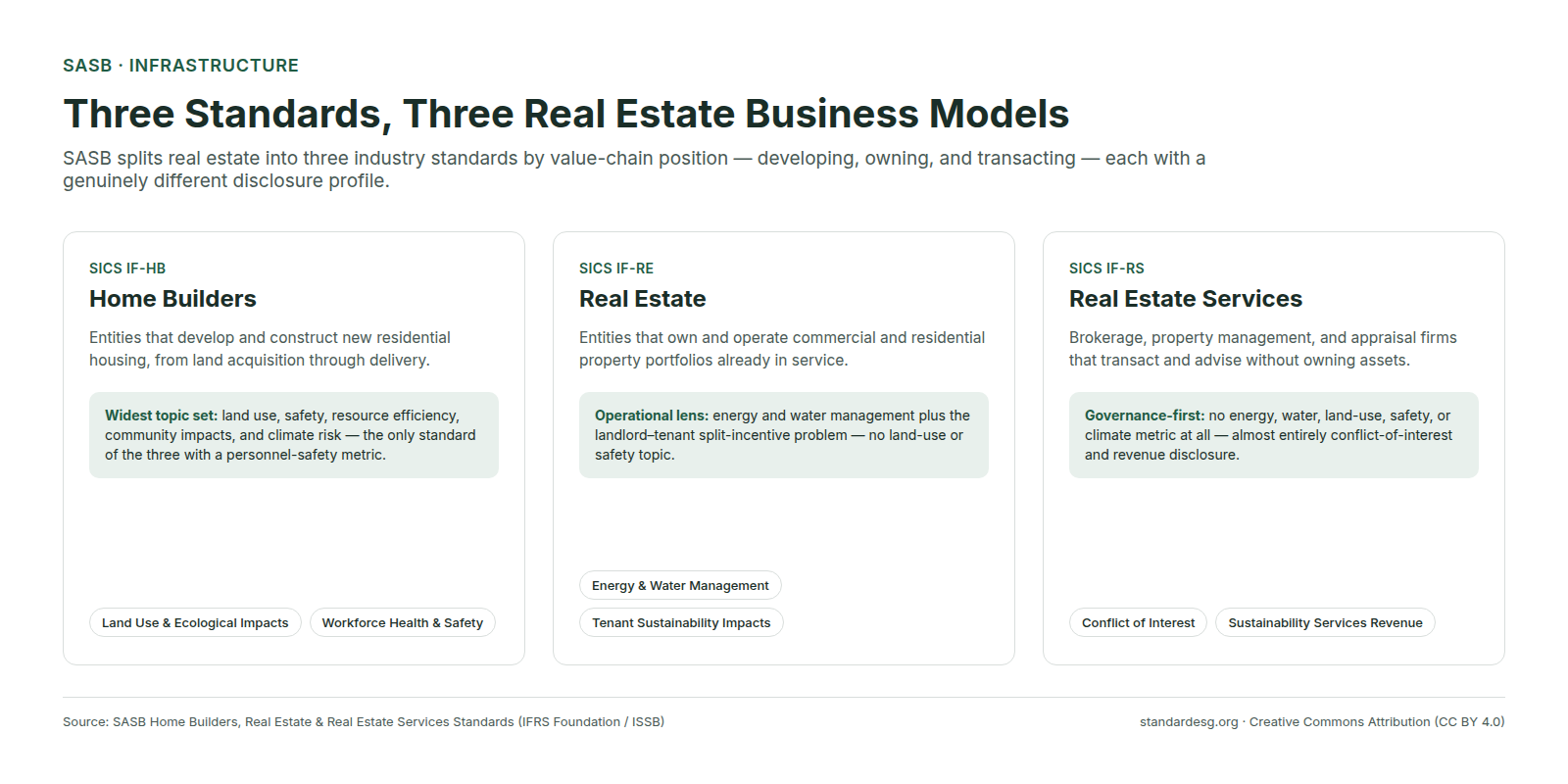
Three Standards for One Built Asset
SASB — now maintained by the International Sustainability Standards Board (ISSB) as part of the IFRS Foundation — splits real estate into three industry standards that correspond to three different relationships with a building: Home Builders (SICS IF-HB), covering entities that develop and construct new residential housing; Real Estate (SICS IF-RE), covering entities that own and operate commercial and residential property portfolios — office, retail, industrial, multifamily, healthcare, lodging, and more; and Real Estate Services (SICS IF-RS), covering brokerage, property management, and appraisal firms that provide services around real estate transactions and building performance without holding the assets themselves. A single diversified real estate group can be subject to more than one of these standards at once — a company that both builds and manages housing, for instance, would apply IF-HB to its development activity and IF-RE or IF-RS to its ownership or services activity — SASB's guidance throughout is to apply each relevant pure-play standard to the corresponding segment of the business.
The Three SASB Standards at a Glance
Home Builders (IF-HB) carries the widest disclosure topic set of the three: Land Use & Ecological Impacts, Workforce Health & Safety, Design for Resource Efficiency, Community Impacts of New Developments, and Climate Change Adaptation. It is the only one of the three standards with a dedicated personnel-safety metric and the only one with a community-impact topic tied specifically to where and how new housing gets built.
Real Estate (IF-RE) is narrower and almost entirely operational: Energy Management, Water Management, Management of Tenant Sustainability Impacts, and Climate Change Adaptation. It has no land-use, safety, or community topic at all — its lens is the building as an asset already in service, not the act of building or selling it.
Real Estate Services (IF-RS) is the sharpest departure of the three. Its only two disclosure topics are Sustainability Services (revenue and floor area associated with energy/sustainability advisory work the entity sells to clients) and Transparent Information & Management of Conflict of Interest (dual-agency and appraisal-integrity risk). There is no energy, water, land-use, safety, or climate metric anywhere in this standard — a striking gap for a real-estate-labeled standard, and the clearest example in this guide of how differently SASB treats a company that owns or builds a building versus one that merely transacts around it.
Resource Efficiency: Energy and Water Management
IF-RE's Energy Management topic requires disclosing energy consumption data coverage as a percentage of portfolio floor area (IF-RE-130a.1), total energy consumed with the grid-electricity/renewable split (IF-RE-130a.2), like-for-like consumption change (IF-RE-130a.3), and the percentage of the portfolio that is ENERGY STAR-certified or carries an energy rating (IF-RE-130a.4), all disclosed by property sector rather than as a single blended figure — an office portfolio and a multifamily portfolio have different baselines and don't compress meaningfully into one number. Water Management mirrors this structure: withdrawal data coverage (IF-RE-140a.1), including the share in regions of High or Extremely High Baseline Water Stress, total withdrawal with the water-stress split (IF-RE-140a.2), and like-for-like change (IF-RE-140a.3).
IF-HB's equivalent, Design for Resource Efficiency, is framed around what gets built rather than what gets consumed in operation: the number of homes delivered with a certified energy-efficiency rating and the average rating (IF-HB-410a.1), the percentage of installed water fixtures certified to a water-efficiency standard (IF-HB-410a.2), and the number of homes certified to a third-party multi-attribute green building standard (IF-HB-410a.3). Both standards measure resource efficiency, but at different points in the asset's life — IF-HB at the point of design and delivery, IF-RE across years of ongoing operation. IF-RS has no resource-consumption metric of its own; its one adjacent metric, floor area under management that obtained an energy rating (IF-RS-410a.3), measures the services firm's advisory reach, not its own or its clients' actual energy performance.
Land Use and Ecological Impacts: A Home-Builder-Only Topic
Land Use & Ecological Impacts exists only in IF-HB, and it is the standard's largest topic by metric count. It requires the number of lots and homes delivered on redevelopment sites — brownfield or greyfield land, as opposed to undeveloped greenfield (IF-HB-160a.1) — the number of lots and homes delivered in regions of High or Extremely High Baseline Water Stress (IF-HB-160a.2), monetary losses from legal proceedings tied to environmental regulations (IF-HB-160a.3), and a qualitative discussion of how environmental considerations are integrated into site selection and design (IF-HB-160a.4). Neither IF-RE nor IF-RS has anything comparable — once a building exists and is being owned, operated, or transacted, SASB no longer tracks the ecological footprint of the land it sits on. That footprint is treated entirely as a development-stage disclosure, owned by whoever does the building.
Climate Change Adaptation: Physical Risk Across Two Standards
Both IF-HB and IF-RE carry a Climate Change Adaptation topic, and the two are close to identical in structure: the area (IF-RE, by square metres) or number (IF-HB, by lots) located in 100-year flood zones (IF-HB-420a.1 / IF-RE-450a.1), and a qualitative discussion of climate risk exposure analysis, the degree of systematic portfolio exposure, and mitigation strategy (IF-HB-420a.2 / IF-RE-450a.2). This is physical climate risk exposure, not GHG emissions accounting — neither standard requires a Scope 1/2 emissions metric for buildings, which is a real gap relative to other SASB sectors and worth flagging rather than assuming coverage that isn't there. IF-RS has no climate exposure metric at all — a broker or appraiser doesn't carry the flood-zone exposure of a property it doesn't own, though its clients' portfolios plainly do.
Workforce Safety and Community Impacts of New Developments
IF-HB is the only one of the three standards with a personnel-safety metric: total recordable incident rate (TRIR) and fatality rate, for direct and contract employees separately (IF-HB-320a.1) — construction is physical, on-site work, and SASB treats it accordingly. Neither IF-RE nor IF-RS carries anything comparable; operating or transacting around a finished building doesn't carry the same occupational-injury profile as building one.
IF-HB also carries Community Impacts of New Developments, covering how proximity to infrastructure and economic centres factors into site-selection decisions (IF-HB-410b.1), the number of lots and homes delivered on infill sites — as opposed to standalone greenfield subdivisions (IF-HB-410b.2), and the number of homes delivered in compact developments along with average density (IF-HB-410b.3). This is a land-use-planning and community-footprint topic, distinct from Land Use & Ecological Impacts above — one is about the ecological cost of where and how a development sits, this one is about the development's effect on surrounding infrastructure, sprawl, and community density patterns.
Managing Tenant Sustainability Impacts
IF-RE carries one topic with no real counterpart in either of the other two standards: Management of Tenant Sustainability Impacts. It requires the percentage of new leases containing a cost-recovery clause for resource-efficiency capital improvements, and the associated leased floor area (IF-RE-410a.1), the percentage of tenants separately metered or submetered for electricity and water (IF-RE-410a.2), and a qualitative discussion of the owner's approach to measuring, incentivising, and improving tenant sustainability impacts (IF-RE-410a.3). This exists because a real estate owner frequently doesn't control the energy or water a tenant actually consumes inside a leased space — the split-incentive problem that shows up across sustainability disclosure generally, where the party paying for efficiency upgrades and the party paying the utility bill aren't the same entity. Green-lease structures, submetering, and cost-recovery clauses are how IF-RE expects owners to address that misalignment.
Transparent Information and Conflict of Interest: Real Estate Services' Different Risk Profile
This is the topic that most separates IF-RS from its two sibling standards. Its metrics are brokerage revenue from dual-agency transactions, where the entity represents both buyer and seller in the same deal (IF-RS-510a.1), revenue from appraisal services (IF-RS-510a.2), and monetary losses from legal proceedings tied to professional integrity, including duty of care (IF-RS-510a.3). SASB's own framing is direct: the real estate services business model depends on client trust, and the range of services and professionals within one organisation makes conflicts of interest — particularly in brokerage and appraisal work — a genuine governance risk rather than an environmental or social one. Paired with the Sustainability Services topic's revenue-and-reach metrics (IF-RS-410a.1–3, described in the Resource Efficiency section above), IF-RS ends up almost entirely a governance-and-business-model standard, with no direct environmental or safety content of its own — a real, not superficial, divergence from IF-HB and IF-RE.
Mapping to Standard ESG Subjects
The brief for this guide anticipated E2 (resource use) and E3 (climate risk) as the core subjects, and both hold up — but reading the three standards closely surfaced a wider spread than that starting hypothesis:
- E2 (Resource use: energy, water, materials) — IF-HB's Design for Resource Efficiency, IF-RE's Energy Management and Water Management, and IF-RE's Management of Tenant Sustainability Impacts (a resource-efficiency incentive-structure topic, not a community one, despite the word "tenant" inviting an S4 reading at first glance).
- E3 (Emissions & climate) — Climate Change Adaptation in both IF-HB and IF-RE. Note what this subject is not covering here: neither standard requires a Scope 1/2 emissions metric for buildings, so this mapping rests entirely on physical climate-risk exposure content, not emissions accounting.
- E5 (Biodiversity & land use, industry-dependent) — added beyond the original brief. IF-HB's Land Use & Ecological Impacts topic is squarely a land-use subject, not a generic resource-use one, and it's large enough in the standard (four metrics, the standard's biggest topic) to warrant its own subject rather than folding into E2.
- S2 (Occupational health & safety) — added beyond the original brief. IF-HB's Workforce Health & Safety metric (TRIR, fatality rate) is a direct match that the brief's S4-only social framing missed.
- S4 (Community involvement & development) — IF-HB's Community Impacts of New Developments (infill vs. greenfield siting, density, proximity to infrastructure). Unlike the E5 land-use topic above, this one is genuinely about community and built-environment effects, not ecology.
- G2 (Ethics, anti-corruption & fair operating practices) — added beyond the original brief. IF-RS's Transparent Information & Management of Conflict of Interest is a fair-dealing and professional-integrity topic, not a risk-management-process one — dual agency and appraisal conflicts are ethics questions about who a broker is actually representing, closer to G2 than G5.
One subject from the original brief didn't hold up on inspection: G5 (Risk management & compliance) was anticipated for the standards' Discussion-and-Analysis climate and legal-proceedings items, but on reading closely, both the climate content (physical exposure and mitigation strategy) and the conflict-of-interest content (professional integrity, not enterprise risk process) map more precisely to E3 and G2 respectively — dropped rather than forced in.
Which SEIC Sectors This Deepens Coverage For
Standard ESG's own industry classification includes dedicated groups for Home Builders, Real Estate, and Real Estate Services under the Infrastructure sector. This guide is their primary industry-specific grounding. One honest gap worth naming: the Home Builders group currently carries no mapped ISIC Rev. 4 classification codes in Standard ESG's own taxonomy, unlike Real Estate and Real Estate Services, which are both mapped — a registrant whose primary activity is home building may currently be classified under a different group pending that mapping being completed.
For companies operating specifically in commercial property valuation and advisory work, see ESG in Commercial Real Estate: The RICS Standard Explained, which covers the professional-standard side of real estate ESG — how sustainability considerations feed into valuation and strategic advice — as a complement to this guide's SASB-specific disclosure-topic angle rather than a duplicate of it.
Getting Started
- Identify which of the three standards — or which combination — actually applies: a pure developer applies IF-HB, a portfolio owner/operator applies IF-RE, and a brokerage, property-management, or appraisal firm applies IF-RS. A diversified group may need more than one.
- Read the full disclosure topic list against your own operations before assuming symmetry between the three standards — each standard carries at least one topic with no equivalent in either of the other two, so treating "real estate" as a single undifferentiated checklist will miss real requirements.
- For portfolio owners specifically, the split-incentive problem behind IF-RE's Tenant Sustainability Impacts topic is worth engaging early — green-lease clauses and submetering infrastructure take time to roll out across an existing portfolio, more than most of the other metrics in this guide.
- Cross-reference against Measuring GHG Emissions: Scope 1, 2 and 3 if your organisation wants to report building emissions directly — SASB's own real estate standards stop at physical climate-risk exposure and don't require it.
Was this page useful?