Why a Separate Evidence Piece
Corporate Governance, Ethics and Anti-Corruption already covers what Standard ESG's subject G1 expects structurally: a board that exercises genuine oversight across financial, human, social, and natural capital, in line with the IFRS Integrated Reporting Framework's capitals thinking. What that primer doesn't do — deliberately, since it's a protocol-mapping piece, not a research survey — is examine the empirical question underneath the structural one: does board composition actually correlate with ESG performance, and which specific characteristics does the evidence support? This guide answers that question directly, grounded in a 2026 peer-reviewed study of European boards, and is written for readers already comfortable with G1's structural requirements who want to know what the data actually says about board design choices.
The Study Behind This Guide
The evidence in this guide is drawn from Pérez Escamez, Santos-Jaén, Gallardo-Vázquez, and Martínez-Conesa's "Corporate governance and ESG integration: pathways to sustainability in European companies" (Economics of Governance, 2026). The study examined companies in the Euro Stoxx 300 index — a benchmark of large, leading European listed firms — over 2012 to 2023, using Thomson Reuters Eikon data across 1,322 firm-year observations. It tested seven board characteristics — gender diversity, the proportion of non-executive members, board tenure, board size, cultural diversity, meeting attendance, and compensation — against overall ESG performance and each of its three pillar scores individually, using fixed-effects panel regression (the model the study's own diagnostic tests favored over ordinary least squares or random effects) to control for unobserved differences between firms. To address the concern that well-governed companies might simply attract certain kinds of directors rather than board composition actually driving ESG outcomes — a reverse-causality problem inherent to this kind of research — the authors additionally re-ran their models using board characteristics lagged by one year, and found materially the same results. This doesn't eliminate causal ambiguity entirely (Section 10), but it's a meaningfully stronger research design than a simple cross-sectional correlation.
Gender Diversity: The Strongest Positive Finding
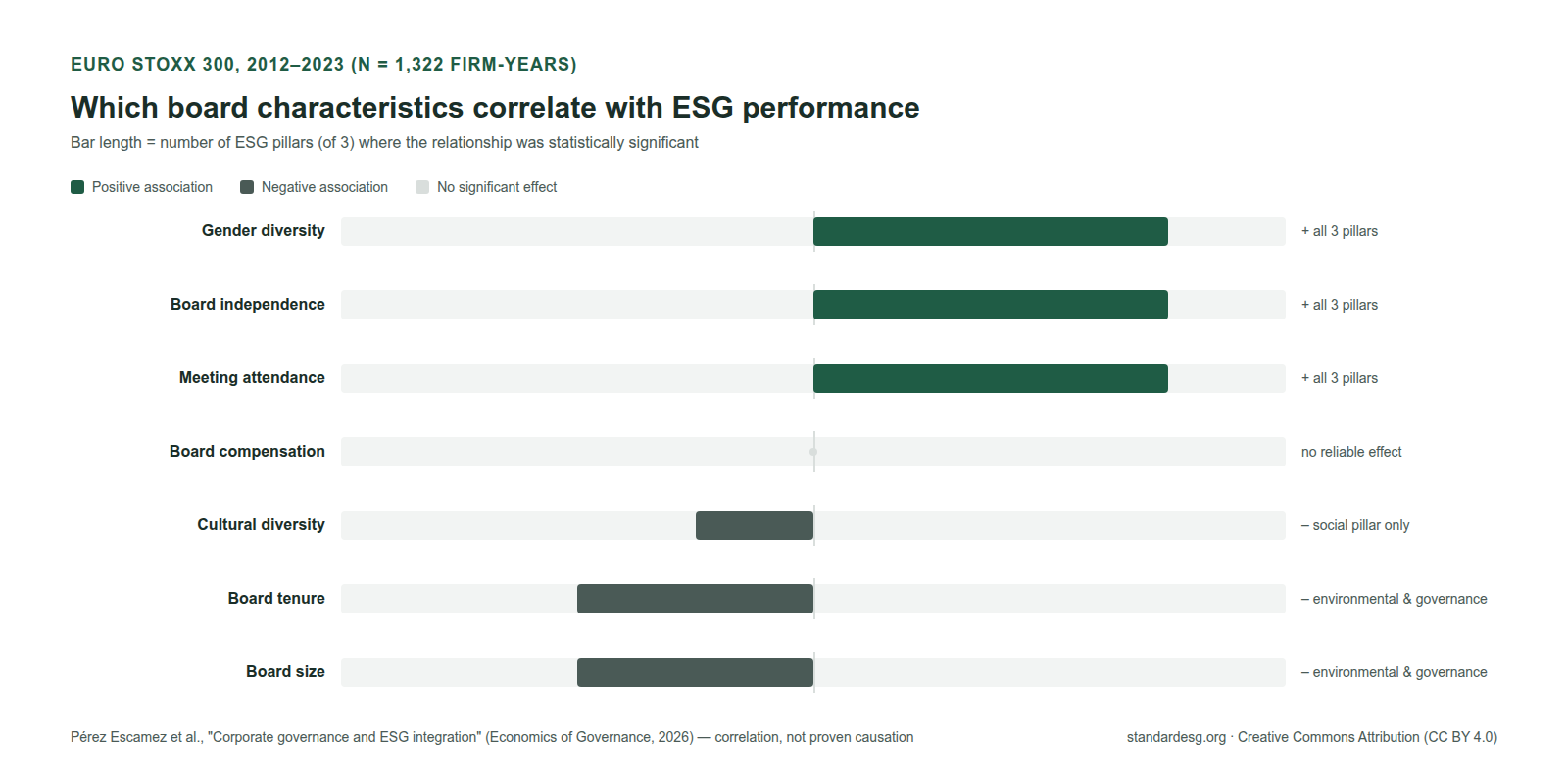
Board gender diversity showed the most consistent result in the entire study: a positive, statistically significant relationship with overall ESG performance and with each of the three individual pillar scores. In the study's preferred fixed-effects model, a percentage-point increase in board gender diversity was associated with a 0.298-point increase in the governance pillar score specifically — a similar pattern held for the environmental and social pillars. The authors' interpretation draws on two complementary explanations from the wider governance literature: female directors are associated with more active monitoring and broader stakeholder orientation, and their presence on a board can function as a signal of the organization's inclusion of a wider stakeholder group more generally. It's worth noting explicitly what the study does and doesn't claim here: it does not claim women are inherently better governors, but that gender-diverse boards, on average, in this European large-cap sample, over this period, correlate with stronger ESG outcomes across all three pillars — the most robust and least contested result the paper produces.
Board Independence: A Second Consistent Positive
The proportion of non-executive (independent) board members showed the same pattern as gender diversity: positive and statistically significant across overall ESG performance and all three individual pillars. The reasoning is more structural than the gender-diversity finding: non-executive directors aren't involved in a company's day-to-day operations, which the literature generally treats as making them more capable of objective, unbiased oversight — including oversight of sustainability commitments that might otherwise get deprioritized against short-term operational pressure. This finding lines up directly with what Standard ESG's own G1 subject already expects structurally (board oversight independent enough to genuinely evaluate management's decisions, not merely ratify them) — it's evidence that the structural requirement and the empirical outcome point the same direction, not just a theoretical alignment.
Board Meeting Attendance: Engagement Matters More Than Structure
A third positive, significant, and consistent finding across every ESG measure: how often board members actually show up. Higher average meeting attendance correlated with better ESG performance overall and on every individual pillar. This is arguably the least glamorous finding in the study, but it may be the most practically useful one for a company evaluating its own governance: attendance is directly observable and directly actionable in a way that "increase board diversity" or "reduce board tenure" are not — a board can decide tomorrow to hold more frequent meetings and expect attendance, in a way it cannot simply decide to become instantly more diverse or younger. The authors frame this as reflecting genuine engagement and active oversight, consistent with agency-theory expectations that regular, well-attended meetings translate into stronger monitoring of management, including on sustainability commitments specifically.
Board Tenure: A Negative Finding, With Caveats
Longer average board tenure showed a negative, statistically significant relationship with overall ESG score and with the environmental and governance pillars specifically — though notably, not with the social pillar, where the relationship wasn't statistically significant. The authors' interpretation leans on a trade-off already well established in governance research: longer-tenured directors accumulate valuable firm-specific knowledge and experience, but can also become more entrenched and less receptive to organizational change — a liability specifically for sustainability questions, which have evolved rapidly and where younger or more recently appointed directors may bring more current awareness of emerging expectations. This is a genuine trade-off, not a one-directional finding: the study isn't arguing that experienced directors are a governance liability generally, only that, in this specific sample and period, longer average tenure correlated with weaker ESG outcomes on two of three pillars.
Board Size: Bigger Isn't Better Here
Board size also showed a negative, significant relationship with overall ESG performance and with the environmental and governance pillars — again, not significantly with the social pillar. This runs against one intuitive assumption (a larger board brings more perspectives and expertise, which should help with complex ESG questions) but is consistent with a competing, equally well-established strand of governance research: past a certain point, larger boards face coordination costs, slower decision-making, and diluted individual accountability that can outweigh the benefit of additional perspectives. The authors describe this as a threshold effect rather than a straight linear one — a genuinely useful nuance, since it means the finding isn't "small boards are always better," but that very large boards specifically may struggle to translate size into more effective sustainability oversight.
Cultural Diversity: A Genuinely Contested Finding
Cultural diversity on the board (measured as diversity of directors' national and cultural backgrounds) showed a negative, significant relationship with overall ESG performance and with the social pillar specifically, but no significant relationship with the environmental or governance pillars. This is the finding this guide treats with the most caution, for two reasons the study itself is candid about. First, the wider academic literature on cultural diversity and governance outcomes is genuinely mixed — the study's own literature review cites research finding positive, negative, and mixed relationships across different countries and samples, not a settled consensus the new finding simply confirms. Second, the authors offer a specifically non-damning interpretation alongside the more common "coordination friction" explanation: a culturally diverse board may reflect a company with greater international operations and regulatory complexity, in which case the observed effect may capture that underlying organizational complexity rather than cultural diversity itself functioning as a governance weakness. Readers should treat this specific finding as suggestive rather than conclusive, more so than the gender-diversity or independence findings above.
Board Compensation: No Reliable Effect Found
Board member compensation was the one characteristic the study tested that showed no statistically significant relationship with ESG performance, overall or on any individual pillar, in the preferred fixed-effects specification — despite some alternative model specifications showing a positive effect, and despite a substantial prior literature arguing that tying director compensation to sustainability metrics should align incentives with ESG outcomes. The authors' own reading is that this result "underscores the limits of incentive-based governance mechanisms" in this sample: formal compensation-linked incentives alone don't appear to reliably drive stronger ESG performance among large European listed firms, at least not in a way this study's methodology could detect. This is a useful corrective for the common assumption that adding an ESG-linked bonus to board compensation is, by itself, a meaningful governance lever — the evidence here suggests it isn't, or at least not consistently.
Correlation, Not Causation: Reading This Evidence Carefully
- Endogeneity isn't fully eliminated. Fixed effects and lagged variables reduce, but don't eliminate, the risk that some unobserved factor drives both a company's board composition and its ESG performance simultaneously — a company already committed to strong governance may independently choose both more diverse boards and stronger ESG practices, without one causing the other.
- The sample is European large-caps, not global. Euro Stoxx 300 companies operate in a specific regulatory and cultural context — relatively mature ESG regulation, strong institutional pressure, common European corporate-governance norms. The authors explicitly caution that results may not generalize to companies in other regions with different legal, cultural, and regulatory environments.
- Relationships were modeled as linear. The study didn't test for threshold or nonlinear effects (a board could plausibly get "diverse enough" or "small enough" that further change stops mattering, similar to the S-shaped ESG-and-firm-value relationship described in ESG and Financial Performance: What the Evidence Actually Shows) — a limitation the study's own authors flag as a direction for future research.
None of this means the findings are unreliable — the fixed-effects design and lagged robustness checks are a genuinely stronger standard of evidence than most single-year cross-sectional studies in this space. It means the honest, defensible reading is "these board characteristics correlate with ESG performance in large European companies, with a research design that partially — not fully — addresses reverse causality," not "diverse, independent, engaged boards cause better ESG performance, proven."
Mapping to Standard ESG Subject G1
Standard ESG's subject G1 — Organizational governance & board oversight scores the structural quality of a company's board oversight, aligned with the IFRS Integrated Reporting Framework's capitals thinking (see Corporate Governance, Ethics and Anti-Corruption for the full detail). This guide's evidence doesn't change what G1 asks for — Standard ESG doesn't score a company's literal board gender ratio or director tenure as indicators in their own right — but it does explain why the structural requirements G1 tests for (genuine independence, active oversight, engaged deliberation) are the ones the protocol emphasizes: they're exactly the board characteristics — independence and meeting attendance specifically — that this evidence base finds most consistently and robustly associated with stronger ESG performance across all three pillars, not just governance in isolation. Where G1 asks "does this board exercise genuine oversight," this guide is evidence for why that question is the right one to be asking in the first place.
What This Means for a Board Composition Decision
- Prioritize genuine board engagement — meeting frequency and attendance — as a practical, directly actionable lever with the most consistent evidence behind it across all three ESG pillars.
- Treat gender diversity and non-executive independence as characteristics with strong, consistent, multi-pillar evidence behind them in this sample, worth weighing seriously in board composition and succession planning.
- Be more cautious drawing a hard conclusion from the board-size and tenure findings — real trade-offs exist (experience and firm-specific knowledge have genuine value), and the evidence points to average, not universal, effects.
- Treat the cultural-diversity finding as the least settled result here, given the genuinely mixed prior literature and the plausible alternative explanation the study's own authors raise.
- Don't treat an ESG-linked compensation scheme as a governance lever that, by itself, reliably improves ESG performance — this evidence found no consistent effect.
- Remember throughout: this is correlational evidence from one region and one period. Weight it as a serious, methodologically stronger-than-average input into a board composition decision — not as settled proof of what causes what.
Standard ESG (standardesg.org) scores board oversight structurally under subject G1. See Corporate Governance, Ethics and Anti-Corruption for the full G1 framework, and ESG and Financial Performance: What the Evidence Actually Shows for the parallel evidence base on ESG and financial outcomes more broadly.
Cette page vous a-t-elle été utile ?