Overview
A company's credit rating, its ESG rating, and a certification like Standard ESG's can all show up in the same due-diligence packet — and it's easy to assume they're measuring roughly the same thing from three different angles. They aren't. This guide explains specifically how the four largest credit rating agencies now incorporate ESG risk into creditworthiness assessments, why the "pure ESG" scores those same agencies also sell are a genuinely different product from the credit rating itself, and why neither one substitutes for independently verified evidence of ESG performance.
Three Different Products, One Company
It's entirely possible for the same company to carry a credit rating, an ESG rating, and a Standard ESG certificate at once — and each one is answering a genuinely different question. A credit rating answers "how likely is this issuer to default on its debt obligations?" — a forward-looking assessment of creditworthiness, traditionally built from financial ratios, cash flow analysis, and competitive position. An ESG rating answers "how well does this company manage environmental, social, and governance factors?" — a sustainability-performance assessment, typically based on disclosed information and a provider's proprietary weighting (see ESG Ratings vs. ESG Certification for the full picture of how that product works and where it falls short). A Standard ESG certificate answers "has this company's ESG performance been independently verified against a published methodology, and to what depth?" This guide focuses specifically on the first category and its increasingly blurred boundary with the second, since major credit rating agencies now produce both products under the same brand.
Why Credit Rating Agencies Started Incorporating ESG
Climate change poses genuine, quantifiable risk to a company's financial position, which is precisely the kind of risk a credit rating agency exists to price. The Task Force on Climate-related Financial Disclosures (TCFD) frames this as two distinct risk types: physical risks — the direct financial impact of more frequent or more severe weather events (acute) or longer-term shifts in climate patterns (chronic) — and transition risks — the financial impact of the shift to a lower-carbon economy itself: policy and legal costs (carbon pricing, new regulation, litigation exposure), technology costs (stranded investment in outdated processes), market shifts (changing customer demand, rising input costs), and reputational effects. Because both risk types can materially affect a company's future cash flows, asset values, and ability to service debt, they fall squarely within what a credit rating is supposed to capture — which is exactly why the four largest global credit rating agencies now build ESG risk into their assessments rather than treating it as a separate, optional overlay.
Physical Risk, Transition Risk, and Credit Quality
The mechanism connecting ESG factors to credit quality runs through ordinary financial statements, not through some parallel sustainability logic. Regulatory changes tied to climate policy can increase the capital a company must hold and compress its operating margins; pollution fines and clean-up liabilities show up as direct cash outflows; governance failures and scandals — child labour, fraud, corruption — damage brand value and investor confidence in ways that deteriorate future credit quality. Credit rating agencies' focus, importantly, is narrower than a full ESG assessment: Moody's, Standard & Poor's, Fitch, and DBRS assess the financial impact ESG factors have on the company itself, not the impact the company has on the environment or society — a single-materiality lens, structurally similar to the financial-materiality test IFRS S1/S2 apply (see IFRS S1 and S2 Explained §3), rather than the double-materiality lens the EU's CSRD/ESRS regime uses.
How the Four Major Agencies Actually Differ
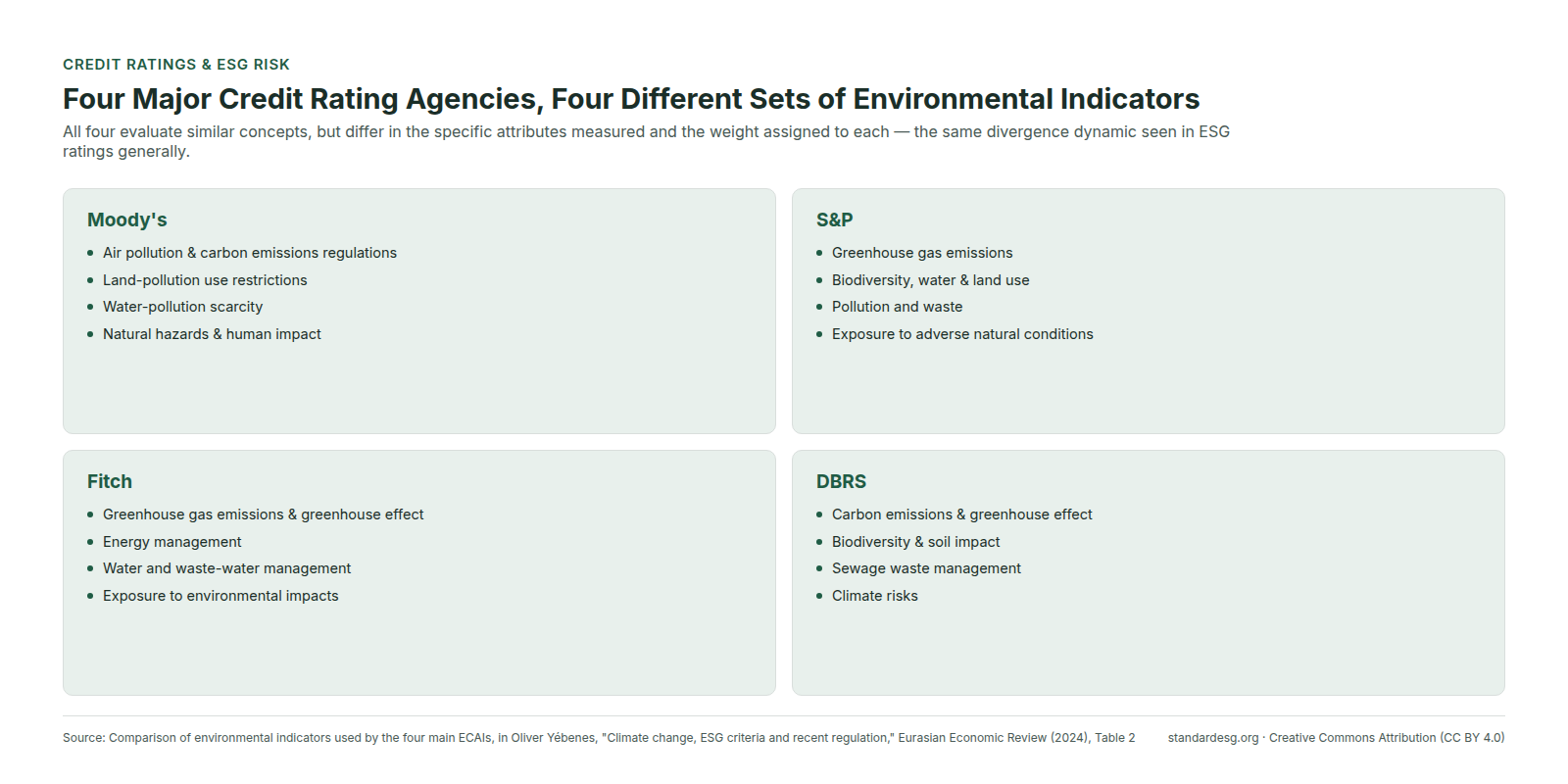
All four major agencies have built their own ESG risk-assessment framework and produce "ESG heat maps" indicating the relative materiality of ESG risk by sector — but the specific indicators each one tracks for environmental and climate risk differ meaningfully:
- Moody's — Air pollution & carbon emissions regulations; land-pollution use restrictions; water-pollution scarcity; natural hazards & human impact.
- S&P — Greenhouse gas emissions; biodiversity, water & land use; pollution and waste; exposure to adverse natural conditions.
- Fitch — Greenhouse gas emissions & greenhouse effect; energy management; water and waste-water management; exposure to environmental impacts.
- DBRS — Carbon emissions & greenhouse effect; biodiversity & soil impact; sewage waste management; climate risks.
All four evaluate broadly similar concepts — emissions, pollution, resource use, and physical exposure — but differ in the specific attributes measured, the underlying methodology, and, critically, the weight each assigns to a given factor. This divergence in weighting is flagged as a likely primary driver of differing ESG-risk impacts on a company's final rating across agencies — the same underlying dynamic behind the broader ESG ratings divergence problem described in ESG Ratings vs. ESG Certification §3, here specifically affecting how climate and environmental risk factor into creditworthiness.
"Pure ESG" Ratings Are a Separate Product
Beyond incorporating ESG into the credit rating itself, major agencies — including several who have acquired specialist ESG-ratings businesses — now also sell standalone "pure ESG" ratings: an evaluation of a company's ESG risk-management performance, independent of and separate from its credit rating. These products use genuinely different scales: Moody's and S&P assign pure ESG scores from 0 to 100, DBRS assigns scores from 0 to 40+, and Fitch does not assign a quantitative score at all for this product. This inconsistency matters for anyone assuming "my rating agency's ESG number" is a standardised industry metric — it isn't, even across the small set of agencies best known for rigorous, comparable credit ratings. A prominent MIT Sloan study found the correlation across six major ESG rating providers averaged just 0.61 — compared to 0.99 for the same agencies' core credit ratings on the same issuers. The contrast is the whole point: these agencies have a long, successful track record of producing comparable credit ratings, and that comparability simply does not carry over to their ESG-specific products.
Why Credit Ratings and ESG Risk Assessments Don't Correlate Well
Even setting comparability across providers aside, research has found a low correlation between an issuer's credit rating and its own ESG risk assessment from the same universe of agencies — a company can carry a strong credit rating alongside a weak ESG risk assessment, or vice versa, more often than a naive reading of "ESG affects credit risk" would predict. The leading explanation is a mismatch in time horizon: credit ratings are typically built around a 2–3 year forward-looking window, while climate and broader ESG risks — particularly physical climate risk — tend to materialise over much longer horizons. A risk that is genuinely material to a company's solvency in 15 years may simply fall outside the window a traditional credit rating is built to price, which helps explain why the two products can diverge even when both are produced by agencies with sophisticated, resourced ESG-risk frameworks.
How CSRD Disclosure Feeds Into Both
The EU's Corporate Sustainability Reporting Directive (CSRD) is directly relevant here, because it's designed to produce exactly the kind of granular, comparable climate-related data that both a credit rating agency's ESG risk framework and a pure ESG rating depend on as raw input (see The Global ESG Disclosure Regulation Guide §3 for the full regime). CSRD's double-materiality principle requires companies to report both financial materiality (the TCFD-aligned lens credit rating agencies use) and environmental/social materiality (the impact lens pure ESG ratings more often draw on) — meaning a single CSRD-compliant disclosure can, in principle, feed both product types at once. This is precisely why better disclosure regulation and better ESG-risk assessment are complementary developments rather than competing ones: CSRD doesn't produce a credit rating or an ESG score itself, but it substantially narrows the raw-data gap that currently contributes to the divergence problems described in Sections 4–6.
Why This Distinction Matters for a Standard ESG Certificate
None of the three products in Section 1 should be read as interchangeable, and the distinction has real practical stakes for anyone comparing a credit rating to a Standard ESG certificate. A credit rating — even one with sophisticated ESG-risk integration — answers a question about default probability, weighted by whatever time horizon and materiality lens that agency applies; it says nothing about whether a company's sustainability claims have been independently checked against documents or on-site evidence. A pure ESG rating comes closer to Standard ESG's subject matter, but inherits the same self-reported-disclosure and undisclosed-methodology limitations that affect ESG ratings generally (see ESG Ratings vs. ESG Certification §3). A Standard ESG certificate is neither: it doesn't forecast default risk, and it isn't a proprietary opinion — it states, at an explicit, stated verification depth (Level 1 self-declared, Level 2 document-verified, Level 3 on-site-verified), that specific evidence substantiates specific claims against a published methodology. A reader who conflates "strong credit rating" or "high ESG score" with "certified ESG performance" is comparing three different kinds of claim as if they were one.
Reading a Company's Full Picture
For an investor, lender, or procurement counterparty assembling a full picture of a company, the practical takeaway is to use each product for what it actually measures rather than treating any one as a substitute for the others: a credit rating for default-risk pricing (recognising its shorter time horizon per Section 6); a pure ESG rating for broad, low-cost screening across a large universe of companies, understanding its provider-dependent inconsistency (Section 5); and independently verified certification evidence — Level 2 or Level 3 in particular — for the specific claims that matter most to a given decision, exactly the layered approach How Certification De-Risks ESG Due Diligence lays out in more depth. None of these three tools was ever meant to do the others' job.
Standard ESG (standardesg.org) neither forecasts default risk nor issues an opaque proprietary opinion — it states a specific verification depth behind every certified claim. See The Three Certification Levels Explained for how Level 1, 2, and 3 verification differ, and The Standard ESG Certification Protocol: A Public Overview for the complete methodology.
Cette page vous a-t-elle été utile ?