What EITI Is and Why It Exists
EITI emerged from the 2003 Lancaster House Conference in London, where a diverse group of countries, companies, and civil society organizations agreed a Statement of Principles — now known as the EITI Principles — aimed at increasing transparency over payments and revenues in the extractive sector. It is implemented country by country: governments choose to join, commit to a set of requirements, and are periodically assessed through a process called Validation to confirm they're actually meeting them. Unlike the certification model Standard ESG operates — a scheme that certifies individual companies — EITI is a country-level transparency standard: it requires disclosure at the national level, from both government and the extractive companies operating within that country's borders, reconciled against each other so any gap between what companies say they paid and what government says it received becomes visible.
The EITI Principles: Whose Wealth Is It?
Twelve principles, agreed at that 2003 conference, remain EITI's cornerstone. The most consequential is the second: that management of natural resource wealth for the benefit of a country's citizens is in the domain of sovereign governments, to be exercised in the interests of national development — EITI doesn't dispute a government's right to manage its own resources, only insists that the exercise of that right be transparent and accountable to the citizens it's meant to benefit. The principles go on to recognize that resource-extraction benefits occur as revenue streams over many years and can be highly price-dependent; that public understanding of government revenue and expenditure over time supports informed public debate about sustainable development choices; and that a broadly consistent, workable disclosure approach — simple enough to actually be undertaken and used — is what's needed, not perfect, maximalist transparency that no country could realistically implement.
How EITI Actually Works: The Reporting Cycle
EITI's own summary diagram lays out the mechanism cleanly: across the extractive value chain — licenses and contracts, monitoring production, tax collection, revenue distribution, expenditure management — companies disclose payments and government discloses receipts, both reconciled and published in a single EITI Report by a national multi-stakeholder group. That reconciled report is then actively communicated to build public awareness and debate about how the country manages its resources. The whole architecture rests on one structural choice: transparency is generated by a tripartite process — government, companies, and civil society sitting together in a national multi-stakeholder group — rather than left to government self-reporting or external auditors alone.
Requirement 1: Multi-Stakeholder Oversight
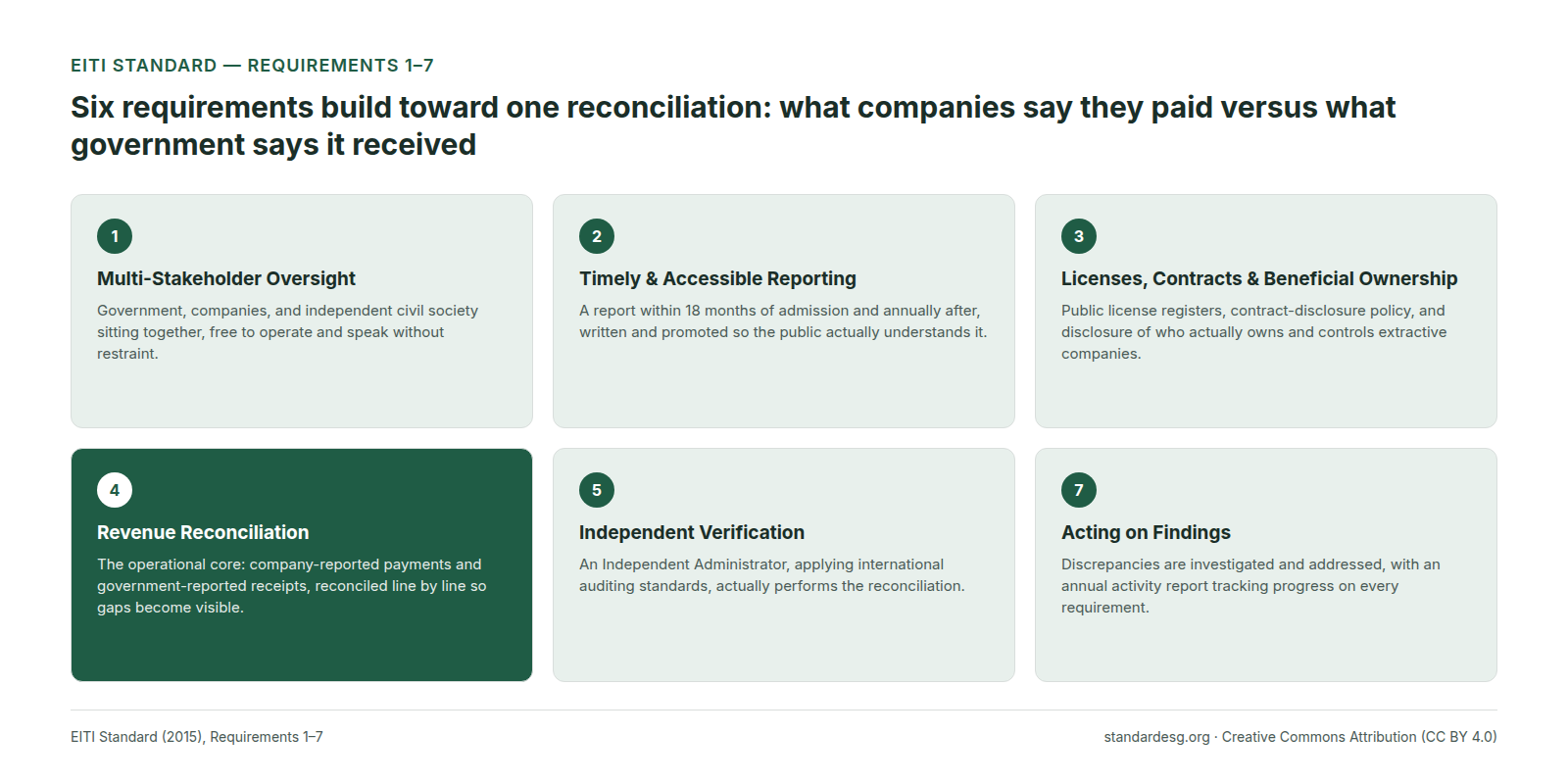
EITI's first and foundational requirement is effective oversight by a functioning multi-stakeholder group involving government, companies, and the full, independent, active participation of civil society. This isn't a token advisory committee: the government must ensure there are no obstacles to civil society or company participation, must refrain from actions that narrow or restrict public debate about EITI implementation, and stakeholders — including but not limited to multi-stakeholder group members — must be able to speak freely on transparency and natural-resource governance issues, operate freely, and express opinions about EITI without restraint, coercion, or reprisal. Civil society groups participating as multi-stakeholder group members must be operationally and politically independent of both government and companies — a structural safeguard against the process being captured by either side it's meant to hold accountable.
Requirements 2 and 6: Timely, Accessible Reporting
Two further requirements ensure EITI Reports are actually useful rather than a compliance formality published and forgotten. Requirement 2 sets reporting deadlines: implementing countries must produce their first EITI Report within 18 months of admission, and annually thereafter, covering data no older than the second-to-last complete accounting period — old enough to be reliable, current enough to still matter to public debate. Requirement 6 addresses what happens after publication: the multi-stakeholder group must ensure the report is comprehensible, actively promoted, publicly accessible, and actually contributes to public debate — written in clear, accessible language and relevant languages, distributed through outreach events involving government, civil society, and companies, not merely posted online and left there. The underlying logic is direct: regular disclosure of revenue streams is of little practical use without public awareness of what the figures actually mean.
Requirement 3: Licenses, Contracts, and Beneficial Ownership
- License registers (3.9–3.10). Implementing countries are required to maintain a publicly available register covering license holders, the coordinates of license areas, and application and award dates — information that lets anyone check who actually holds rights to extract a given country's resources, not just what they pay.
- Beneficial ownership (3.11). At the point this Standard was issued, it was recommended — not yet universally required — that implementing countries maintain a publicly available register of the beneficial owners (the actual natural person(s) who directly or indirectly own or control a corporate entity) of companies that bid for, operate, or invest in extractive assets. Where a government or state-owned enterprise holds its own stake in an extractive company, disclosure of that government beneficial ownership was already a firm requirement (Requirement 3.6(c)). The Standard's own text flags an explicit intent to make full beneficial ownership disclosure a firm requirement from 1 January 2016 onward, once piloting was complete — a sign of how directly this provision anticipates the wider beneficial-ownership transparency movement that has since become a standard feature of anti-corruption regimes generally.
- Contracts (3.12). Countries are encouraged to publicly disclose the full text of contracts and licenses governing oil, gas, and mineral exploitation, and are required, at minimum, to document the government's own policy on contract and license disclosure — so that even where full contract texts aren't yet public, the reasoning and any planned reforms are.
Beneficial ownership disclosure exists for a specific reason worth naming directly: anonymous or opaque corporate ownership is one of the most common mechanisms for disguising the proceeds of corruption in resource-rich countries specifically, since a politically connected individual can hold an extractive-sector stake through layers of shell entities that a revenue-reconciliation exercise alone would never surface.
Requirement 4: The Revenue Reconciliation at EITI's Core
Requirement 4 is the operational heart of the whole EITI model: comprehensive EITI Reports that include full government disclosure of extractive-industry revenues and disclosure of all material payments to government by oil, gas, and mining companies — reconciled against each other so any gap becomes visible. Before reporting begins, the multi-stakeholder group must agree which payments and revenue streams are material enough to require disclosure, and document the reasoning behind those materiality thresholds. The revenue streams EITI expects covered are broad: the host government's production entitlement, national state-owned company production entitlement, profits taxes, royalties, dividends, signature and production bonuses, licence and rental fees, and any other significant payment or material benefit to government. This is what distinguishes EITI from a simple government revenue-disclosure exercise: because company-reported payments and government-reported receipts are reconciled line-by-line against each other, a discrepancy between what a company says it paid and what government says it received becomes visible and has to be explained — exactly the kind of gap self-reported figures alone would let quietly disappear.
Requirement 5: Independent Verification
Requirement 5 supplies the credibility mechanism behind the reconciliation described above: an Independent Administrator, appointed by the multi-stakeholder group and applying international professional standards (the International Standards on Auditing for companies, the International Standards of Supreme Audit Institutions for public entities), is responsible for actually reconciling the payment and revenue data submitted by companies and government. The multi-stakeholder group and the Independent Administrator agree in advance what assurances reporting entities must provide to support the credibility of their figures — which can include a senior company or government official signing off on the completed reporting form as a complete and accurate record — and the Independent Administrator may recommend improvements to audit and assurance practices going forward, including addressing any gaps identified in prior reports. This structural role — an independent party verifying figures each side self-reports, rather than accepting either side's account at face value — is the same underlying logic behind Standard ESG's own document-verification and on-site assessment levels (Section 11), applied here at the level of a national reporting process instead of a single company's assessment.
Requirement 7: Acting on What's Found
The final requirement closes the loop: the multi-stakeholder group must take steps to act on lessons learned and review the outcomes and impact of EITI implementation, not simply publish a report and move on. This includes identifying, investigating, and addressing the causes of any discrepancies the reconciliation surfaces, considering recommendations from the Independent Administrator, and publishing an annual activity report assessing progress against every EITI requirement — including, notably, progress specifically on beneficial ownership and contract disclosure (Section 6). The requirement exists because a reconciliation exercise that surfaces a discrepancy and then does nothing about it isn't meaningfully different from not reconciling at all — the accountability EITI is built around depends on discrepancies actually being followed up, not just documented.
Mapping to Standard ESG Subjects G2 and G3
EITI deepens two of Standard ESG's Governance subjects specifically for extractive companies. G2 — Ethics, anti-corruption & fair operating practices is deepened by EITI's beneficial-ownership and revenue-transparency requirements (Sections 6–7): a company operating in an EITI-implementing country that fully participates in its national reporting process — accurately disclosing payments, cooperating with reconciliation, supporting beneficial-ownership disclosure — is generating exactly the kind of evidence trail Standard ESG's G2 anti-corruption criteria look for, applied specifically to the payment types (royalties, licence fees, production-sharing terms) unique to extractive-sector operations. G3 — Transparency & reporting (GRI alignment) is deepened by EITI's Requirement 6 emphasis on comprehensible, actively promoted, publicly accessible reporting — a standard for what "genuine" disclosure looks like that extends naturally alongside the GRI-derived disclosure principles G3 already draws on (see Sustainability Reporting with GRI). Neither subject changes its underlying architecture for an EITI-active company; EITI simply supplies extractives- specific, field-tested content for what strong G2 and G3 evidence looks like in this sector, the same relationship the IFC Performance Standards have to E5, S3, and S4.
Complementing the Level 3 On-Site Checklist
EITI's revenue-reconciliation model has a direct structural echo in two of Standard ESG's eight Level 3 on-site checklist domains. Domain 7 — supply-chain due diligence examines supplier selection criteria and evidence of supplier assessments; for an extractive-sector company, this naturally extends to counterparty due diligence on the entities it transacts with in licensing and production-sharing arrangements, exactly the relationships EITI's beneficial-ownership provisions are designed to make transparent. Domain 8 — data trail verification traces declared quantitative indicators back to meters, invoices, or logs; for a company reporting in an EITI-implementing country, its own EITI-reported production and payment figures are a directly citable, independently reconciled data source an on-site auditor can cross-check declared indicators against, rather than relying solely on the company's own internal records. A company that already participates transparently in its country's EITI process is, in effect, arriving at a Level 3 assessment with an independently reconciled evidence base already built for exactly the domains that matter most in its sector.
Getting Started
- Confirm whether the country you operate in is an EITI-implementing country, and if so, whether your company's payments are covered by the current materiality thresholds the multi-stakeholder group has agreed (Section 7).
- Participate accurately and promptly in the national reporting cycle — provide complete payment data to the Independent Administrator and, where requested, supporting assurances, rather than treating the request as a compliance afterthought.
- If beneficial-ownership disclosure applies in your jurisdiction, maintain accurate, current records of your own beneficial owners proactively, rather than reconstructing them under time pressure when a disclosure deadline arrives.
- Where your country's contract-disclosure policy allows it, support public disclosure of your own licenses and contracts rather than treating disclosure as something to be resisted — see the case for why voluntary transparency complements rather than competes with regulation in How Third-Party Certification Complements Regulation.
- Keep your own internal payment and production records in a form that would reconcile cleanly against your government counterpart's — the same discipline that makes a Level 2 evidence library easy to maintain (see The ESG Evidence Checklist) pays off directly here.
Standard ESG (standardesg.org) draws on EITI's country-level transparency model to deepen subjects G2 and G3 for extractive-sector companies, alongside the IFC Performance Standards for E5, S3, and S4. See The Standard ESG Certification Protocol: A Public Overview for how industry-specific grounding fits into the full pillar and subject architecture.
Cette page vous a-t-elle été utile ?