Overview
An environmental management system (EMS) is the difference between "we care about the environment" and "here is how we systematically manage our environmental impact, and here's the proof." ISO 14001:2015 is the world's reference standard for what a real EMS looks like. This primer explains it in plain language — what it requires, how the Plan-Do-Check-Act cycle actually works in practice, and how building one directly strengthens your Standard ESG environmental pillar.
What an EMS Is, and What It's For
ISO 14001:2015 defines an environmental management system as a framework that lets an organization achieve the environmental outcomes it sets for itself — not a fixed list of performance targets, but a systematic way of setting, pursuing, and improving on those targets. Its stated aims include protecting the environment by preventing or mitigating adverse impacts, fulfilling compliance obligations, enhancing environmental performance, controlling how products and services are designed, made, and disposed of across their life cycle, and communicating environmental information credibly to interested parties.
Critically, the standard is explicit that adopting it does not by itself guarantee good environmental outcomes — what it guarantees is a disciplined process for pursuing them, one whose success depends on genuine commitment from top management and integration into how the organization actually makes decisions, not a document that sits in a drawer.
The Plan-Do-Check-Act Model
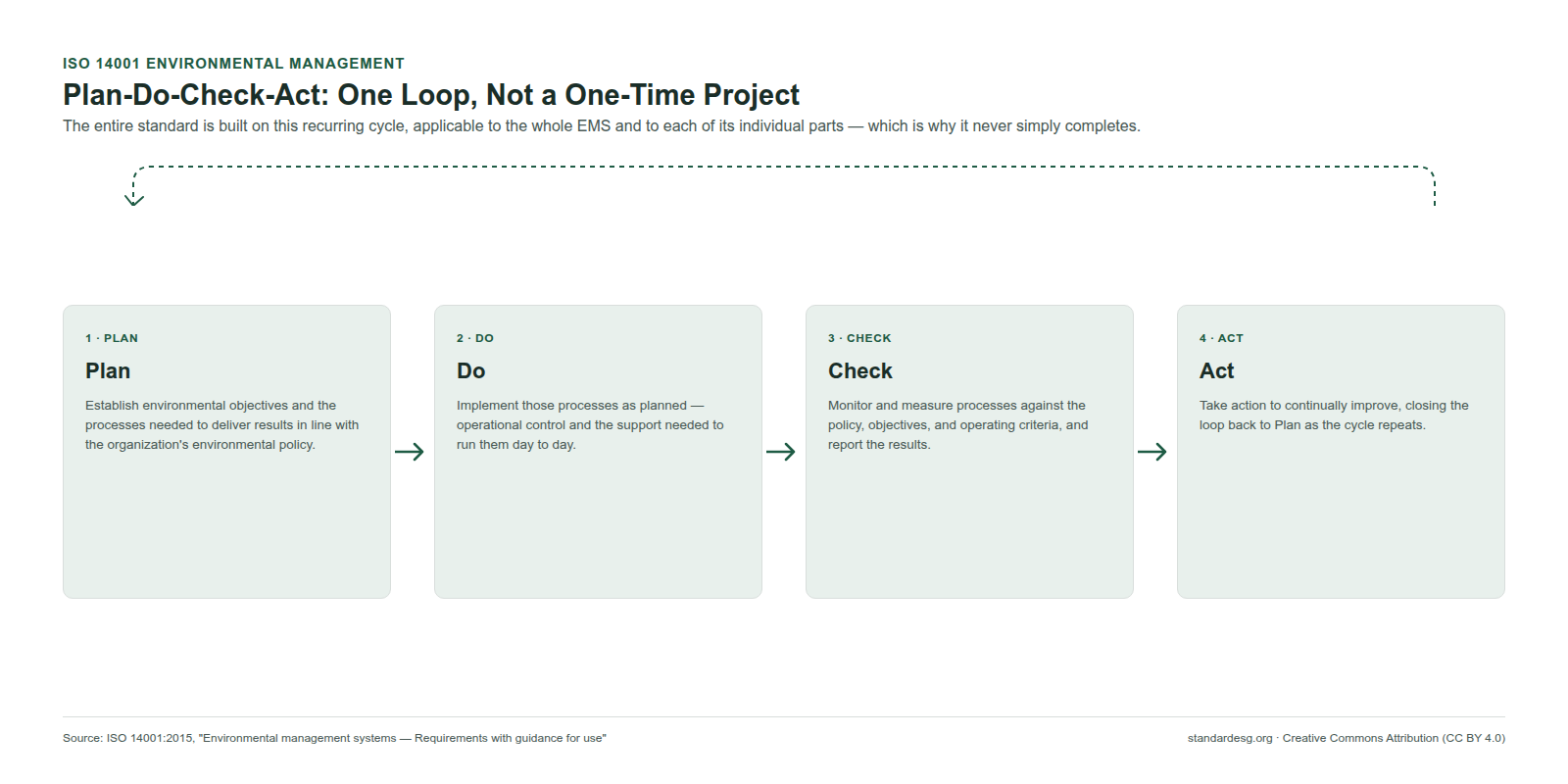
The entire standard is built on one recurring idea: Plan-Do-Check-Act (PDCA), an iterative cycle used to drive continual improvement, applicable to the whole EMS and to each of its individual parts:
- Plan — establish environmental objectives and the processes needed to deliver results in line with the organization's environmental policy.
- Do — implement those processes as planned.
- Check — monitor and measure processes against the policy, objectives, and operating criteria, and report the results.
- Act — take action to continually improve.
This isn't a one-time project that completes and then stops; it's a loop that keeps running, which is exactly why "management system" rather than "environmental initiative" or "sustainability programme" is the right term.
Context of the Organization: Where It Starts
Before writing a policy, ISO 14001 requires understanding your organization's context — the internal and external issues relevant to your purpose that affect your ability to achieve your EMS's intended outcomes, and the needs and expectations of interested parties (regulators, customers, employees, communities, and others affected by or interested in your environmental performance). This step exists so the EMS that follows is proportionate and relevant to your actual business, not a generic template — the standard is explicit that two organizations with similar activities can have entirely different compliance obligations, commitments, and environmental goals, and both can conform.
Plan: Policy, Aspects, and Legal Compliance
Planning starts with three things:
- An environmental policy, set and communicated by top management, committing the organization to protecting the environment (including pollution prevention) and complying with its legal and other obligations.
- Environmental aspects — the elements of your activities, products, and services that interact with the environment (energy use, emissions, waste generation, water discharge, and so on) — and their associated impacts, identified using a life-cycle perspective so impacts aren't just shifted elsewhere rather than reduced.
- Compliance obligations — a working knowledge of the legal and other requirements that apply to your environmental aspects, often maintained as a legal register, so compliance isn't assumed but actively tracked.
From this planning work, the organization sets environmental objectives — specific, measurable where practicable, and consistent with the policy — along with the actions needed to achieve them.
Do: Operational Control and Support
Implementation covers two areas. Support — the resources, competence, awareness, and communication needed to run the EMS, plus documented information (procedures, records) proportionate to the organization's complexity. Operational control — the actual processes needed to meet environmental requirements: controlling how significant environmental aspects are managed day to day, preparing for and responding to potential emergency situations (a spill, a fire, an equipment failure with environmental consequences), and, where relevant, controlling or influencing outsourced processes and the environmental requirements for procured goods and services.
This is the layer where policy becomes practice: it's the difference between having an environmental policy and having, say, a documented procedure for chemical storage that staff actually follow, with someone responsible for checking it's followed.
Check: Monitoring, Measurement, and Internal Audit
An EMS only improves what it actually measures. This stage covers monitoring and measuring environmental performance against the policy and objectives (energy use, emissions, waste volumes, and other indicators relevant to your significant aspects), evaluating compliance with legal and other obligations on a planned basis, and conducting internal audits at planned intervals to check the EMS is both properly implemented and effective — not just present on paper.
Act: Management Review and Continual Improvement
At planned intervals, top management reviews the EMS's continuing suitability, adequacy, and effectiveness — considering audit results, compliance status, progress on objectives, and changes in circumstances — and drives continual improvement based on that review. Nonconformities (failures to meet a requirement) trigger corrective action addressing the root cause, not just the immediate symptom. This closes the loop back to Plan, and the cycle repeats.
How an EMS Maps to Standard ESG's E1-E5
The Standard ESG Certification Protocol's environmental pillar is organized into five core subjects, and a functioning EMS is the direct engine behind all of them:
- E1 — Environmental management system & policy is, essentially, ISO 14001 itself: do you have a policy, and a system for acting on it? This is the subject an EMS most directly answers.
- E2 — Resource use (energy, water, materials) is exactly what an EMS's aspect identification and monitoring activities track.
- E3 — Emissions & climate flows from the same monitoring and measurement discipline, applied specifically to GHG data (see Measuring GHG Emissions: Scope 1, 2 and 3).
- E4 — Waste, circularity & pollution prevention is a core aspect most EMS implementations address directly, including the emergency-preparedness element for pollution incidents.
- E5 — Biodiversity & land use is captured where relevant through the same aspects-and-impacts assessment, scaled to how much your operations actually touch land and ecosystems.
In short: a genuine EMS doesn't just help with E1 — it's the operational infrastructure that makes credible answers to E2 through E5 possible in the first place, rather than guesses.
What an EMS Generates for Level 2 Evidence
If you're working toward Level 2 verification, an operating EMS produces most of the environmental evidence category as a natural byproduct rather than a special exercise: your environmental policy document, your legal register (evidencing environmental permits and compliance tracking), your monitoring records (energy bills, meter readings, waste transfer notes), your internal audit records, and your management review minutes. Organizations that build the EMS first and pursue certification second consistently find Level 2 evidence-gathering far faster, because the documents already exist as a normal output of running the system, rather than being assembled retroactively under deadline pressure.
Do You Need Formal ISO 14001 Certification?
No — and this distinction matters. ISO 14001 itself recognizes several ways an organization can demonstrate conformity: a self-determination and self-declaration, confirmation by an interested party such as a customer, confirmation of a self-declaration by an external party, or formal third-party certification/registration of the EMS. Standard ESG certification does not require you to hold a formal ISO 14001 certificate — what matters for subject E1 and the broader environmental evidence base is that you actually run a system with these characteristics (policy, aspects identification, operational control, monitoring, review), whether or not you've paid for a separate ISO certification body to attest to it. A genuine, smaller-scale EMS built along these lines, honestly documented, is worth more to your Standard ESG score than a framed certificate with no substance behind it.
Getting Started Without a Sustainability Team
You don't need a dedicated environmental manager to start. A workable minimum version:
- Write a one-page environmental policy, signed by the most senior person in the organization.
- List your significant environmental aspects — for most SMEs, this is a short list: energy use, waste, and maybe water or materials, depending on your operations.
- Gather your utility bills and any existing permits into one place — this is your starting legal register and monitoring baseline.
- Set two or three simple, honest objectives for the year (reduce energy use by X%, formalize waste segregation, etc.).
- Review progress against those objectives at least annually, and adjust.
This lightweight version already produces most of what subject E1 asks for and gives you the monitoring habit that E2–E5 depend on. See Getting Started with ESG: A Practical Guide for SMEs for how this fits into a broader first-90-days plan.
Standard ESG (standardesg.org) maps subject E1 directly to ISO 14001's structure — policy, planning, operational control, monitoring, and review — because that structure is what makes an environmental claim genuinely checkable. See What is ESG? A Complete Introduction for how the environmental pillar fits alongside Social and Governance.
Cette page vous a-t-elle été utile ?