Overview
Climate change is the single issue most people associate with ESG, and for good reason: it's measurable, global, and urgent in a way few other sustainability topics are. But climate ambition without operational discipline produces pledges, not progress. This guide looks at the Environmental pillar specifically through a climate lens — what actually needs to be managed, how a management system turns ambition into control, and why verification is what separates real climate accountability from marketing.
Why Corporate Climate Accountability Matters
Climate change is a systemic risk that no individual government can fully manage through regulation alone — corporate behaviour, aggregated across millions of organizations' energy use, emissions, and supply-chain decisions, is a primary driver of the physical trajectory the planet is on. This is why climate sits at the center of so much recent ESG regulation: the EU's CSRD, California's SB 253 and SB 261, and the ISSB's IFRS S2 are all, at their core, climate-disclosure regimes wearing a broader ESG label. Corporate accountability on climate isn't a side effect of ESG — for much of the current regulatory wave, it's the primary target.
The Environmental Pillar, Climate-First
Standard ESG's Environmental pillar organizes into five core subjects, and climate touches nearly all of them, even though only one is named for it directly:
- E1 — Environmental management system & policy is the operational infrastructure that makes every other climate commitment actionable rather than aspirational.
- E2 — Resource use (energy, water, materials) is where most emissions actually originate — energy use in particular is the direct input to Scope 1 and 2 emissions.
- E3 — Emissions & climate is the subject most directly about climate: GHG Scope 1–2 reporting is required, and Scope 3 is encouraged.
- E4 — Waste, circularity & pollution prevention connects to climate through methane from landfilled waste and the emissions embedded in producing replacement materials.
- E5 — Biodiversity & land use connects to climate through carbon sequestration in natural ecosystems and the mutual reinforcement between biodiversity loss and climate instability.
Greenhouse Gas Emissions: The Core Metric
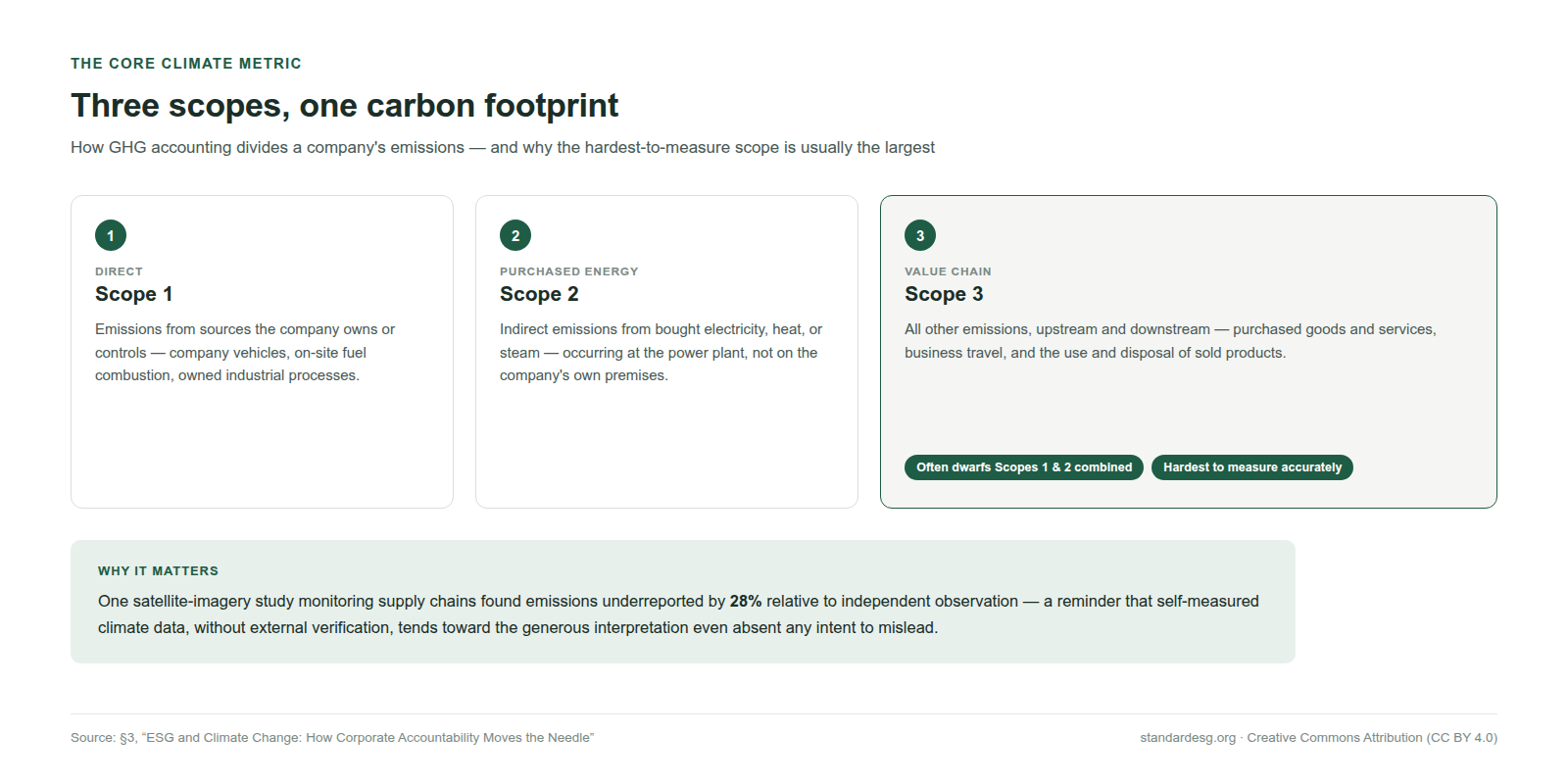
GHG accounting is organized into three scopes, and understanding the distinction is essential to reading any corporate climate claim honestly:
- Scope 1 — direct emissions from sources the company owns or controls: company vehicles, on-site fuel combustion, owned industrial processes.
- Scope 2 — indirect emissions from purchased energy: the electricity, heat, or steam a company buys, with emissions occurring at the power plant rather than on the company's own premises.
- Scope 3 — all other value-chain emissions, both upstream (purchased goods and services, business travel) and downstream (use and disposal of sold products). For most companies, Scope 3 dwarfs Scopes 1 and 2 combined, often by a wide margin, because it captures the emissions embedded across an entire supply and use chain rather than just direct operations.
Scope 3 is also the hardest to measure accurately, and the evidence on measurement quality is sobering: one study using satellite imagery to independently monitor supply chains found emissions underreported by 28% relative to self-reported figures — a reminder that self-measured climate data, without external verification, tends toward the generous interpretation even absent any intent to mislead. See Measuring GHG Emissions: Scope 1, 2 and 3 for the detailed mechanics of building an accurate inventory.
Resource Use as a Climate Lever
Energy use is the direct driver of most Scope 1 and 2 emissions, which makes subject E2 a climate lever in its own right, not just an adjacent topic. The share of energy drawn from renewable sources, energy efficiency improvements, and water and materials efficiency all reduce the emissions intensity of an organization's operations before any offsetting or carbon-market activity even enters the picture — reduction, not compensation, is the more durable and more scrutiny-resistant climate strategy.
Waste, Circularity, and Their Climate Connection
Waste connects to climate more directly than it might first appear: organic waste sent to landfill generates methane, a greenhouse gas with a substantially higher near-term warming effect than CO2, while every material sent to landfill rather than recovered or reused represents embedded emissions from its original production that must be repeated to replace it. Circular-economy practices — designing for reuse, recovering materials, extending product life — reduce this embedded-emissions burden in a way that pure end-of-pipe waste management does not.
Biodiversity: The Frontier Beyond Emissions
Biodiversity and land use (subject E5) is the least emissions-centric of the environmental subjects, but it's increasingly understood as inseparable from climate risk rather than a separate concern: natural ecosystems — forests, wetlands, soils — are major carbon sinks, and their degradation both releases stored carbon and reduces future sequestration capacity. The Taskforce on Nature-related Financial Disclosures (TNFD) is developing a framework to help organizations assess and report on their dependencies and impacts on nature, mirroring the structure of the (now-superseded) TCFD climate framework — a sign that the field's understanding of environmental risk is maturing from a narrow climate focus toward a broader, more interconnected view of systemic natural risk. For most organizations, biodiversity impact is highly industry-dependent — critical for agriculture, forestry, mining, or construction, and comparatively minor for a purely office-based business.
From Ambition to Operational Control: ISO 14001's Role
A climate target is a statement of intent; an environmental management system is what turns intent into repeatable operational control. ISO 14001's Plan-Do-Check-Act cycle — policy, identification of significant environmental aspects (including energy use and emissions sources), operational controls, monitoring and measurement, and management review — is exactly the discipline that separates an organization that reduces emissions from one that merely announces an emissions target. See Building an Environmental Management System for the full walkthrough of how this cycle works. The specific value for climate claims: an EMS forces monitoring and measurement as a standing practice, not a once-a-year exercise assembled for a sustainability report — which is precisely what makes its outputs credible evidence rather than retrospective narrative.
The Greenwashing Problem, Specifically for Climate
Climate claims are especially exposed to greenwashing because "carbon neutral" and "net zero" are attractive, high-impact phrases that are also easy to assert and hard to verify without underlying data. The evidence on this is stark: a 2022 analysis found that over 70% of climate-themed ESG funds failed to align with the global climate goals they claimed to pursue. Common failure patterns include: claiming Scope 1–2 reductions while Scope 3 (the majority of actual impact) goes unmeasured or unreported; relying on offsets to claim "neutrality" while underlying operational emissions continue to rise; and describing a single certified facility or product line as representative of the whole organization. See Greenwashing and the Trust Problem for the broader pattern this fits into.
How Standard ESG Verifies Climate Claims
Standard ESG's certification levels apply directly to climate data, closing the verification gap described above at each successive level. At Level 1, E3 answers are self-declared, reviewed for plausibility. At Level 2, the environmental evidence category specifically includes energy bills/audits and a GHG inventory — declared emissions figures need to be backed by the underlying invoices and records, or the relevant indicator is discounted. At Level 3, one of the eight on-site checklist domains is data trail verification: declared quantitative indicators, including emissions figures, are traced back to meters, invoices, or logs by an auditor physically on site — the exact mechanism designed to catch the kind of underreporting the satellite-imagery study found. This is, in miniature, exactly the fix the field's own climate-greenwashing problem calls for: not more ambitious claims, but claims that can be traced to evidence.
What This Means for Your Organization
Concretely, moving from climate ambition to accountable climate action means: building even a lightweight environmental management system rather than treating climate as a one-off reporting exercise; measuring Scope 1 and 2 emissions accurately before making any public claim, and being honest about the state of Scope 3 measurement rather than omitting it silently; keeping the underlying evidence — utility bills, energy audits, waste records — organized as you go, since this is exactly what substantiates a Level 2 claim later; and treating a climate claim's precision as a signal of its credibility — "we reduced Scope 1 and 2 emissions by 12% year-over-year, verified against utility records" is a fundamentally different, and fundamentally more trustworthy, statement than "we are committed to sustainability."
Standard ESG (standardesg.org) requires Scope 1–2 GHG reporting and encourages Scope 3 under subject E3, with declared figures checked against evidence at Level 2 and traced to source data on site at Level 3. See Measuring GHG Emissions: Scope 1, 2 and 3 for the practical mechanics of building your own inventory.
Cette page vous a-t-elle été utile ?