Overview
India runs one of the world's largest mandatory non-financial disclosure regimes, and most of the world outside India has never heard of it by name. The Business Responsibility and Sustainability Report (BRSR) now requires the top 1,000 listed companies by market capitalisation to report against a detailed, principle-by-principle framework — a bigger mandatory universe than most Western disclosure regimes reach on their own. This guide explains where BRSR came from, what it actually asks companies to disclose, and how a company already filing BRSR can put much of that same evidence to work toward Standard ESG certification.
From Voluntary Guidelines to Mandatory Reporting
BRSR's roots go back to 2009, when India's Ministry of Corporate Affairs issued the "Voluntary Guidelines on Corporate Social Responsibility" — an early, non-binding attempt to get Indian businesses thinking about responsibility beyond financial performance. Momentum built steadily from there: the 2011 "National Voluntary Guidelines on Social, Environmental and Economic Responsibilities of Business" (NVGs) followed India's endorsement of the UN Guiding Principles on Business and Human Rights, and the Securities and Exchange Board of India (SEBI) introduced the first mandatory non-financial disclosure — the Business Responsibility Report (BRR) — for India's top 100 listed companies in 2012. SEBI extended the BRR mandate to the top 500 companies in 2015 and the top 1,000 in 2019, widening the mandatory universe well before the disclosure content itself was substantially rewritten. In 2019, the NVGs were revised into the National Guidelines on Responsible Business Conduct (NGRBC), and in May 2021 SEBI used that revised foundation to introduce BRSR itself, mandatory for the top 1,000 listed companies from FY 2022–23 onward.
What BRSR Replaced, and Why
BRSR did not just rename the BRR — it rebuilt it. The BRR's five reporting sections (general information, financial details, other details, BR information, principle-wise performance) collapse into three more tightly structured BRSR sections, described in Section 4 below. The content grew far more substantially: BRR asked 59 mostly qualitative questions in a single universal format, while BRSR asks around 140 — roughly 98 mandatory ("essential") and 42 voluntary ("leadership") — split explicitly between qualitative and quantitative indicators. That shift from mostly-qualitative to quantitative-and-qualitative is the single biggest functional change: a company can no longer satisfy its principle-wise disclosure with narrative alone where BRSR expects a number. Disclosure now flows through both the company's annual report and the MCA21 portal (India's central corporate-filings database), rather than the annual report alone.
Who Has to File
The mandate is defined purely by market capitalisation rank, not sector or ownership structure: the top 1,000 listed companies on Indian exchanges by market capitalisation must file a BRSR as part of their annual report from FY 2022–23 onward. This market-cap-based scoping is what makes BRSR's mandatory universe so large relative to disclosure regimes elsewhere — it captures essentially every major listed Indian company across every sector at once, rather than phasing in by company size, revenue threshold, or industry as many disclosure regimes elsewhere do (compare, for instance, California's SB 253/261 revenue threshold or the EU's CSRD company-count phase-in — see The Global ESG Disclosure Regulation Guide).
The Three Sections of a BRSR Filing
A BRSR filing is organised into three sections, each with a distinct purpose:
- Section A — General disclosures: baseline information about the listed entity: products and services, operations, employees, holdings, subsidiaries and joint ventures, and the entity's own transparency and disclosure practices.
- Section B — Management and process disclosures: the policies and processes the company has in place against each of the nine NGRBC principles (Section 6), covering oversight, governance structure, and stakeholder engagement — with links to the company's own published policies wherever relevant.
- Section C — Principle-wise performance disclosures: the operational core of the filing: for each of the nine principles, the company reports key performance indicators demonstrating actual intent and outcomes, not just stated policy.
This structure itself signals what BRSR is designed to catch: Section B alone (stated policy) is not sufficient — Section C requires the company to show what actually happened, which is precisely the gap between declared intent and verified performance that certification schemes like Standard ESG exist to test independently.
Essential vs. Leadership Indicators
Within Section C, every one of the nine principles is reported against two tiers of indicator:
- Essential indicators (mandatory): these cover core environmental data (energy, emissions, water, waste), training conducted, community initiatives, and the social impact the company has generated — the minimum bar every filer must clear.
- Leadership indicators (voluntary, for now): not yet mandatory, but SEBI actively encourages reporting against them for stronger transparency and accountability. Leadership indicators go further than essential ones — for example, Scope 3 emissions reporting, a fuller breakdown of energy consumption, and health-and-safety assessments extended to value-chain partners rather than just the company's own operations.
This two-tier structure gives BRSR a built-in glide path: it sets a mandatory floor today while signalling exactly which disclosures are likely to become mandatory next, letting companies get ahead of a requirement before it's compulsory rather than scrambling once it is.
The Nine NGRBC Principles
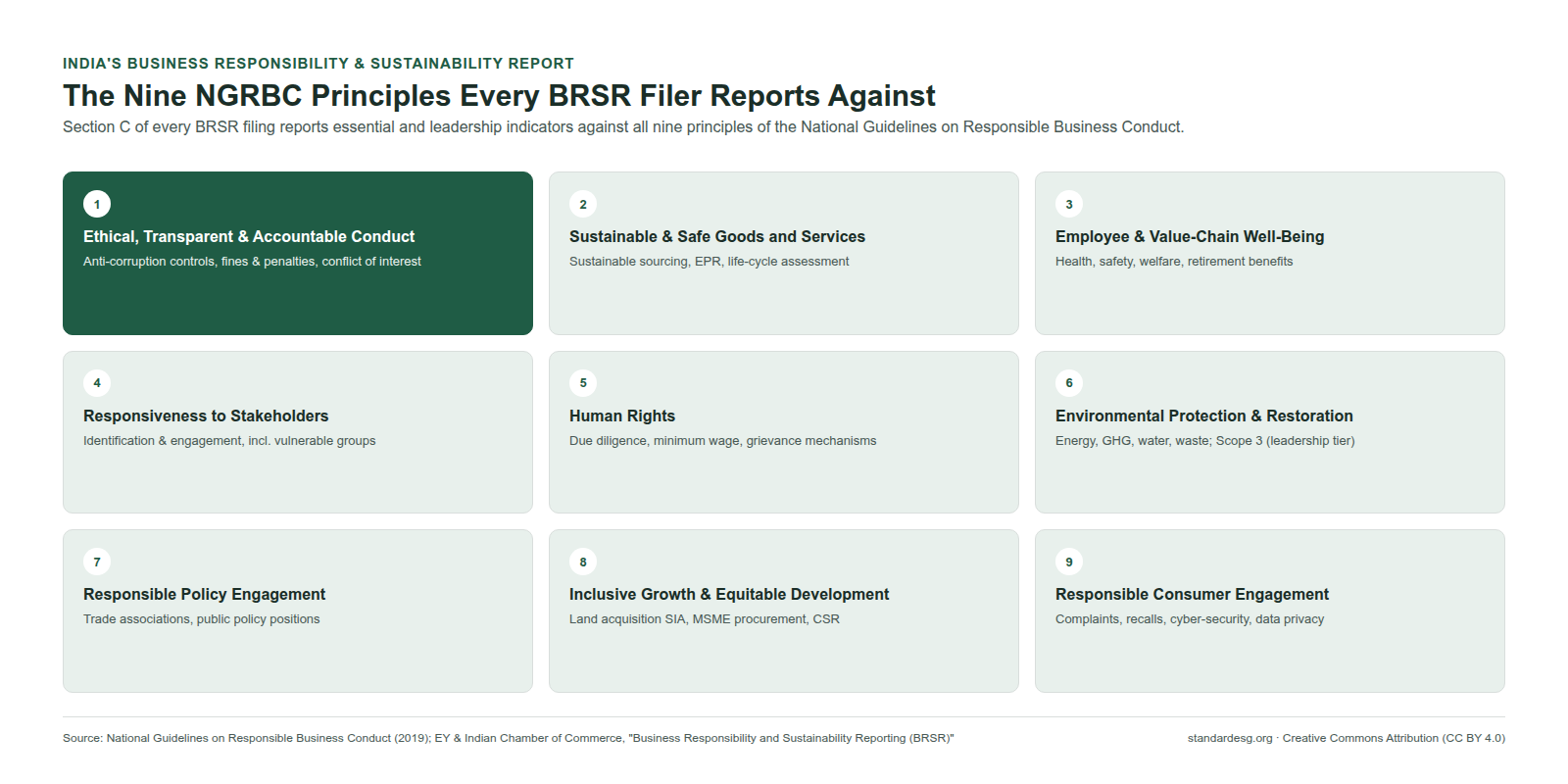
Every BRSR filing is organised around the nine principles set out in the 2019 National Guidelines on Responsible Business Conduct. Each principle carries its own set of key components a filer must report against:
- 1. Ethical, transparent and accountable conduct: fines, penalties and settlements paid; anti-corruption and anti-bribery controls; conflict-of-interest disclosure and remediation.
- 2. Sustainable and safe goods and services: resource allocation toward sustainable product design; sustainable sourcing; extended producer responsibility and life-cycle-assessment coverage; recycled-input-material disclosure.
- 3. Employee and value-chain worker well-being: health, safety and welfare policies; retirement benefits; accessibility for workers with disabilities.
- 4. Responsiveness to stakeholders: stakeholder identification and prioritisation, including vulnerable or marginalised groups; consultation processes feeding back into policy.
- 5. Human rights: human-rights training; minimum-wage and remuneration disclosure, including median pay ratios; grievance mechanisms; human-rights due diligence.
- 6. Environmental protection and restoration: energy, GHG emissions, water and waste data; environmental approvals in or near ecologically sensitive areas; renewable vs. non-renewable energy mix; Scope 3 emissions (leadership tier).
- 7. Responsible public and regulatory policy engagement: trade-association affiliations; corrective action for anti-competitive conduct; public-policy positions advocated.
- 8. Inclusive growth and equitable development: social-impact-assessment disclosure for land acquisition; procurement from MSMEs and small enterprises; CSR-project beneficiary identification.
- 9. Responsible engagement with consumers: complaint-handling processes; product recalls; cyber-security and data-privacy incidents; data-breach disclosure.
The nine principles map cleanly onto UN SDG targets — SEBI's own alignment table ties each principle to the specific SDGs it advances — which is one of the deliberate design choices that makes a BRSR filing legible to a global investor audience even though the framework itself is India-specific.
How BRSR Aligns with Global Frameworks
BRSR was built with interoperability, not isolation, in mind. Its disclosure content deliberately cross-references internationally accepted frameworks — GRI, SASB, and the Task Force on Climate-related Financial Disclosures (TCFD) — and where a company's annual report already contains the same underlying data under one of those frameworks, SEBI permits cross-referencing rather than duplicating the disclosure. For a company already producing GRI-aligned sustainability reporting (see Sustainability Reporting with GRI), most of the qualitative groundwork behind BRSR's principle-wise narrative is already done; what BRSR adds on top is the quantitative essential/leadership indicator structure and the specific NGRBC principle framing.
Assurance: Where BRSR Is Headed
BRSR's own trajectory follows a now-familiar regulatory pattern: start with disclosure, then layer independent assurance on top once the disclosure baseline is established. Having moved reporting from voluntary to mandatory and from mostly-qualitative to quantitative, the direction of travel for India's regime — consistent with global peers like the EU's CSRD, which mandates independent assurance of sustainability disclosures (see The Global ESG Disclosure Regulation Guide §10) — is toward third-party assurance of BRSR's core disclosures for large filers, rather than self-certified numbers standing indefinitely on their own. That trajectory is exactly the gap independent certification is built to close: a BRSR filing states what a company did; a Standard ESG certificate — Level 2 in particular — independently verifies that the underlying documents actually support what was stated.
Challenges Companies Actually Face
Companies making the transition from BRR to BRSR report three recurring difficulties:
- The sheer jump in reporting volume: going from 59 questions to roughly 140, including a large increase in quantitative KPIs, requires updated internal processes and policies that many companies' existing reporting infrastructure wasn't built for.
- Cross-departmental data collection: BRSR's holistic view of financial and non-financial performance pulls in HR, environment/health/safety, IT, R&D, procurement and operations all at once — departments that, in many companies, have never had to feed a single unified disclosure exercise before.
- Rising stakeholder expectations: BRSR is explicitly designed to push companies from "doing no harm" toward "contributing proactively for a change," which raises the performance bar stakeholders expect year over year, not just the disclosure bar.
None of these are reasons to treat BRSR as a compliance afterthought — SEBI's own stated intent is for BRSR to help companies benchmark their own sustainability ambitions against their industry's leaders, using the essential/leadership split as a self-diagnostic for where a company actually stands.
Using a BRSR Filing as Level 2 Evidence
A company that already files a complete, accurate BRSR has done a meaningful share of the work needed to substantiate a Standard ESG Level 2 assessment, because the two frameworks ask for structurally similar things: named policies, documented processes, and quantitative performance data tied to specific claims. Under Standard ESG's evidence rules, an indicator whose required supporting document is missing, expired or rejected is scored at only 50% of its declared value until a verified document is on file (the "evidence discount" — see The ESG Evidence Checklist). For an Indian registrant, BRSR's own underlying records are a natural evidence source for several of Standard ESG's core subjects simultaneously:
- Principle 6's energy, water, waste and GHG data substantiates environmental-pillar indicators directly.
- Principle 5's human-rights, minimum-wage and grievance-mechanism disclosures substantiate subject S3 evidence (see Human Rights Due Diligence: The UN Guiding Principles Explained).
- Principle 1's anti-corruption, conflict-of-interest and fines/penalties disclosures substantiate subject G2 evidence directly.
- Principle 9's complaint-handling, product-recall and data-privacy disclosures substantiate subject S5 evidence (see Consumer and Product Responsibility: A Starter Guide).
This isn't a formal equivalence — Standard ESG's evidence rules still require the underlying document itself, not just a cross-reference to a BRSR filing — but it means a company that already maintains disciplined BRSR records is, in practice, arriving at a Level 2 assessment with most of its evidence library already assembled rather than starting from a blank page.
Getting Started
For an Indian company preparing its first BRSR filing, or refining an existing one with an eye toward certification evidence as well as regulatory compliance:
- Map your existing GRI, SASB or TCFD-aligned disclosures against the nine NGRBC principles first — much of the qualitative narrative BRSR asks for may already exist under a different label.
- Treat leadership indicators as a preview of next year's essential indicators, not optional extras — building the capability now (particularly Scope 3 measurement) avoids a scramble once SEBI mandates them.
- Assign clear departmental ownership for each principle's KPIs before the reporting cycle starts; BRSR's cross-departmental data demands are the most commonly cited implementation obstacle.
- Keep the underlying documents behind every BRSR figure — not just the filed figure itself — in a form that would satisfy an independent verifier, since that same evidence library is what a Level 2 Standard ESG assessment will draw on.
Standard ESG (standardesg.org) treats a well-maintained BRSR evidence library as a strong starting point for Level 2 certification evidence for Indian registrants. See The Standard ESG Certification Protocol: A Public Overview for how Level 2 evidence fits into the full scoring architecture, and The ESG Evidence Checklist for how the evidence discount mechanism works in practice.
Cette page vous a-t-elle été utile ?