Why Procurement Is a Sustainability Lever
Every organization has environmental, social, and economic impacts — and for most organizations, a large share of those impacts occur not inside their own walls but across their supply chain, in what they choose to buy and from whom. ISO 20400 frames procurement as a powerful instrument precisely because of this: by integrating sustainability into procurement policy and practice, an organization can manage risks (and opportunities) for environmental, social, and economic development at a scale far beyond what its own direct operations could achieve alone — while also improving productivity, enabling better communication between purchasers, suppliers, and other stakeholders, and encouraging innovation.
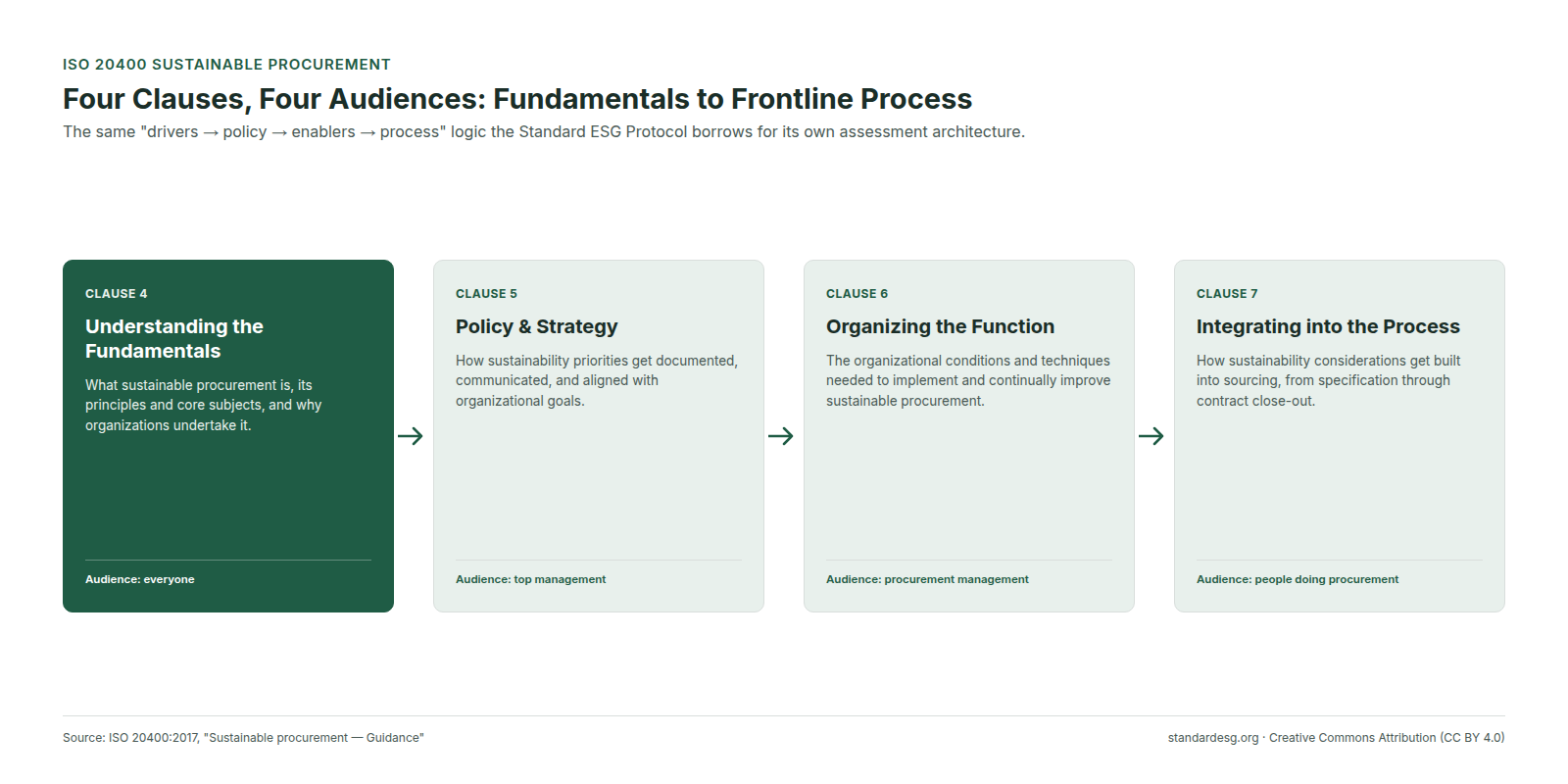
The Four-Layer Structure of ISO 20400
- Clause 4 — Understanding the fundamentals: an overview of what sustainable procurement is, its principles and core subjects, and why organizations undertake it. Relevant to everyone.
- Clause 5 — Integrating sustainability into the organization's procurement policy and strategy: aimed primarily at top management — how sustainability priorities get documented, communicated, and aligned with organizational goals.
- Clause 6 — Organizing the procurement function towards sustainability: aimed at procurement management — the organizational conditions and techniques needed to implement and continually improve sustainable procurement.
- Clause 7 — Integrating sustainability into the procurement process: aimed at the individuals actually doing procurement — how sustainability considerations get built into existing sourcing processes, from specification through contract close-out.
This structure — fundamentals, then strategy, then organizational enablers, then process — is exactly the "drivers → policy → enablers → process" logic that the Standard ESG Protocol explicitly borrows for its own assessment architecture.
Understanding the Fundamentals: Principles and Core Subjects
ISO 20400 defines sustainable procurement around a set of principles — accountability, transparency, ethical behaviour, respect for stakeholder interests, respect for the rule of law, respect for international norms of behaviour, and respect for human rights — and a set of core subjects drawn directly from ISO 26000: organizational governance, human rights, labour practices, the environment, fair operating practices, consumer issues, and community involvement and development. This is precisely why the same seven core subjects echo across so much of the ESG standards landscape — ISO 20400 doesn't invent its own taxonomy; it applies ISO 26000's to the specific context of buying decisions.
Key terms worth knowing: due diligence — the process by which an organization proactively identifies, assesses, prevents, mitigates, and accounts for its actual and potential adverse impacts, as an integral part of decision-making and risk management; decent work — work performed in conditions of freedom, equity, security, and human dignity; and circular economy — an economy that is restorative and regenerative by design, aiming to keep products, components, and materials at their highest utility and value for as long as possible.
Drivers, Due Diligence, and Managing Risk
The fundamentals clause examines why organizations undertake sustainable procurement in the first place — the drivers, which range from regulatory pressure and stakeholder expectation to genuine risk management and competitive opportunity — and frames the core discipline as managing sustainability-related risks (including opportunities) through due diligence: proactively identifying where adverse impacts might occur in the supply chain, rather than only reacting once something has already gone wrong. This includes setting priorities (not every supplier or spend category carries equal risk), exercising positive influence where the organization has leverage, and avoiding complicity in a supplier's harmful practices.
Integrating Sustainability into Policy and Strategy
This is where top management's role comes in: committing to sustainable procurement explicitly, clarifying who is accountable for it, aligning procurement objectives with the organization's broader goals, understanding the organization's actual procurement practices and supply chains well enough to set realistic priorities, and managing how the strategy gets implemented. The key deliverable at this level is a documented sustainable procurement policy — the equivalent, for procurement, of the environmental policy at the heart of ISO 14001.
Organizing the Procurement Function
Below strategy sits organizational capability: governing procurement so sustainability considerations are actually embedded in how sourcing decisions get made and approved; enabling people through training and clear responsibilities; identifying and engaging stakeholders, including suppliers themselves; setting concrete sustainable-procurement priorities; measuring and improving performance over time; and establishing a grievance mechanism so concerns about supply-chain practices — including from workers in the supply chain, not just internal staff — have somewhere to go.
Integrating Sustainability into the Procurement Process
This is the operational clause, aimed at whoever actually runs a sourcing process day to day: building sustainability into the existing procurement process rather than running a separate parallel process; planning the sourcing exercise; defining sustainable procurement criteria and choosing which requirements are mandatory versus optional; finding the information needed to set realistic requirements; and evaluating whether those requirements are actually being met, not just stated.
Selecting and Managing Suppliers
The process clause continues through the supplier relationship itself: assessing supplier capacity, prequalifying suppliers against sustainability criteria, managing the tender process, and awarding the contract — followed by actually managing the resulting relationship: implementing the contract, using a contract management plan, managing performance, encouraging joint supplier-customer initiatives where useful, managing supplier failure when it occurs, and managing disposal and end-of-life considerations. The cycle closes with reviewing and learning from the contract once it's complete — feeding lessons back into the next sourcing decision, the same continual-improvement logic found throughout every management-system standard in this library.
How This Maps to Standard ESG Subject G4
Standard ESG's Governance pillar includes subject G4 — Sustainable procurement & supply-chain management, explicitly described as the ISO 20400 core of the protocol. G4 scores the maturity of an organization's sustainable procurement practice: whether a policy exists, whether a supplier code of conduct is genuinely in use (not just published), whether suppliers are actually segmented and assessed by risk rather than treated uniformly, and whether corrective action is followed up when a supplier assessment finds a problem. This maps directly onto ISO 20400's Clauses 5–7 as described above — G4 is, in effect, asking whether your organization has actually built the structure ISO 20400 describes, at whatever scale is proportionate to your size.
What Level 2+ Evidence Looks Like Here
For Level 2 verification, the governance document category includes a supplier code of conduct and a procurement policy — the direct outputs of ISO 20400 Clauses 5–6. Beyond initial documents, Standard ESG may ask for anonymized evidence of actual supplier assessments carried out, which corresponds to the process work described in the supplier-selection section above — the difference between having a supplier code of conduct on file and being able to show it's actually applied when selecting and reviewing suppliers.
Why Suppliers Must Certify Independently
One structural point is worth being explicit about, because it shapes how G4 works in practice: Standard ESG does not certify a company's suppliers through that company's own certificate. A strong G4 score reflects the maturity of your process for managing supplier sustainability — your policy, your segmentation, your assessment practice — not a claim that your suppliers themselves are certified. If your suppliers want their own Standard ESG certification, they register and are assessed independently, just as your organization did. This mirrors ISO 20400's own logic: sustainable procurement is about how an organization manages its supply-chain relationships and influence, not a guarantee about every supplier's own internal conduct.
Getting Started at Any Size
ISO 20400 is explicitly scalable — it applies to any organization "regardless of size or location," with the adoption of sustainable procurement by large organizations specifically noted as creating opportunities for small and medium-sized suppliers in their chains. A proportionate starting point for a smaller organization:
- Write a short supplier expectations statement — even a single paragraph — committing suppliers to basic labour and environmental legal compliance.
- Identify your highest-risk spend categories (often labour-intensive manufacturing or raw-material sourcing) and prioritize sustainability questions there first, rather than trying to assess every supplier equally.
- Ask new suppliers a small number of concrete questions before onboarding, rather than relying on assumption.
- Keep a simple record of which suppliers you've asked, and what they said — this becomes your evidence base for G4 without requiring a formal supplier-management system.
See Getting Started with ESG: A Practical Guide for SMEs for how this fits into a first-year plan.
Standard ESG (standardesg.org) built its assessment structure on ISO 20400's core — the protocol is explicitly ISO 20400-compatible. See The Standard ESG Certification Protocol: A Public Overview for how all seven underlying standards fit together.
Cette page vous a-t-elle été utile ?