What SASB Is
Founded in 2011, SASB set out to build disclosure standards that let investors compare ESG performance across companies on a consistent, industry-specific basis. That mandate produced something structurally different from most of the standards covered in The ESG Standards Landscape Explained: rather than one document applicable to every organization, SASB built 77 separate Industry Standards, each specifying the sustainability topics a reporting company in that industry is likely to find financially material, and the metrics it should use to report on them. The Industry Standards Standard ESG draws on — all 68 of the currently published ones — are the current, ISSB-stewarded editions of this same body of work.
Financial Materiality, Not Stakeholder Impact
SASB's defining design choice is its materiality test: a topic belongs in a SASB Industry Standard only if it's reasonably likely to affect a company's financial condition, operating performance, or risk profile — and, downstream, its enterprise value. This is a narrower question than the one GRI asks. Where GRI reports on how an organization affects the economy, environment, and society — its own topic-materiality process is built around stakeholder impact — SASB asks only how sustainability issues affect the reporting company itself. Framework developers describe this split cleanly: SASB focuses on financial materiality while GRI centers impact reporting. Neither question is more correct than the other; they're answers to different questions, which is exactly why a company can legitimately report under both without contradiction, and why Standard ESG's own protocol draws on several standards built around different materiality concepts rather than treating one as canonical.
SICS: Eleven Sectors, Seventy-Seven Industries
Every SASB Industry Standard is classified under the Sustainable Industry Classification System (SICS), which groups the 77 industries into 11 broader sectors: Consumer Goods, Extractives & Minerals Processing, Financials, Food & Beverage, Health Care, Infrastructure, Renewable Resources & Alternative Energy, Resource Transformation, Services, Technology & Communications, and Transportation. Each industry carries a short SICS code — for example, Software & IT Services is TC-SI, Commercial Banks is FN-CB, Biotechnology & Pharmaceuticals is HC-BP — that appears on the standard's own cover page alongside its sector and the phrase "Under Stewardship of the International Sustainability Standards Board." An entity is expected to apply the standard matching its primary industry, and to additionally consider other Industry Standards where it has substantial business in more than one SICS industry.
Anatomy of a SASB Standard
Every SASB Industry Standard is built from the same five components, regardless of which of the 77 industries it covers:
- Industry description — the business models, activities, and other common features that characterize participation in the industry, used to help a company confirm it's reading the right standard.
- Disclosure topics — the specific sustainability-related risks or opportunities associated with the industry's activities. A software company's disclosure topics, for instance, include data privacy and data security; a commercial bank's include financed emissions and incorporation of ESG factors into credit analysis.
- Metrics — quantitative or qualitative measures, individually or as a set, meant to provide useful information on a company's performance against a disclosure topic.
- Technical protocols — definitions, scope, implementation, and presentation guidance for the associated metrics, so two companies reporting the same metric are actually measuring it the same way.
- Activity metrics — figures that quantify the scale of a company's operations (production volume, store count, number of employees), used alongside the topic metrics to normalize data and make cross-company comparison meaningful.
A separate SASB Standards Application Guidance document, referenced by every Industry Standard, governs how these five components should be defined, scoped, and presented across the whole set — so an analyst moving between, say, the Software & IT Services and Commercial Banks standards finds a consistent underlying grammar even though the disclosure topics themselves are entirely different.
The Materiality Map
SASB organizes its full set of disclosure topics into 26 general issue categories — identified through a multi-year, comprehensive stakeholder consultation process — that recur, in different combinations, across the 77 Industry Standards. Plotting which general issue categories are likely material for which industries produces what SASB calls its materiality map: a matrix view of the whole standard-setting output, letting an investor or analyst see at a glance, for instance, that data security is a likely material topic for the Technology & Communications sector but not for Forestry Management, while GHG emissions runs the other way. The map is a navigation tool built on top of the underlying standards, not a separate disclosure requirement of its own — the actual obligations always live in the Industry Standard text itself.
From SASB to the Value Reporting Foundation to the ISSB
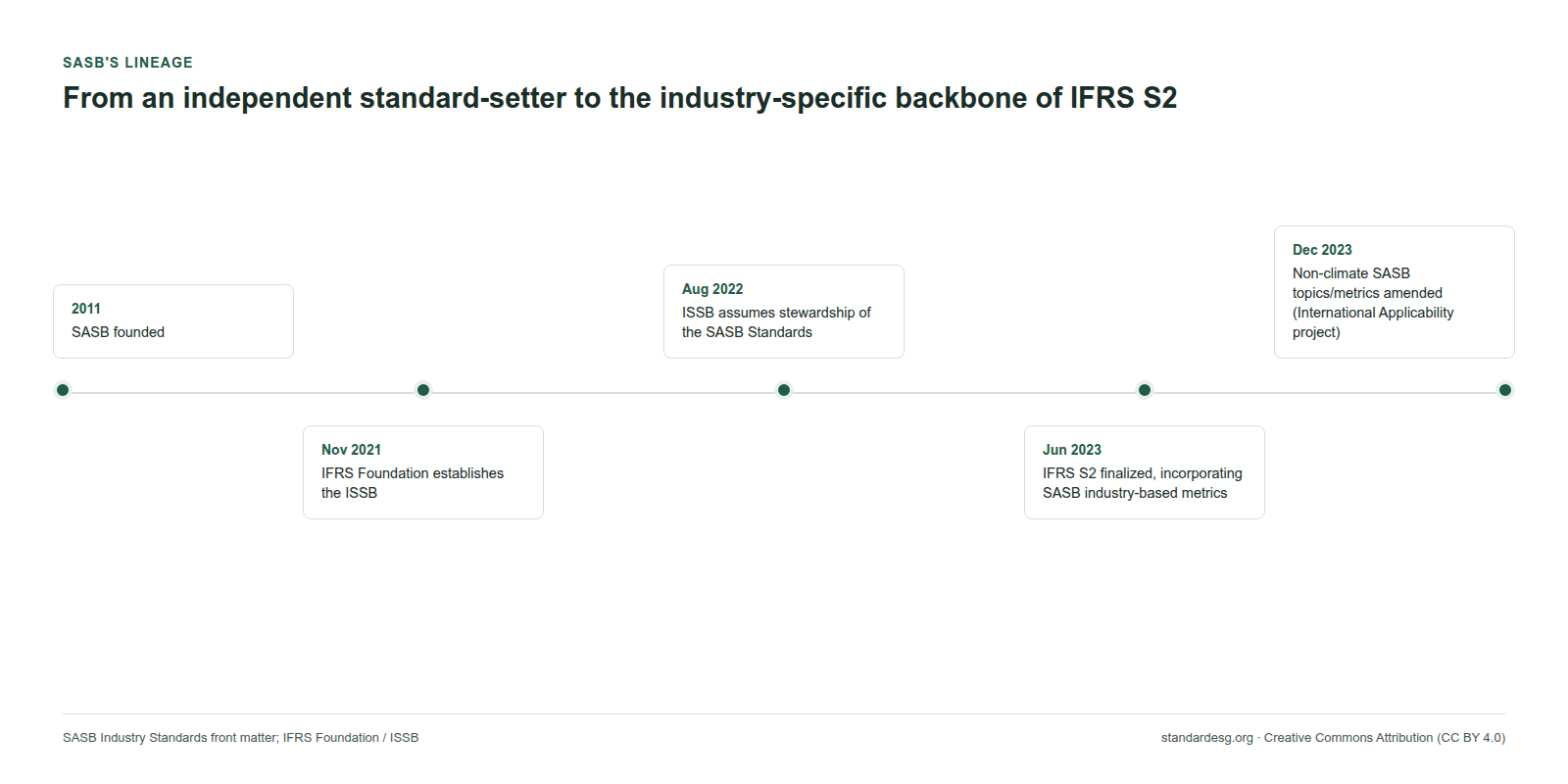
SASB spent its first decade as an independent standard-setter before joining a broader consolidation of the sustainability-disclosure landscape. It merged with the International Integrated Reporting Council (IIRC) — steward of the ⟨IR⟩ Framework discussed in Corporate Governance, Ethics and Anti-Corruption — to form the Value Reporting Foundation. That consolidation continued when the IFRS Foundation established the International Sustainability Standards Board (ISSB) in November 2021 to build a global baseline for sustainability disclosure, assembling under one roof the Value Reporting Foundation, the Climate Disclosure Standards Board, and the Task Force on Climate-related Financial Disclosures' technical work. By August 2022, the ISSB had formally assumed responsibility for maintaining, enhancing, and evolving the SASB Standards themselves — the point at which every current SASB Industry Standard's cover page began carrying the phrase "Under Stewardship of the International Sustainability Standards Board." The standards keep being actively maintained under that stewardship rather than frozen in place: the ISSB amended climate-related SASB topics and metrics in June 2023 to align with IFRS S2's industry-based guidance, amended non-climate topics and metrics in December 2023 as part of an International Applicability project, and — illustrating that maintenance continues industry by industry — amended the Commercial Banks standard's financed-emissions metrics again as recently as December 2025.
SASB Inside IFRS S2
SASB's most consequential second act is architectural: it's the mechanism the ISSB uses to give its own standards industry-specific teeth. IFRS S1 and S2 Explained covers the two standards' shared governance/strategy/risk-management/metrics architecture in depth; this article won't repeat that ground. What matters here is narrower: IFRS S1 requires an entity to refer to and consider the applicability of SASB disclosure topics and metrics wherever no ISSB standard directly covers a risk, and IFRS S2 goes further, requiring disclosure of industry-based metrics determined by reference to SASB's industry classification system applied specifically to climate. In practice, this is the answer to a structural problem IFRS S2 would otherwise have: its own cross-industry climate metrics are necessarily generic, and SASB's 77 Industry Standards are what let a bank, an oil and gas producer, and a retailer each end up disclosing metrics that actually fit their business model rather than a lowest-common-denominator climate metric set.
How Standard ESG Uses the SASB Standards
Standard ESG certifies companies against 15 core subjects spanning the Environmental, Social, and Governance pillars — but, as with IFRS S2, a generic questionnaire can't fully differentiate a chemicals manufacturer from a software company on its own. Standard ESG's answer is its own industry classification, the Standard ESG Industry Classification (SEIC): 86 industry groups, mapped from ISIC Rev. 4 codes and informed by — but deliberately not identical to — SASB's SICS. Where SEIC and SICS diverge is by design: SEIC exists to match Standard ESG's own certification scope and the industries its customer base actually operates in, not to reproduce SICS boundary-for-boundary. The overlap is still substantial, and where a SEIC group corresponds closely to a SICS industry, the matching SASB Industry Standard is one of the grounding inputs Standard ESG draws on when authoring that SEIC group's questionnaire indicators, Level 2 document requirements, and Level 3 on-site checklist — alongside other industry-specific standards, such as the IFC Performance Standards for high-impact sectors or the Bonsucro Standard for sugarcane. A SASB Industry Standard's disclosure topics translate naturally into indicator language; its metrics and technical protocols translate into the kind of specific, checkable evidence Standard ESG's Level 2 document review and Level 3 on-site assessment are built to verify.
Getting Started
If you're trying to understand what SASB means for your own company's certification:
- Identify your primary SICS industry and locate the matching Industry Standard from the ISSB's own SASB Standards library — each standard's cover page lists its SICS code and sector alongside the phrase "Under Stewardship of the International Sustainability Standards Board."
- Read the standard's disclosure topics section first, not the metrics — the topics tell you what SASB considers likely material for your industry, before you worry about how to measure it.
- Cross-check which Standard ESG core subjects (E1–G5) those disclosure topics map onto — data security and IP protection topics generally deepen subject G3, labour and workforce topics deepen S1/S2, resource and emissions topics deepen E2/E3.
- If you already produce SASB-aligned or IFRS S2-aligned disclosure, that documentation is directly reusable as Level 2 evidence — see The Evidence Checklist for Level 2 Certification for how document evidence is reviewed and scored.
See the forthcoming sector-specific deep dives in this series — covering Financial Services, Health Care, Technology & Communications, Transportation, and Renewable Resources & Alternative Energy — for how particular clusters of SASB Industry Standards translate into concrete Standard ESG certification content.
Standard ESG (standardesg.org) draws on the SASB Industry Standards, alongside SA8000, ISO 45001, ISO 20400, and the IFC Performance Standards, as industry-specific grounding for its SEIC template architecture. See The Standard ESG Certification Protocol: A Public Overview for how industry-dependent subjects fit into the full pillar and subject architecture.
Cette page vous a-t-elle été utile ?