Overview
ESG only works if the claims behind it are true. When they aren't, the result has a name: greenwashing. This resource defines the problem precisely, surveys how large it actually is, and explains why the answer isn't better wording or stricter penalties alone, but a structural change in how claims get checked — the same verification ladder built into the Standard ESG Certification Protocol.
What Greenwashing Actually Means
Greenwashing is the practice of making misleading or unsubstantiated claims about environmental — and by extension, social or governance — benefits. It ranges from outright fabrication to something subtler and more common: real initiatives described in language that implies far more than the underlying practice supports. A company that runs one solar-powered facility out of twenty and markets itself broadly as "renewable-powered" is not lying in the narrow sense, but it is misleading in the sense that matters — a reasonable reader would draw a false conclusion.
The term originated around environmental claims specifically, but the same dynamic applies wherever a company describes its social or governance conduct more favorably than the evidence supports. Because ESG spans all three pillars, this resource uses "greenwashing" as shorthand for the broader phenomenon: claims that outrun evidence.
The Family of Terms: Greenwashing, Greenhushing, Greenwishing
Greenwashing has close relatives worth distinguishing, because each calls for a different response:
- Greenwashing — overstating or fabricating positive claims.
- Greenhushing — the opposite failure: companies with genuine progress staying quiet about it, often out of fear that any public claim will be scrutinized and found wanting, or out of caution amid shifting political attitudes toward ESG disclosure. Greenhushing is a rational response to a market that punishes imperfect but honest disclosure as harshly as it punishes fabrication — which is itself a sign the verification system is broken.
- Greenwishing — sincere overstatement: a company genuinely believes its own optimistic narrative because it has never rigorously measured whether the narrative is true. This is arguably the most common failure mode and the hardest to catch, because there's no bad intent to uncover — only an absence of measurement discipline.
A credible verification system needs to address all three: catching outright fabrication, giving honest companies confidence to disclose without disproportionate risk, and forcing sincere-but-unmeasured claims to either get measured or get corrected.
How Big Is the Problem?
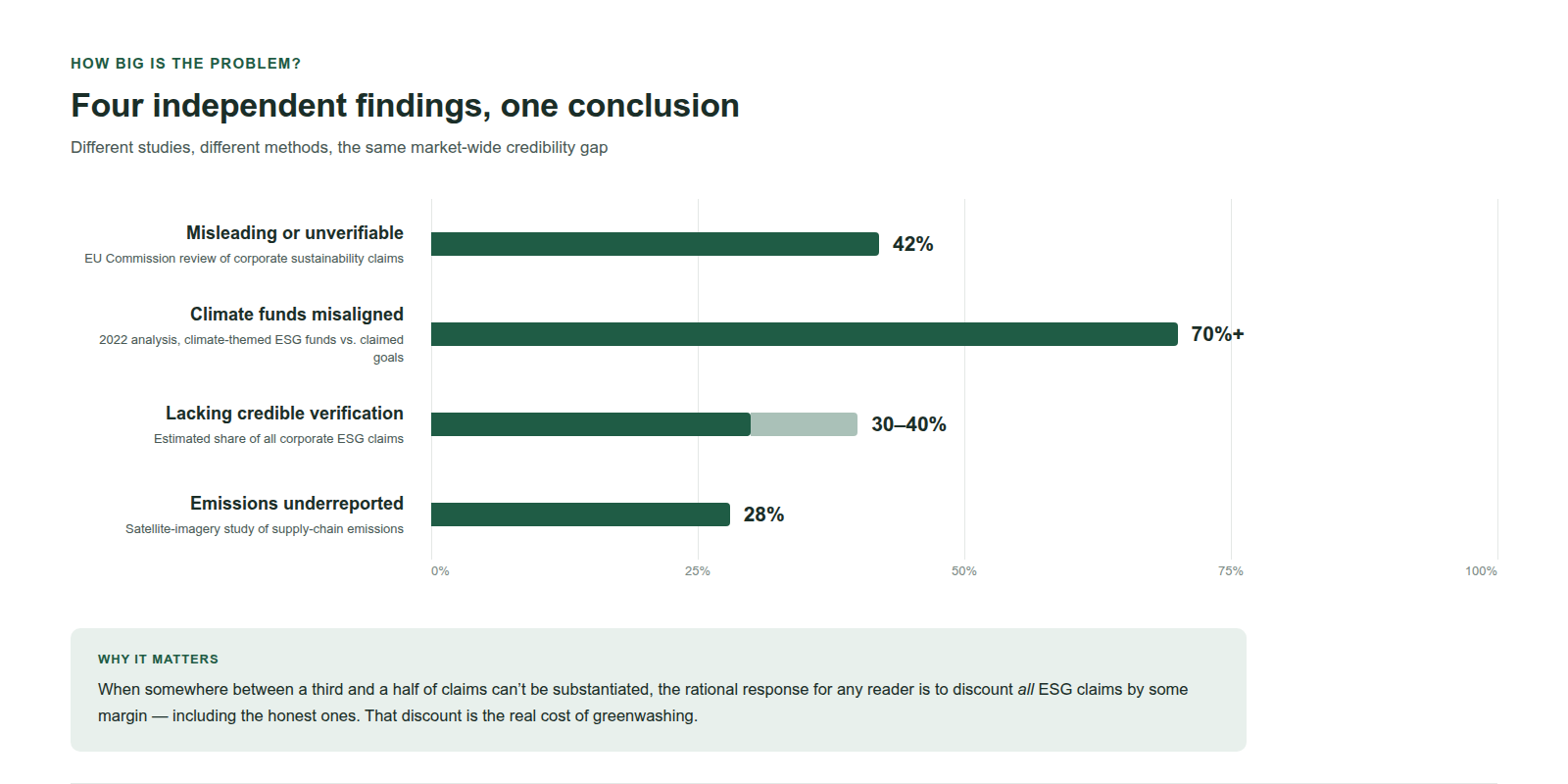
The scale is not marginal. A European Commission review found that 42% of corporate sustainability claims examined were misleading or unverifiable. A 2022 analysis found that over 70% of climate-themed ESG funds failed to align with global climate goals they claimed to pursue. More broadly, an estimated 30–40% of all corporate ESG claims lack credible verification — meaning the claim exists in a disclosure or marketing document with no evidence trail behind it that a third party could check.
These numbers describe a market-wide credibility gap, not a handful of bad actors. When somewhere between a third and a half of claims can't be substantiated, the rational response for any reader — investor, buyer, regulator, or consumer — is to discount all ESG claims by some margin, including the honest ones. That discount is the real cost of greenwashing: it doesn't just mislead the people who believe a false claim, it degrades trust in every claim, including true ones made by companies that did the work.
Why Self-Declared Data Fails Markets
The structural root of greenwashing is straightforward: self-reported data creates an inherent conflict of interest. The party making the claim is also the party who benefits from the claim being believed, and in most markets, no one else checks. This isn't a claim that companies are dishonest by nature — most disclosure gaps are plausibly greenwishing rather than fraud — but incentive structures without verification predictably drift toward overstatement over time, the same way any unaudited self-reporting system does in any domain.
Independent research bears this out even for supposedly hard, physical data. One satellite-imagery study monitoring supply chains found emissions underreported by 28% relative to what independent observation showed — not through malice necessarily, but because self-measurement without external check tends toward the generous interpretation.
The ESG Ratings Divergence Problem
A second symptom of the same root cause: major ESG rating providers frequently disagree sharply about the same company. Research has found correlations between different providers' ESG scores as low as 0.38 — compared to roughly 0.92 for traditional credit ratings, where methodology is far more standardized. This divergence is attributed primarily to differing measurement methodologies and metric choices across providers, not just differing data sources.
The lesson is not that ratings are useless, but that a rating built primarily from self-reported disclosures, aggregated through a proprietary and often opaque methodology, inherits both of the problems above: unverified inputs, and un-auditable weighting. See ESG Ratings vs. ESG Certification: Understanding the Divergence Problem for a deeper treatment of this specific issue.
The Verification Ladder: A Structural Answer
If the root problem is claims without evidence, the structural fix is a system that makes evidence — not narrative — the thing being scored, at increasing depth. This is exactly the architecture the Standard ESG Certification Protocol implements as its three certification levels:
- Level 1 — Self-Assessment. The company's own account, reviewed for plausibility and checked against hard gates, but explicitly labeled: "Based on self-declared data, not independently verified." This is honest about being the least verified rung on the ladder — the opposite of greenwashing, because it doesn't overclaim its own reliability.
- Level 2 — Verified Documents. Every material claim must now be backed by a dated, attributable document that Standard ESG's team individually verifies. Any indicator whose supporting evidence is missing, expired, or rejected is automatically discounted to 50% of its declared value — the system doesn't just ask for documents, it mechanically penalizes claims that can't produce them.
- Level 3 — On-Site Assessment. Trained auditors physically confirm conditions, including confidential worker interviews conducted without management present specifically to surface the gap between what's declared and what's actually true. Where an on-site finding contradicts a declared answer, the on-site finding overrides it and the score is corrected.
Each rung doesn't just add confidence — it actively hunts for and corrects the specific failure mode of the rung below. Level 2 catches claims that documents don't support; Level 3 catches claims that documents alone could still misrepresent.
How Standard ESG's Gates Stop the Worst Cases Cold
Beyond graduated verification, the protocol applies hard gates that override the scoring arithmetic entirely, denying certification regardless of an otherwise strong composite score if there is credible evidence of child or forced labour, an undisclosed material sanction for environmental crime or corruption, any pillar scoring below the minimum floor, or incomplete mandatory indicators. This is a direct structural answer to the "good average masks a serious problem" failure mode that makes many aggregate ESG scores unreliable indicators of the worst risks — a company cannot offset a disqualifying fact in one pillar with strength in another.
Public Verification as Anti-Fraud Infrastructure
Verification at the point of assessment isn't the whole answer — claims also need to stay checkable over time, by anyone, without re-doing the original work. Every Standard ESG certificate carries a QR code linking to a public verification page showing current validity status, score, level, company name, and dates. If a certificate is later revoked for fraud or a gate violation discovered after issuance, that status change is reflected immediately and publicly. Template versions are additionally content-hashed at lock time, so the exact criteria a certificate was scored against can always be confirmed and can never be silently altered after the fact. See Verify a Certificate for the full mechanics.
This closes a gap that static PDF certificates and one-time audits leave open: a claim that was true at assessment time but has since been revoked, or that never should have been issued, doesn't just sit unchallenged in someone's marketing materials — it's checkable and correctable in near real time.
Spotting Greenwashing: A Practical Checklist
Whether you're an investor, a buyer, or simply a reader of a company's sustainability page, a few questions cut through most greenwashing quickly:
- Is the claim specific, or vague? "Committed to sustainability" is not a claim that can be checked. "Scope 1 and 2 emissions reduced 12% year-over-year, verified by [named party]" is.
- Is there a named, independent verifier, and can you check their work directly — not just take the company's word that verification happened?
- Does the scope of the claim match the scope of the evidence? A single certified facility does not support a company-wide claim.
- Is the claim time-bound and current, or could it describe a state of affairs from years ago that's no longer true?
- Can you independently verify the underlying certificate or report, the way you can with a Standard ESG certificate's QR code, rather than relying on a logo or badge image alone?
What This Means for Each Audience
For companies: the honest path and the credible path are now the same path. Building an evidence trail as you go — the same evidence a Level 2 or Level 3 assessment would require — costs less than retrofitting one after a claim gets challenged, and it protects you from the reputational and legal risk that comes with claims regulators or journalists later find unsupported.
For investors: treat verification depth, not score alone, as a primary signal. A high self-declared score tells you what a company believes about itself; a high verified or on-site-assessed score tells you what independent checking confirmed.
For regulators: structural verification systems — graduated levels, hard gates, public checkability — complement mandatory disclosure regimes by giving the market a mechanism to distinguish substantiated claims from unsubstantiated ones without waiting for enforcement action. See How Third-Party Certification Complements Regulation.
Standard ESG (standardesg.org) built its certification levels specifically to make the gap between claim and evidence visible and closeable. Read The Three Certification Levels Explained to see how, or What is ESG? A Complete Introduction for the broader context.
Cette page vous a-t-elle été utile ?